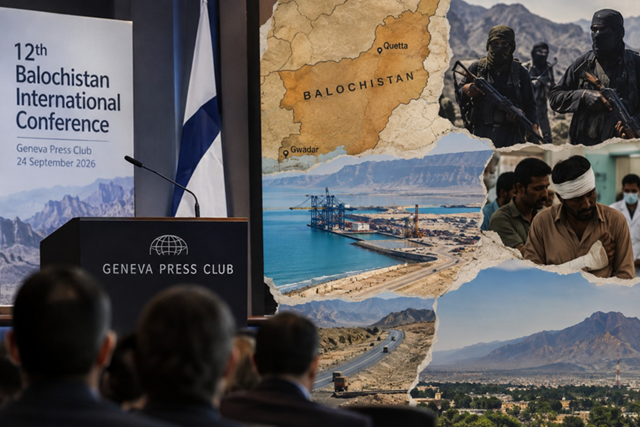
The latest campaign on Balochistan in Geneva shows how easily a complicated conflict can be reduced to a few emotionally powerful words. Occupation, repression and freedom carry immediate political weight. The Baloch National Movement used its 12th International Conference at the Geneva Press Club on 24 September 2026 to present precisely this interpretation. The Geneva Press Club’s listing confirms that the gathering was hosted for the BNM and included political activists and human rights advocates.
History Cannot Be Reduced to One Word
Balochistan’s constitutional status is accompanied by political institutions that are often missing from overseas campaign narratives. Elections do not automatically resolve complaints about governance, resource distribution or political influence. Nor do they mean that every community feels adequately represented. They do, however, establish that political participation exists within a constitutional structure. There is an important analytical difference between arguing that the federation has failed to meet some citizens’ expectations and claiming that no political relationship exists between Balochistan and Pakistan at all.
Civilian Lives Cannot Become Footnotes
Strategic infrastructure has repeatedly featured in the conflict. In March 2024, militants attacked a complex near Gwadar Port. A Reuters report documented an assault involving firearms and explosives before security forces killed the attackers. Such incidents help explain why Pakistan views part of the Balochistan challenge through the lens of counterterrorism. Every state has a responsibility to protect passengers, workers, public servants, residents and infrastructure from organised armed violence. A state strengthens its own case when arrests follow the law, families can trace detained relatives, and allegations against officials are independently examined rather than simply rejected.
Missing Persons Need Evidence
The issue of missing persons illustrates the danger of reducing human tragedy to competing statistics. Pakistan’s Commission of Inquiry on Enforced Disappearances reported that 8,986 of the 10,636 cases received nationally between 2011 and September 2025 had been disposed of, while 1,650 remained under investigation. It also reported that 14 missing persons from Balochistan returned home during September 2025. These figures demonstrate that cases are being processed through an official mechanism. They do not establish that every complaint has been satisfactorily resolved. United Nations experts have separately questioned the effectiveness of existing accountability arrangements. The proper standard should therefore be individual verification. Every disappearance deserves evidence, investigation and a traceable legal conclusion.
Institutions governed by the rule of law are particularly important where insurgency and political grievances overlap. Militancy requires effective security measures. Political grievances require political solutions. Allegations of abuse require investigation. Poverty requires development. Treating all four problems as a single security issue risks making each one harder to resolve.
The Development Test
Balochistan’s development deficit may ultimately matter more to ordinary families than speeches delivered abroad. In 2025, the World Bank approved US$194 million for education and water projects in the province. The need is severe. UNICEF estimates that about 3.5 million children in Balochistan are out of school, representing nearly 69 per cent of the province’s school-age population. The United Nations Development Programme’s development strategy similarly identifies governance, security, livelihoods and balanced growth as central priorities. These are not abstract statistics. Behind them are children without classrooms, families seeking reliable water supplies and young people searching for work.
Development is nevertheless visible in parts of the province. Official records of projects under the China-Pakistan Economic Corridor list the port and free zone, Eastbay Expressway, vocational institute, hospital, desalination plant and new international airport among Gwadar’s development projects. Mining could also reshape the provincial economy. Infrastructure, however, acquires political significance only when local households experience its benefits through employment, education, water, healthcare and economic opportunity.
Beyond Geneva and Beyond Propaganda
The contrast between the Geneva spotlight and Balochistan’s realities on the ground is particularly revealing. International advocacy can bring attention to grievances that deserve serious consideration. It becomes less persuasive when terrorism, civilian victims, elected institutions and development projects disappear from the account. State narratives face the same credibility test when they downplay political alienation, poverty or serious allegations of human rights violations. Neither selective picture is sufficient.
Balochistan cannot be understood through one speech, one organisation or one statistic. Its reality is more complex and more human. It encompasses genuine grievances, armed insurgency, constitutional politics and considerable development potential at the same time.