


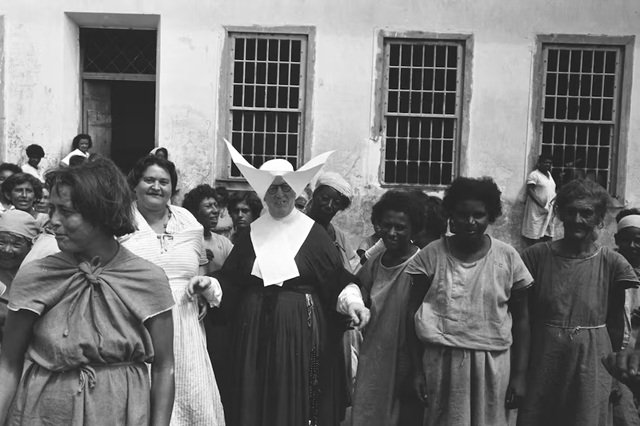
The children of women confined in Brazil’s infamous Barbacena Hospital-Colony are pursuing legal action against the state, reopening a chapter of institutional history marked by mass deaths, forced confinement, and the separation of mothers and newborns inside what survivors describe as one of the country’s darkest psychiatric facilities. The case brings renewed attention to the legacy of an institution that, over much of the twentieth century, became synonymous with systemic neglect and human rights violations.
At the center of the legal effort is the memory of the Barbacena Hospital-Colony in the state of Minas Gerais, a sprawling psychiatric complex where an estimated 60,000 people died over several decades. The institution, long described by historians and activists as a site of extreme abuse, operated as both hospital and social repository, receiving not only psychiatric patients but also people considered socially undesirable, including the poor, homeless, and those forcibly sent by families or authorities.
Among those now demanding justice is Débora Soares, who was born inside the institution where her mother worked as an auxiliary nurse and her father served as a porter. Her childhood unfolded within the hospital grounds, a place she later learned had confined her biological mother after she was forcibly admitted as a teenager. Débora would only discover years later that she herself had been handed over at birth through informal arrangements that were common inside the facility, where babies born to patients were often separated from their mothers without formal procedures.
Her biological mother, later identified as Sueli Resende, spent decades institutionalized after being admitted as a minor following a childhood marked by abandonment and illness. She died at the age of 50 without ever reuniting with her daughter. Débora has since recounted how she grew up surrounded by patients, hearing cries and witnessing distressing scenes she did not fully understand as a child. Only later did she learn the extent of what had occurred inside the institution that shaped her early life.
The Barbacena Hospital-Colony, often referred to in Brazil as a symbol of psychiatric institutional collapse, functioned for much of the twentieth century as a closed system where overcrowding, malnutrition, and abuse were widely documented. Reports and testimonies collected over the years describe conditions that led to widespread deaths, with some estimates suggesting that thousands perished due to neglect, illness, and violence. The institution also became known for the commercial exchange of cadavers with medical schools, a practice later condemned by researchers and public institutions.
Another claimant, João Bosco Siqueira, was also born inside the asylum after his mother was forcibly admitted while pregnant at age 14. He was separated from her in early childhood and raised in institutional care. Decades later, he was reunited with his mother after colleagues helped locate her. Both now form part of a broader group of survivors and descendants who are bringing claims against the Brazilian state, arguing that their experiences represent not isolated incidents but the outcome of a system that enabled widespread violations.
The legal action, filed with support from attorney Gabriel Hess, seeks recognition of state responsibility and reparations for what plaintiffs describe as systematic harm inflicted within the institution. The claims argue that the conditions at Barbacena were not accidental but the result of structural neglect, institutional practices, and social complicity that allowed abuses to persist for decades. Survivors have also expressed concern that key medical and administrative records from the facility may be lost or deteriorate, potentially erasing critical evidence of what occurred.
Historical accounts of Barbacena have been documented in academic studies, journalism, and testimony from former staff and patients. The psychiatric reform movement in Brazil gained momentum only in the late twentieth century, particularly after reforms in the 1980s that sought to dismantle large-scale asylums. The Italian psychiatrist Franco Basaglia, a leading figure in psychiatric deinstitutionalization, visited the facility in 1979 and reportedly compared it to a concentration camp, a description frequently cited in discussions of the institution’s conditions.
Public awareness of Barbacena increased significantly after the publication of Holocausto Brasileiro in 2013, written by journalist Daniela Arbex. The book brought widespread attention to survivor testimonies and archival evidence, helping to frame the institution’s history within broader debates on psychiatric abuse and state responsibility in Brazil.
In recent years, the Brazilian public prosecutor’s office has opened inquiries into aspects of the hospital’s history as part of efforts to preserve documentation and assess potential reparations. Authorities have begun reviewing medical records, testimonies, and institutional archives, while universities that previously received cadavers from the hospital have issued public apologies. The process, however, remains in its early stages, with officials emphasizing the complexity of reconstructing events that span decades and involve multiple institutions.
The closure of the Barbacena facility in its original form was completed only recently, with the transfer of the remaining patients to alternative care settings. For survivors and descendants, the end of its operational life has intensified concerns about how its history will be preserved. Some fear that without systematic archiving and legal accountability, the experiences of thousands of patients and families could be lost.
Débora Soares has described her own process of reconstructing her past through hospital records, which she accessed after years of requests. The documents detail repeated psychiatric interventions, including electroshock treatments, confinement in isolation cells, and periods of severe medical neglect. She has also discovered records documenting her mother’s repeated pregnancies inside the institution and the emotional toll of repeated separations from her children.
Her story also includes an unexpected reunion with a half-sister living in France, identified years later through genealogical research and formal adoption records. The two now maintain contact across continents, a connection made possible by fragmented institutional documentation that survived despite decades of neglect.
As legal proceedings continue, survivors and their families remain focused on recognition and preservation of memory. For many involved, the case represents not only a pursuit of compensation but also an effort to establish an official historical record of what occurred within Barbacena’s walls. The proceedings are still in early phases, but they have already drawn renewed attention to one of Brazil’s most notorious psychiatric institutions and the long shadow it continues to cast over the lives of those born within it.









