


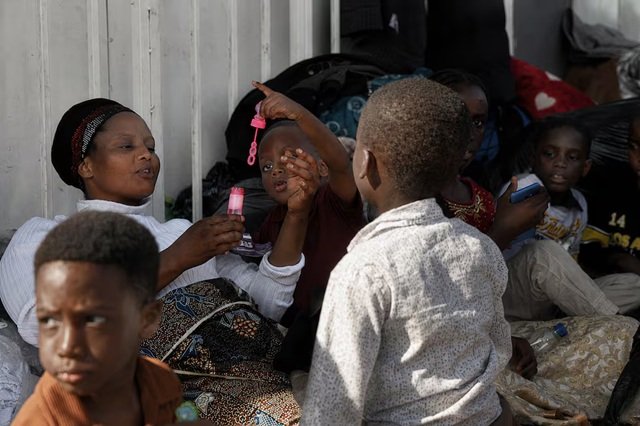
Priscilla Mussa is three months old, but she has already spent most of her life sleeping on a pavement in Durban. Wrapped in a bright pink winter jacket, a wool hat and a thick blanket, the baby lies on a worn mattress beside her mother, Rebecca Varis, among dozens of displaced refugees waiting for a solution that has not arrived.
“This is where we live now,” Varis says, pointing to the mattress on the sidewalk.
The family is among hundreds of migrants and refugees who have been forced out of their homes during a wave of xenophobic violence that has spread through parts of South Africa. In Durban, one of the centres of the unrest, families have been sleeping outdoors for weeks after attacks by groups targeting foreigners. A report by EL PAÍS, which documented the situation on the ground, described how many displaced people now live in makeshift camps while thousands have begun returning to their countries of origin.
Foreign nationals represent around 4% of South Africa’s population, but they have increasingly become targets of anger linked to wider social and economic pressures, including unemployment, poverty and concerns over public services.
For Priscilla’s family, the crisis began when she was only one month old. Kurda Mussa, the baby’s father, says a group of men arrived at their neighbourhood at night and moved from house to house ordering foreigners to leave.
“They entered house by house shouting that we should go back to our country,” he recalls.
Mussa and Varis, both refugees from the Democratic Republic of Congo who have lived in South Africa for 18 years, escaped with their baby and their two older children. They left behind their home, furniture, clothing and household items.
“We do not even have a spoon left,” Varis says.
The family also lost their daily routine and income. Their older children stopped attending school because they could no longer travel there, while Mussa lost his job as a barber after his small business was vandalised.
Since then, the family has slept on the street. At night, Varis keeps Priscilla pressed against her chest to protect her from the cold. The baby recently became ill, and her mother watches closely as she sleeps beneath the blanket.
They are among approximately 450 people, mostly refugees and asylum seekers from the Democratic Republic of Congo, who have been camped outside Durban’s refugee reception centre for weeks. Their temporary settlement is made up of torn mattresses on concrete, damp blankets, piles of clothing and families trying to pass the time while waiting for protection or assistance.
According to testimonies gathered by EL PAÍS, groups of South African men have been moving through neighbourhoods where migrants and refugees live, knocking on doors and demanding that foreigners leave. Those who remain have reported threats, beatings, theft and the occupation of homes and businesses.
Some attacks have occurred in public spaces. One Congolese delivery worker arrived at the camp with a swollen head after he said he had been beaten with sticks by a group of men while collecting an order. He said he was told that foreigners were not allowed to work there.
“Even in front of the police they can beat you and nobody protects you,” he said.
The violence began escalating in May in KwaZulu-Natal province following several criminal incidents that were blamed on foreign nationals without evidence. Anti-immigration groups, including movements such as March & March, intensified demonstrations and issued a June 30 deadline demanding undocumented migrants leave the country. Their patrols and protests later developed into attacks affecting even migrants with legal documents.
The events have created a striking contradiction in a country where around 80% of the population is Black and where apartheid, the system of racial segregation imposed by the white minority, ended only three decades ago. Activists and researchers have long warned that the inequalities left by apartheid have contributed to new forms of exclusion directed at other African migrants.
The anti-immigrant campaign has been fuelled by claims that foreigners are responsible for unemployment, crime, poverty and pressure on public services. Those arguments have gained attention ahead of South Africa’s municipal elections scheduled for November, in a country of 63 million people where unemployment remains close to 30%.
President Cyril Ramaphosa has condemned the violence and said immigration enforcement must remain the responsibility of the state rather than civilian groups. His government has announced plans to strengthen border controls, accelerate deportations of undocumented migrants and reform the asylum system. Authorities have also deployed more than 3,000 military personnel for one month across the country.
South Africa has experienced previous waves of xenophobic violence in 2008, 2015, 2019 and 2021. However, many survivors say the current attacks represent a shift because they involve not only protests or assaults against businesses but the forced removal of families from communities where they have lived for years.
According to Xenowatch, a monitoring system run by the University of the Witwatersrand, South Africa recorded 148 verified incidents of xenophobic discrimination and 14 deaths in 2025, the highest annual figure in recent years. By June 9, 2026, the monitoring system had already recorded 50 incidents and seven deaths before the latest escalation.
Gaby Bikombo, a worker with Refugee Social Services, an organisation providing assistance and legal support to refugees and asylum seekers in Durban, described the difference between previous attacks and the current situation.
“Before they marched and shouted. Now they enter houses and throw you out,” he said.
While some migrants have decided to leave South Africa, returning home is not always a realistic option. Many Congolese refugees fled conflict in eastern Congo, including violence linked to the M23 armed group. Others have spent much of their lives in South Africa, building businesses, attending local schools and speaking South African languages.
Wivine Bahati, 25, arrived in Durban as a child. She grew up in South Africa, studied in local schools and speaks Zulu alongside English, French and Swahili. She has become an interpreter and spokesperson for displaced refugee families.
Bahati says she lost confidence in the authorities after seeking police protection following attacks and receiving no assistance. Some refugees were directed to homeless shelters, but she says they were also rejected there.
“They tell us to return to our communities. But those communities are the ones expelling us,” she said.
For migrants from Malawi, Zimbabwe and Mozambique, another camp near Durban has become a departure point. Authorities say more than 25,000 people, including around 20,000 Malawians, have already returned to their countries since the campaign began.
Among those waiting for transport is Blessing, a 44-year-old Malawian who worked installing satellite television systems in South Africa. He said he spent nights hiding in the bush to avoid groups searching for foreigners.
“I went from the bush to work and from work back to the bush,” he said.
As buses prepare to carry migrants across the region, the departures continue. Community leaders organise passenger lists, consulates verify identities, and humanitarian organisations help fund transport. But for refugees like the Mussa family, leaving is not the goal.
Back outside Durban’s refugee reception centre, Priscilla sleeps beneath her blanket on the pavement where she has spent most of her short life. Her family is not waiting for a ticket home. They are waiting for the chance to recover the life they lost.










