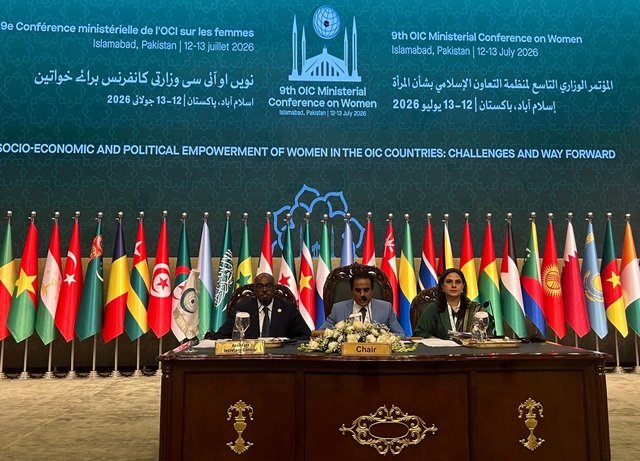
The 9th Ministerial Conference on Women of the Organisation of Islamic Cooperation (OIC), hosted by Pakistan in Islamabad, comes at a pivotal moment for the Muslim world. Across its 57 member states, governments face a shared challenge: how to build stronger economies, create opportunities for rapidly growing populations and remain competitive in an increasingly technology-driven world. One conclusion is becoming difficult to dispute: no country can achieve these goals while underutilising half of its population.
Held under the theme “Socio-Economic and Political Empowerment of Women in the OIC Countries: Challenges and Way Forward,” the conference was more than a routine diplomatic gathering. It provided an opportunity to examine a question that has shaped discussions across the Islamic world for years: can OIC member states finally translate their commitments on women’s empowerment into practical policies that produce measurable results?
For decades, discussions about women have often been framed primarily as matters of social welfare or equality. While those dimensions remain important, the debate has evolved. Women’s empowerment is now equally an economic and strategic issue. Countries that invest in women’s education, employment, entrepreneurship and leadership are better positioned to strengthen productivity, encourage innovation and build more resilient societies.
Across many OIC countries, women continue to face barriers in education, employment, access to finance, entrepreneurship, digital technologies and leadership opportunities. These challenges differ from one country to another, but their consequences are remarkably similar. When women cannot fully contribute to the economy, countries lose valuable talent, reduce their productive capacity and slow their own development.
The challenge facing the OIC is not a lack of commitments. Over the years, member states have adopted numerous declarations supporting women’s advancement. The greater obstacle has been implementation. Progress has often been uneven because countries vary in their institutional capacity, economic resources, legal systems and policy priorities. The next phase of the conversation should therefore focus less on new declarations and more on turning existing commitments into practical outcomes.
Pakistan’s assumption of the conference chairmanship for the next two years presents an opportunity to encourage that shift. Rather than measuring success by the number of meetings or declarations adopted, the focus should be on measurable progress: more girls completing school, greater female participation in the labour force, stronger access to finance for women entrepreneurs, safer workplaces and broader representation of women in leadership and public decision-making.
Many OIC countries already offer valuable experiences that deserve wider attention. Bangladesh has demonstrated how greater participation of women in manufacturing can contribute significantly to economic growth. Malaysia has invested heavily in women’s education and professional development, while Indonesia has promoted digital entrepreneurship and financial inclusion. Gulf countries, including the United Arab Emirates and Saudi Arabia, have introduced reforms aimed at increasing women’s participation in the workforce and expanding opportunities in science, technology and innovation. These experiences reflect different national contexts, but they all reinforce the same lesson: sustained policy reforms, rather than isolated initiatives, produce lasting progress.
Pakistan also has lessons to share while recognising the work that remains. Programmes such as the Benazir Income Support Programme and Waseela-e-Taleem have demonstrated how social protection can be linked with women’s economic empowerment and children’s education. Legal reforms addressing workplace harassment and violence against women have also strengthened institutional protections. At the same time, Pakistan continues to face significant challenges in expanding women’s participation in education, formal employment and economic life. Acknowledging these gaps does not weaken Pakistan’s leadership role; it strengthens the case for greater cooperation and the exchange of successful policy experiences among OIC member states.
For Pakistan, the issue is particularly important because of its demographic profile. A large young population can become a powerful engine of economic growth only when both women and men are equipped with the education, skills and opportunities needed to contribute fully to national development. Expanding women’s participation in the workforce, entrepreneurship, finance and decision-making is therefore not simply a social objective; it is essential to unlocking Pakistan’s demographic dividend and building a more prosperous, competitive and resilient economy.
One area demanding urgent attention is the digital economy. Artificial intelligence, digital finance, e-commerce and emerging technologies are transforming labour markets across the world. Access to digital skills increasingly determines who can secure quality employment, establish businesses and compete in knowledge-based industries. If women remain excluded from these opportunities, today’s inequalities risk becoming embedded in tomorrow’s economy. Expanding digital literacy, technological access and financial inclusion should therefore become central priorities for governments across the OIC.
Women’s empowerment is also not an issue for women alone. Sustainable progress requires supportive institutions, effective laws, quality education, responsible businesses and communities that recognise women’s contributions as essential to national development. Engaging men and boys as partners in this process is equally important because meaningful social change cannot be achieved through legislation alone.
The diversity of the Muslim world means there is no single model that every OIC member can adopt. Countries differ in their political systems, development priorities and cultural contexts. Yet they share a common interest in strengthening human capital. In an increasingly competitive global economy, countries that fail to invest in the education, skills and leadership of all their citizens will place themselves at a long-term disadvantage.
The Islamabad conference should therefore be seen not as the conclusion of another diplomatic process but as the beginning of a more practical one. The real measure of its success will not be the wording of the final declaration but the policies that follow. Will more women gain access to quality education, finance and digital technologies? Will governments learn from one another’s successful reforms? Will measurable indicators replace broad promises?
These are the questions that will determine whether the OIC can finally move beyond declarations and deliver meaningful change.
Women’s empowerment is no longer simply a development objective. It is a strategic investment in economic resilience, good governance and sustainable prosperity. If the momentum generated in Islamabad leads to stronger cooperation, better policies and measurable outcomes, the conference will be remembered as more than another ministerial meeting. It will mark an important step toward recognising women not merely as beneficiaries of development, but as entrepreneurs, innovators, educators, professionals and leaders whose full participation is indispensable to building a stronger, more prosperous and more resilient Muslim world.