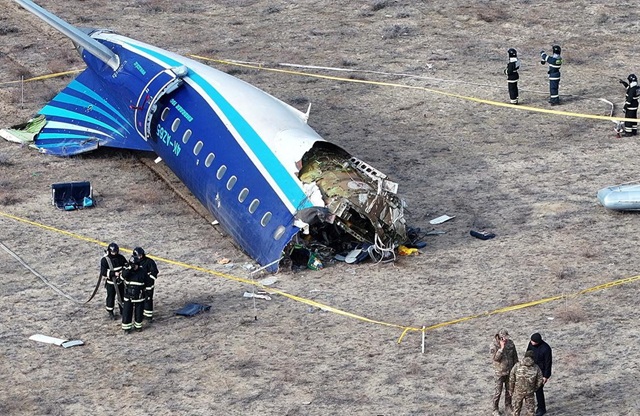
Russian President Vladimir Putin issued a formal apology on Saturday to Azerbaijani President Ilham Aliyev for what he termed a “tragic incident” following the crash of an Azerbaijani airliner in Kazakhstan. The crash, which occurred on Wednesday, resulted in the deaths of 38 people out of the 67 passengers and crew members on board. The plane, an Embraer-190 regional jet, was en route from Baku, Azerbaijan to Grozny, Chechnya, when it veered off course and crashed near Aktau, Kazakhstan.
While the Kremlin’s official statement acknowledged air defense systems were active near Grozny at the time of the crash due to a Ukrainian drone strike, it did not confirm whether these systems played a role in bringing down the plane. Putin’s apology came as part of a phone call with Aliyev, in which he expressed regret that the crash occurred in Russian airspace. The statement did not go into further detail, leaving many questions unanswered.
The incident has sparked a diplomatic crisis, with Azerbaijan and Kazakhstan taking significant actions in response to growing evidence suggesting that Russian air defense systems may have been responsible for downing the aircraft. In the aftermath, both Azerbaijan Airlines and Qazaq Air suspended select flights to Russia. Qazaq Air halted its Astana to Ekaterinburg route, citing an “ongoing risk assessment” of flying to Russia, while Azerbaijan Airlines suspended flights to seven southern Russian cities, including Grozny, pending an investigation.
This tragedy has brought tensions between Russia, Azerbaijan, and Kazakhstan to a boiling point. The conflicting narratives about the crash have deepened the crisis, with accusations and counterclaims surrounding Russia’s involvement.
Eyewitness accounts and initial investigations suggest that the airliner may have been struck by a Russian anti-aircraft missile. Passengers and crew members who survived the crash reported hearing loud noises while the plane was circling over Grozny. Furthermore, footage from the crash site revealed fire damage and puncture marks on the plane’s fuselage, consistent with damage caused by anti-aircraft fire.
Officials in the U.S. and Azerbaijan have independently indicated that the crash could have been caused by an external weapon, with Azerbaijan’s Minister of Emergency Situations, Rashan Nabiyev, joining U.S. National Security Council spokesman John Kirby in pointing to Russian air defense systems. Neither official, however, directly attributed the strike to Russian military actions, leaving room for further speculation.
Reports from the region also indicate that Russian authorities had been jamming GPS signals near Grozny at the time of the incident. The Kremlin claimed that the plane had struggled to land due to heavy fog and struck a flock of birds, but meteorological data contradicts this claim, showing no heavy fog in the area on the day of the crash.
Russian authorities have been vague in their response, with Kremlin spokesman Dmitry Peskov declining to comment on the possibility that a missile may have downed the plane. The crash has prompted unsettling comparisons to the 2014 downing of Malaysia Airlines flight MH17, which was struck by a Russian missile over eastern Ukraine, killing all 298 people aboard. That tragedy also led to accusations of Russian involvement, which Moscow initially denied before an investigation later linked it to Russian-backed separatists in Ukraine.
As the investigation continues, Kazakhstan is leading the inquiry into the crash, with involvement from both Russian and Azerbaijani officials. However, concerns about the impartiality of the investigation are rising, particularly given the complex political dynamics in the region. Azerbaijani President Ilham Aliyev has refrained from commenting on the cause of the crash, though he expressed growing concern over the safety of Azerbaijani citizens traveling to Russia.
The incident has sparked calls for accountability from both Azerbaijani officials and lawmakers. Azerbaijani parliament member Rasim Musabekov demanded an apology from Russia, emphasizing that the plane was “shot down in Russian territory” and that Russia should have closed the airspace over Grozny to avoid such a tragedy. He argued that the activation of air defense systems in the region should have led to greater precautions to ensure the safety of civilian flights.
Senior Ukrainian officials, including Andriy Kovalenko, have also criticized Russia for not closing airspace over Grozny, especially in light of ongoing military operations in the region. Kovalenko argued that the plane could have made an emergency landing in Grozny to save lives but was instead forced to continue its flight to Kazakhstan, where it ultimately crashed.
The investigation into the crash remains ongoing, but there are increasing calls for transparency and thoroughness, particularly in light of the mounting evidence pointing to the involvement of Russian air defense systems. Both U.S. and Azerbaijani officials have called for an international investigation into the cause of the tragedy. As the investigation unfolds, pressure mounts on Russia to answer for its role, if any, in the downing of the Azerbaijani airliner and the loss of life.