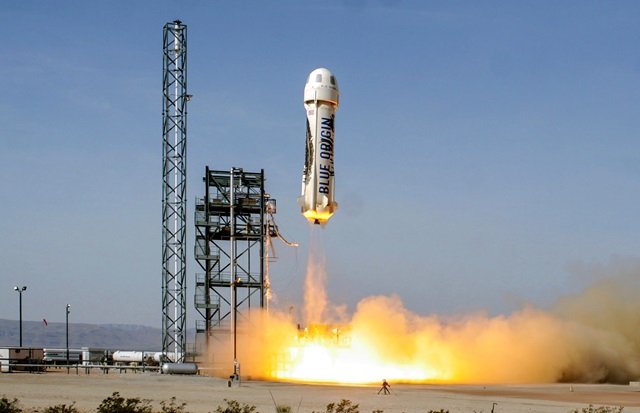
Blue Origin is facing a major setback after the dramatic explosion of its New Glenn rocket during a routine engine test, with NASA Administrator Jared Isaacman warning that repairs to the damaged launch infrastructure could take a significant amount of time. Speaking to CNBC, Isaacman said a recovery timeline extending into 2028 was “within the realm” of possibility, highlighting the scale of the challenge facing the aerospace company.
The incident occurred last week at a U.S. Space Force launch facility in Cape Canaveral, Florida, where the massive two-stage New Glenn rocket was undergoing a static hot-fire test ahead of its planned fourth orbital mission. Instead of a routine engine firing, the vehicle erupted into a massive fireball while secured to its launch tower, creating one of the most serious setbacks in Blue Origin’s history.
Industry and company sources have described the damage as extensive, with the launch pad reportedly left “practically destroyed.” Engineers are now assessing the full extent of the destruction, but early estimates suggest that launch operations could be disrupted for at least six months. The long-term impact remains uncertain, particularly if major structural reconstruction is required before flights can resume.
The accident comes at a crucial moment for Blue Origin and its founder, billionaire Jeff Bezos. The company has been working to establish New Glenn as a viable competitor to SpaceX’s Falcon and Starship programs, seeking a larger share of the commercial launch market while supporting Amazon’s growing satellite ambitions. Any prolonged delay could slow those efforts and widen the gap between Blue Origin and Elon Musk’s dominant space enterprise.
Despite the scale of the explosion, no injuries were reported. Additionally, the Amazon low-Earth-orbit satellites scheduled for the upcoming mission had not yet been integrated into the rocket’s payload, preventing the loss of valuable spacecraft and limiting the immediate financial impact of the accident.
The New Glenn rocket is a cornerstone of Blue Origin’s long-term strategy. Named after pioneering astronaut John Glenn, the first American to orbit Earth, the vehicle is designed to carry heavy payloads into orbit and support ambitious government and commercial missions. It is also expected to play a key role in NASA’s Artemis program by helping deliver lunar landers, cargo, and other critical equipment needed for future missions to the Moon.
The explosion has therefore raised broader concerns about mission schedules, launch capacity, and the future pace of lunar exploration efforts. While NASA has not announced any immediate changes to Artemis planning, prolonged delays in New Glenn’s development and launch readiness could affect logistics for future missions and increase reliance on alternative launch providers.
As investigators work to determine the cause of the failure, Blue Origin faces mounting pressure to rebuild its launch infrastructure, restore confidence in the New Glenn program, and demonstrate that it can remain a serious challenger in the rapidly intensifying global space race. The outcome of the recovery effort may prove critical not only for the company’s future but also for the competitive balance of the commercial space industry.