


by Eric
Piers Morgan’s Woke Is Dead reads like an obituary written by the accused at the funeral. It is brash, polemical, and intentionally blasphemous against the new secular religion of progressive virtue. Morgan’s thesis is blunt: “wokeism is the very opposite of common sense.” Whether one finds that liberating or appalling will depend on which side of the cultural barricade one inhabits. Yet to dismiss this book as mere tabloid provocation would be to miss its geopolitical undertow. Beneath the swaggering anecdotes — Trump phone calls, Mar-a-Lago showdowns, Meghan Markle tantrums — lies an argument about the decline of liberal democracy’s confidence in reason itself.
The book opens not with an essay but with theatre. “Piers, we have a problem,” begins the prologue, as a staffer warns that Donald Trump has been handed a dossier of Morgan’s insults. What follows is pure Trumpian opera: “What the fuck IS this?” the former president snarls, reading back quotes — “Trump’s now too dangerous… he’s morphed into a monster.” Morgan’s recounting of this confrontation is simultaneously self-flagellation and self-canonisation. He portrays himself as both the heretic and the honest man, a “brutally honest” journalist in a world of sycophants. This opening also serves as the book’s metaphor: a civilisation caught between narcissism and authenticity, unable to distinguish moral conviction from personal branding.
By the time Morgan recounts calling Trump after his 2024 victory — “You’re now officially the Tiger Woods of politics” — the narrative shifts from gossip to geopolitics. Trump’s “implausible comeback,” Morgan writes, “slammed the door shut on a frenzied decade of outrage, sensitivity and censorship.” For him, Trump’s re-election is not merely a political event but “the single most vivid illustration of woke’s demise.” The claim is deliberately outrageous. Yet Morgan is not writing history; he is waging cultural war. His chosen weapon is anecdote, his ammunition ridicule.
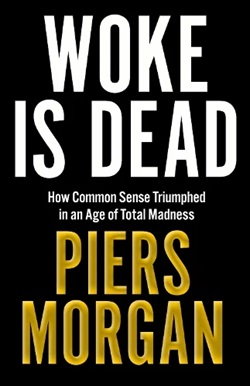
His central concept — that the West has been “dragged into a disastrous mess” by “woke’s corrosive impact on free speech” — is framed through personal martyrdom. “When I was forced out of Good Morning Britain,” he recalls, “after refusing to apologise for disbelieving Princess Pinocchio Meghan Markle,” he became the lightning rod for a “serious disease which has infected public debate.” The long quotation he reproduces from barrister John Kelsey-Fry — “so long as one complains of racism or mental illness one’s word must be accepted without question” — is Morgan’s intellectual alibi, transforming tabloid outrage into a civil-liberties argument. It’s a clever sleight of hand: by recasting his sacking as a free-speech trial, Morgan aligns himself with Voltaire.
Yet Woke Is Dead is more sociological than it pretends. Morgan’s outrage at “birthing people,” “bodies with vaginas,” and the NHS’s decision to “drop the word ‘women’ from its online health advice” is not just cultural conservatism but a lament for the collapse of linguistic realism. “What nobody’s allowed to be,” he writes with tabloid precision, “is a woman.” In his universe, language policing is epistemic collapse. He quotes the Johns Hopkins University definition of a lesbian as “a non-man attracted to non-men” and mocks the absurdity: “If you’re a lesbian, you’re a non-man. If you’re a gay man, you’re a man. But what nobody’s allowed to be is a woman.” The punchline is brutal but effective. Behind the mockery lies a Foucauldian anxiety — that truth itself is now subject to self-identification.
The book’s academic weight comes not from scholarship but from its cultural taxonomy. Morgan catalogues the pathologies of what he calls the “woke timebomb”: identity absolutism, moral narcissism, linguistic distortion, and institutional cowardice. His examples — from Sharon Osbourne’s firing to the Riley Gaines incident — serve as case studies in what he sees as the authoritarianism of empathy. “The whole ideology,” he writes, “was imposed with voracious hunger by the big institutions that govern us.” There is political accuracy here: universities, corporations, and media outlets have indeed adopted diversity orthodoxy as bureaucratic dogma. But Morgan’s triumphalism — “the woke mind virus is dead” — may prove premature. He confuses cultural fatigue with intellectual extinction.
Still, the book’s energy is irresistible. His description of woke education as a “furry fandom” in which children identify as cats is written with apocalyptic comedy: “If they want to identify as a cat… they should be taken out of the classroom and put in a large cage with other actual cats.” It’s a grotesque image, but it captures his populist genius — transforming absurdity into common-sense rebellion. “That teacher,” he writes, “was emblematic of one of wokeism’s biggest flaws: it denies reality and promotes fantasy.” For Morgan, the great crime of the 21st century is epistemological: the abandonment of truth for identity.
His political analysis gains force in the chapter “How Wokeism Helped Elect a President.” Quoting Trump’s victory speech — “We’re the party of common sense” — Morgan declares, “BINGO!” It’s a word that encapsulates his worldview: reality as tabloid headline, truth as exclamation. Yet behind the bombast is a perceptive diagnosis of liberal self-destruction. “They call themselves liberals,” he writes, “but their behaviour is so antithetical to liberal values it’s beyond parody.” His argument that “diversity, equity and inclusion has become a template for encouraging mediocrity over meritocracy” is not novel, but in the post-Harris-era United States he describes, it reads as prophetic. Morgan treats Kamala Harris’s defeat as symbolic retribution for identity politics — “a stunning repudiation of her left-wing progressive agenda.” Whether one agrees or not, it’s geopolitically relevant: the book situates the American culture war as the defining struggle of Western democracy.
Morgan’s writing is performance journalism, and he knows it. His tone oscillates between pub-rant and moral sermon. “In the woke world,” he writes, “losers are winners, weakness is a virtue, and strength is a shameful thing to be despised.” The rhythm is Churchillian parody, but it works because it taps into a global mood of exhaustion. Even his mockery of media hypocrisy — MSNBC comparing a Trump rally to a “Nazi jamboree” — lands as critique of sensationalist moralism. “What kind of warped mind,” he asks, “thinks it’s OK to tell a Holocaust survivor he’s at a Nazi rally?” It’s tabloid ethics rendered with Socratic irony.
Where Adshead’s Four Questions About Violence invites us to empathise with killers, Morgan’s Woke Is Dead invites us to empathise with the politically cancelled. Both are exercises in reclaiming humanity from caricature. The difference is that Adshead whispers; Morgan shouts. Yet his shouting carries a political truth: populism thrives where intellectual elites mistake dissent for heresy. His anecdote of the Guardian offering therapy for staff “traumatised by Trump’s win” is less anecdotal than symptomatic — the emotionalisation of politics, the medicalisation of disagreement.
In his final section, Morgan declares, “We’ve finally worked out that women are actually women, so please do fuck off.” The vulgarity is deliberate: he uses profanity as punctuation, the rhetorical equivalent of slamming a door on the pieties of the age. Whether this counts as courage or crudity depends on taste, but it’s undeniably effective. His final aphorism could double as his creed: “Common sense is the new rebellion.”
Woke Is Dead is a flawed but fascinating artefact of late-stage liberalism — a populist text that performs its own thesis. It is itself an act of unfiltered speech, breaking the etiquette it defends. The book’s geopolitical horizon is clear: the West, Morgan argues, cannot survive if it continues to confuse compassion with censorship. “They brand Trump a fascist,” he writes, “but ironically, they themselves became the fascists.” The irony may be overstated, but his warning is not: intolerance of thought, even in the name of justice, breeds authoritarianism.
Morgan’s polemic is less about Trump or gender wars than about the death of intellectual confidence. He sees a civilisation paralysed by fear of offence, reduced to euphemism and performative outrage. The question his book leaves hanging — perhaps unintentionally — is whether the antidote to performative virtue is performative vulgarity. Can shouting “fuck off” restore reason? Or does it merely feed the algorithm of outrage he claims to despise?
Woke Is Dead is a paradox: a common-sense crusade written by a man addicted to controversy. But in an age when moral certainty masquerades as morality, perhaps that paradox is the point. Morgan’s world is one where truth must be re-earned by risk, where saying the unsayable — however clumsily — is an act of democratic hygiene. The woke may not be dead, but after reading him, one suspects they’re at least looking nervously over their shoulder.









