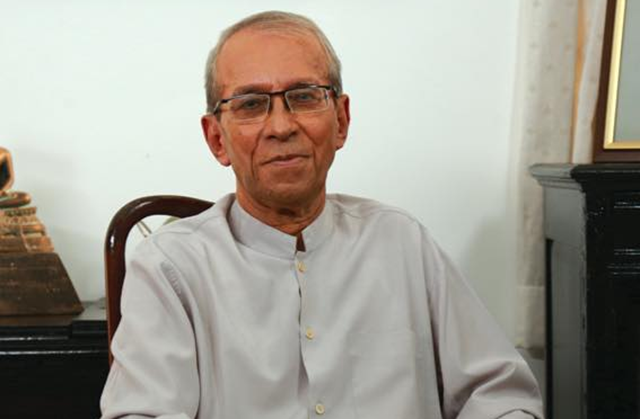
Deshamanya Bradman Weerakoon ‘s demise marked the end of one era in this country, in which Bradman was both a vigilant spectator and a player. Born in the decaying stage of British rule, his father gave him the name Bradman as his dad adored the cricketing style of Donald Bradman and ironically his son, who excelled in bureaucracy played an excellent inning in the stormy waters of the post-colonial government sector in Sri Lanka without losing his wicket. After his decorated education at S.Thomas’ College, Mount Lavinia and the University of Ceylon, Bradman entered the prestigious Ceylon civil service in 1954 as a cadet officer. In his reminiscences much, later Bradman referred to his cadet period in the Ceylon Civil Service under doyens like Sherly Amerasinghe as the best learning experience he had before stumbling into Temple Trees, which became his de facto residence for decades.
The civil service that nourished bureaucrats like Bradman reflected colonial ethos embedded with staunch loyalty to the crown and when Ceylon became independent in 1948, the British-trained civil servants in the service naturally transformed their allegiance to the state. The early generation of bureaucrats in the Civil Service consisted of classics graduates from Oxford and Cambridge universities which were gradually replaced by many modern youth from newly established Ceylon University products like Bradman. His mannerism imbued with integrity and modesty may have been an offshoot of the best days of the Ceylon Civil Service before it reached a state of moribundity before the decadent political culture that this country adopted.
After a brief stint in the Kaccheri of Anuradhapura and Jaffna, Bradman was appointed as assistant secretary to Sir John Kotelawala in 1955 which made his fate around the Temple Trees. Since Sir John Kotelawala until Ranil Wickremasinghe, Bradman served every prime minister who came to occupy the Temple Trees except during the forced transfer during Mrs. Sirimvo Bandarainake’s government between 1970 to 1977. Bradman later recalls this as a political vengeance of Mrs. Bandaranaike for the evidence provided by Bradman during the trial against her brother Macky Ratwatte, which was one of the fine examples showing how political culture in Sri Lanka began to undermine the impartiality of the state service.
Besides his acumen in bureaucracy, Bradman was a prolific writer who produced a corpus of literature on his experience in the civil service and some of his writings dealt with urban history, ethnography and many more subjects. From several books that he authored, perhaps “Rendering unto Caesar” was his magnum opus as it provides a vivid account of the premiers he served. In fact, this work is filled with Bradman’s wit and it is a text that unfolds how some of the leaders in this country made blunders that turned into unmitigated disasters and became the nemesis of the island. SWRD’s chauvinism that propelled the communal disharmony when SLFP thugs attacked the Tamil protestors in Galle Face and JR’s political vapidity amidst the 1983 July riots by not declaring state emergency, which allowed the mobs to loot the Tamils were aptly portrayed in Rendering unto Caesar” as events that marred the fate of this island. In his accustomed humour, Bradman mentioned how JR kept providing political metaphors at the climax of the riots, which was a sound manifestation of his political maturity.
I think Dudley Senanyake was the most affable leader that Bradman often praised, perhaps due to their common link with the school by the sea, where both of them played cricket for the first eleven Thomian team. But, Bradman equally admired the craftiness of Mrs. Sirimavo Bandaranaike who consolidated the power crushing every political obstacle during her first tenure and her ambitious nephew Felix Dias was the linchpin of the cynical circle of power that Sirmivao cemented which set the precedent for chain of much more family circles of powers entered the political lexicon of Sri Lanka later. When he was transferred from Temple Trees to the Civil Service as a punishment transfer, his stoic nature helped him cope with all the hardships and he spent his time understanding the rural village life in Sri Lanka.
Under R. Premadasa’s secretary, Bradman helped the former to polish his political niche, when it was at bay before much ambitious ministers like Lalith and Gamini. As Premadasa’s secretary during his tenure as the premier, Bradman drafted the prime minister’s speeches often at international conferences. Praising Premadasa’s gusto, Bradman remarked how assiduously Premadasa prepared for the speeches he delivered in the international conference, whereas the UN General Assembly Session was one example as Bradman spent three months making the speech. Flows in characters are a common feature for humanity and it was similarly applicable to Bradman Weerakoon as well. While serving under President Premadasa, he authored his biography, which was akin to an encomium written by a political stooge. Later, Dr. Wickrema Weerasorriya replied to this by publishing another small booklet revealing many unknown facets of President Premadasa’s early political career.
Moreover, Dr. Weerasorriya disclosed how Bradman’s pen earned him good merits as Premadasa sent Bradman’s younger brother Ronny to Egypt as the ambassador and his son Esala was selected to the Sri Lankan foreign service. In his retirement, Bradman devoted his time to writing and scholarly activities at the Royal Asiatic Society of Sri Lanka, where Bradman played an active role. As Marcus Atony said in the funeral oration of Julius Caesar, in Shakespeare’s play “ The evils that men do lives after them, The good is oft interred with their bones”, thus one we should not be over critical about Bradman’s career in an era when the whole country was in the doldrums. All in all, Bradman did the maximum justice to his father who gave him the apt name as he played a wonderful inning until the very last.