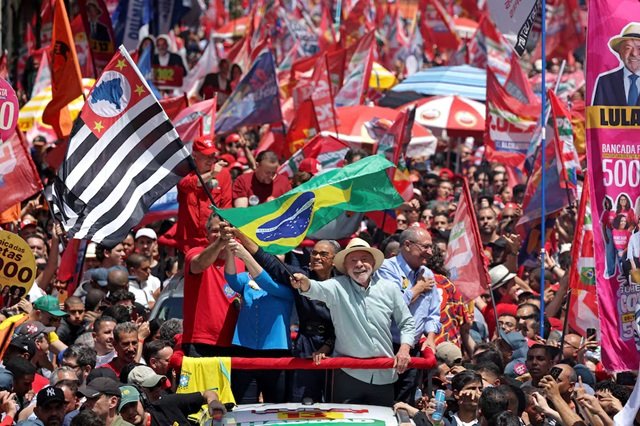
Brazil votes on Sunday in a presidential and legislative election that has become the third consecutive electoral confrontation between the democratic left represented by Luiz Inácio Lula da Silva and the Bolsonaro family’s far right. The names have changed, but the political divide remains. Lula, 80, is seeking a fourth presidential term after a long career that has made him one of Brazil’s most consequential political figures. His opponent, 45-year-old Senator Flávio Bolsonaro, is the political heir of former president Jair Bolsonaro and a candidate supported by conservatives and voters united primarily by their opposition to Lula. Polls have kept the two effectively level for months, leaving little room for undecided voters and making a second round on 25 October the most likely outcome.
The scale of the vote extends well beyond the presidency. Almost 159 million Brazilians are eligible to choose the head of state, the Chamber of Deputies, two-thirds of the Senate, all 27 governors and state legislative chambers. A presidential candidate must secure more than 50 per cent of valid votes to win outright on Sunday, a result regarded as highly unlikely. The expected second-round contest is projected by polls to be an exceptionally close one. Four years ago, Lula won the presidency by only 1.8 percentage points, the narrowest victory in Brazil’s history. This time, the difference indicated by surveys is smaller still. Prediction markets including Polymarket have strongly favoured Bolsonaro.
Lula has framed the election as a fundamental choice. “The people are called to choose between democracy and barbarism,” he has said. Flávio Bolsonaro has described the contest instead as a confrontation “between Good against Evil”. The senator has promised to respect the election result, even as the polarisation surrounding the vote has made narrow electoral victories increasingly routine elsewhere in the region. The election has also unfolded amid widespread disenchantment. Lula is fighting what may be the final presidential battle of his political career, while the Bolsonaro family is seeking a political comeback after the former president’s fall from office and subsequent imprisonment.
Lula has used the powers of the presidency prominently in his campaign. His government increased Bolsa Família assistance against poverty by 15 per cent for the 20 million families receiving it, banned sports betting, which he says has contributed to an epidemic of debt and mental-health problems, and promised that the public health system would provide free weight-loss injections. He has also pledged to moderate spending to reduce public debt, which stands at 82 per cent, while maintaining social programmes. For supporters in poor areas, such policies are linked to tangible changes. Joana Basilio, 47, a cook from São Paulo, said her neighbourhood had gained a health clinic, paved roads and a nursery “thanks to the left”. Her sister Isabel, 55, pointed to three members of their family studying medicine-related subjects. When they were young, she said, university “was something very distant”.
For Bolsonaro, the first presidential act would be aimed at his father. He has promised to pardon Jair Bolsonaro and promote an amnesty for those involved in the assault on Brazil’s Three Powers in Brasília, which took place seven days after Lula assumed the presidency with a mandate to repair the damage left by his predecessor. The Bolsonaro camp maintains that the former president is a political victim and that the attack was merely vandalism, a view that extends beyond the movement’s most radical supporters. The issue carries particular weight in a country where confidence in institutions has historically been weak. According to the latest Latinobarómetro, the proportion of Brazilians who believe democracy is preferable to any other form of government has fallen from 45 per cent to 41 per cent in two years. Only Guatemala records a lower level of attachment in the region.
The campaign itself has been unusually fragmented and constrained by the candidates’ reluctance to leave their political strongholds. Lula withdrew from a scheduled Globo debate on Thursday, despite its prime-time slot, choosing instead to appear on a friendly podcast watched live by 1.5 million people. Bolsonaro appeared in a YouTube livestream, following the format his father turned into a weekly political broadcast, drawing an audience of about 500,000. The debate would have offered one of the few opportunities for voters who reject both candidates to see them confront one another directly.
Those voters remain frustrated that no alternative has emerged. A complicated fraud case involving much of the Supreme Court and prominent politicians from the right and, to a lesser extent, the left has dominated the campaign, alongside repeated expectations of revelations capable of deciding the election. Yet public security and the economy, the issues most concerning voters, have received less attention. Feminicide has gained prominence in campaign speeches, although this is also the most male-dominated Brazilian election of the century: none of the six leading presidential candidates, or their running mates, is a woman.
Both candidates carry high rejection rates. Flávio Bolsonaro was damaged by revelations linking him to the alleged mastermind of the multimillion-real Banco Master fraud, but polling suggests he has survived the corruption investigation that followed. Lula remains the principal barrier for progressive voters who fear a return to Bolsonaro-style politics, but even many on the left are tired of the veteran PT leader.
That fatigue is visible among voters who have changed sides. Domingos, 65, a municipal street cleaner in São Paulo, voted for Lula in the previous election but now supports Bolsonaro. “We need a change. Enough. Lula has already given everything he could give,” he said, calling for new economic ideas and greater help for the poor. Nearby, Helena, 21, who earns 100 reais a day waving a campaign flag, said she would vote for Lula because “Lula is the least bad”. Eight years after Jair Bolsonaro defeated a Lula who was then in prison, the former president is now incarcerated after being convicted of leading the gravest attack on Brazil’s democracy, while the movement he created has become a central force in national politics. Brazil now has the choice of whether to alter a recent Latin American sequence of seven consecutive electoral victories for forces aligned with Trump and the region’s most conservative currents.