by Our Diplomatic Affairs Editor
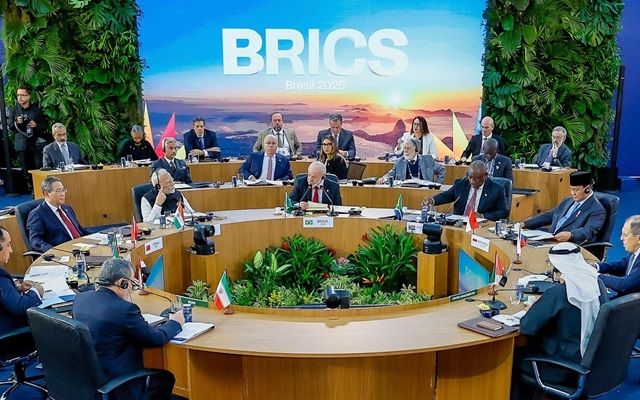
We must, without doubt, congratulate another gathering of BRICS 2025, but this polished ceremony of rhetorical commitment masks a disquieting duplicity—a theatre of solidarity that often performs global resistance while preserving systemic inequality. The Rio de Janeiro Declaration, verbose and virtuous on the surface, reveals itself upon closer scrutiny as an elaborate diplomatic performance, dangerously devoid of the very action it so profusely promises.
The declaration’s repeated invocation of multilateralism and equity—”a more just, equitable, agile, effective, efficient, responsive, representative, legitimate, democratic and accountable international and multilateral system”—verges on the baroque. Such florid language, though aspirational, dilutes rather than sharpens intent. The ambiguity here is strategic. Beneath the ornate syntax lies an evasion: BRICS remains unable—or unwilling—to offer a coherent vision of structural transformation beyond reiterating grievances about Western dominance.
For all the talk of sovereign equality and a “more representative, fairer international order,” we must ask: what structural alternatives are BRICS proposing that do not merely mirror the very hegemonies they denounce? While the bloc “reaffirms… support to the aspirations of Brazil and India to play a greater role in the United Nations, including its Security Council,” this seems less a call for transformation than a bid for elevation within the current framework. It is not revolution—it is rotation.
The solemn assertion that BRICS is a voice for the Global South is undermined by its internal contradictions. The bloc laments the “monopoly on senior posts in the UN system by nationals of any State or group of States” yet fails to offer its own transparent principles for appointment beyond vague calls for “geographical diversity.” It opposes unilateral coercive measures and Western sanctions regimes, yet remains ominously silent on member states’ own internal repressions, extrajudicial policies, and the militarised securitisation of dissent.
Equally disconcerting is BRICS’ uncritical embrace of fossil fuel dependency under the guise of developmental sovereignty. The declaration insists, “fossil fuels will still play an important role in the world’s energy mix” while reaffirming a “just, orderly, equitable and inclusive energy transition.” One cannot serve both carbon and climate. This simultaneous support for fossil dependency and climate leadership is the very definition of cognitive dissonance—cloaked in sovereignty, but ultimately capitulating to petro-nationalism.
The celebration of the New Development Bank’s role in “advancing sustainable development” rings hollow when it is equally committed to “expand local currency financing” for infrastructure projects that often entrench extractivist economies. “We strongly support the further expansion of NDB membership,” they write, as if breadth alone could redeem a development paradigm that still mimics Bretton Woods logics—only this time with new gatekeepers.
Even its calls for “a fair agricultural trading system” betray a paradox. How can one oppose “unilateral, punitive and discriminatory protectionist measures” while simultaneously calling for the establishment of exclusive platforms like the BRICS Grain Exchange? The declaration valorises food sovereignty and trade resilience, yet undermines these ambitions by fetishising South-South liberalisation without adequately addressing unequal land ownership, domestic agrarian crises, or the class dynamics within BRICS states themselves.
On artificial intelligence and digital governance, the bloc exhibits commendable foresight—endorsing “an AI governance that upholds our shared values” and the BRICS Leaders’ Statement on Global Governance of Artificial Intelligence. Yet, despite the inclusionary language, it fails to acknowledge that several BRICS members have abysmal records on surveillance, data privacy, and digital censorship. AI in the hands of techno-authoritarian regimes is not development—it is digital dispossession.
Even its fierce moralism regarding Gaza, while ethically aligned, suffers from selective indignation. “We call for… the full withdrawal of Israeli forces from the Gaza Strip… and the release of all hostages,” yet the declaration avoids equivalent condemnation of state violence or occupation practices elsewhere, especially when BRICS partners are implicated. That this document rails against “violations of international humanitarian law” while remaining tepid on issues such as China’s treatment of Uyghurs, or Russia’s actions in Ukraine (merely referencing “national positions” and “dialogue”), is proof that moral clarity is often sacrificed at the altar of bloc politics.
Perhaps most tellingly, the BRICS rhetoric on peace and diplomacy repeatedly returns to a hollow mantra of “dialogue, consultation and diplomacy” without confronting the historic complicities of its own members in fomenting regional instability. They speak of strengthening “African solutions to African problems,” yet Africa’s most pressing issues—resource predation, foreign debt, governance fragility—are left unexamined. Is this solidarity or selective paternalism?
The crux of the problem lies in BRICS’ refusal to confront its own contradictions. Its performative invocations of justice mask the absence of emancipatory imagination. It wields critique against Western hegemony but replicates the same imperial geometries—repackaged in southern vernaculars. The “Global South” here becomes not a political project of liberation, but a rhetorical artefact—useful for moral posturing but insufficient for world-making.
We are told BRICS is building a new world order. But the real question is: to what end, and for whom? The Declaration is a masterclass in non-committal multilateralism—urgent in tone but inert in action, ambitious in appearance yet haunted by the ghosts of realpolitik. In this theatre of global governance, BRICS is not the counter-hegemon it imagines itself to be; it is the mirror.