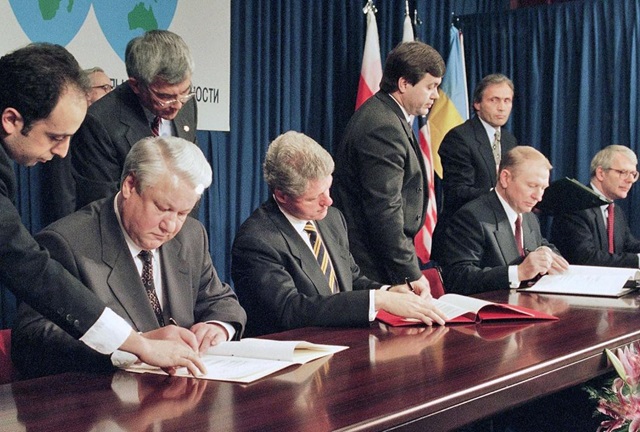
Thirty years ago, the Budapest Memorandum ensured the destruction of dangerous post-Soviet nuclear stockpiles but was overshadowed at the time by Russian President Boris Yeltsin’s complaint that NATO expansion was causing a new division of Europe, according to declassified U.S. documents published on the anniversary today by the National Security Archive.
Yeltsin’s “cold peace” blowup at Bill Clinton in Budapest in December 1994 represented the biggest train wreck on the track to NATO expansion in the 1990s and resulted from “combustible” domestic politics in both the U.S. and Russia, together with contradictions in the Clinton attempt to have his cake and eat it too—expanding NATO and partnering with Russia at the same time, according to the documents.
The blowup occurred simultaneously with one of the most significant achievements of U.S.-Russian-Ukrainian cooperative threat reduction: the signing of the Budapest Memorandum with Ukraine on disposing the deteriorating Soviet arsenal of nuclear weapons based in Ukraine. The documents show that Ukraine bargained hard for a trade very much in its own national interest, where the 1000+ nuclear warheads left in Ukraine, each a mini-Chernobyl in the making, would be re-processed in Russia for fuel rods that provided electricity in Ukraine for the next decade, in a sequence lubricated with funding from the American Nunn-Lugar program.
The security assurances in the Budapest Memorandum, signed by the other nuclear powers at the highest political level as part of the deal with Ukraine, only lasted 20 years, until Russia violated those pledges (and its other treaty commitments under the Helsinki Final Act and the UN Charter) by seizing Crimea in 2014 and then invading Ukraine in 2022.
In hindsight, critics of the Budapest Memorandum inaccurately describe the Soviet warheads as Ukraine’s “nuclear deterrent” against Russia, when the documents show those weapons were targeted on the U.S. and could not be maintained safely in Ukraine. One leading Russian expert advised Yeltsin in September 1994 against offering any inducements to the Ukrainians because the warheads were already rotting: Soon, “Ukraine itself will be asking us” to take the warheads “and it will have to pay for the transfer.”
The Ukrainian Academy of Sciences had already concluded that Ukraine could not afford the billions necessary for a nuclear fuel cycle that would prevent decay of the warhead fissile material, especially in the face of inevitable international sanctions such as those placed on North Korea. Ukraine’s oil and gas debts to Russia at the time had already reached $5 billion, according to documents from the Russian Duma, and more than half of that would be forgiven as part of the Budapest deal.
The Yeltsin eruption on December 5, 1994, made the top of the front page of the New York Times the next day, with the Russian president’s accusation (in front of Clinton and other heads of state gathered for a summit of the Conference on Security and Cooperation in Europe, CSCE) that the “domineering” U.S. was “trying to split [the] continent again” through NATO expansion.
The angry tone of Yeltsin’s speech was echoed years later in his successor Vladimir Putin’s famous 2007 speech at the Munich security conference, though by then the list of Russian grievances went well beyond NATO expansion to such unilateral U.S. actions as withdrawal from the Anti-Ballistic Missile Treaty and the invasion of Iraq in 2003 (a violation of international law that Russia would emulate with its invasion of Ukraine in 2022).
These documents, the result of a Freedom of Information Act lawsuit by the National Security Archive, include a series of revelatory Strobe Talbott memos to Clinton and to Secretary of State Warren Christopher and the secret memcon of the presidents’ one-on-one at the Washington summit in September 1994. Clinton kept assuring Yeltsin that any NATO enlargement would be slow, with no surprises, building a Europe that was inclusive, not exclusive, and in “partnership” with Russia.
At the same time, however, “policy entrepreneurs” in Washington were revving up the bureaucratic process for more rapid NATO enlargement than expected either by Moscow or the Pentagon, which was committed to the Partnership for Peace as the main venue for security integration of Europe, not least because it could include Russia and Ukraine.
The documents include insightful cables from U.S. Ambassador to Moscow Thomas Pickering, explaining Yeltsin’s new hard line at Budapest as the result of multiple factors. Not least, Pickering pointed to “strong domestic opposition across the [Russian] political spectrum to early NATO expansion,” criticism of Yeltsin and his foreign minister, Andrei Kozyrev, as too “compliant to the West,” and the growing conviction in Moscow that U.S. domestic politics—the pro-expansion Republicans’ sweep of the Congressional mid-term elections in November 1994—would tilt U.S. policy away from taking Russia’s concerns into account.
Pickering was perhaps too diplomatic, because there was plenty of blame to go around on the U.S. side. Clinton wrote in his memoir, “Budapest was embarrassing, a rare moment when people on both sides dropped the ball….” Actually, the drops were almost all in Washington. White House schedulers led by chief of staff Leon Panetta tried to prevent Clinton from even going to Budapest by constraining his window there to eight hours, which meant there was no time for a one-on-one with Yeltsin. Clinton himself thought he was doing Yeltsin a big favor by even coming and expected good press from the substantial reduction in nuclear arsenals that would result from the signing of the Budapest memorandum on security assurances for Ukraine.
National Security Adviser Tony Lake gave Clinton a prepared text that “was all yin and no yang – sure to please the Central Europeans and enthusiasts for enlargement, but equally sure to drive the Russians nuts….” The author of that phrase, Deputy Secretary of State Strobe Talbott, wasn’t even in Budapest, paying attention to the Haiti crisis instead (“never again” he later wrote, would he miss a Yeltsin meeting). Talbott’s own “you gotta go” memo to Clinton before Budapest devotes only a sentence to the arms-control denuclearization success that was possible there and focuses on the need to reassure Yeltsin about NATO expansion.
The documents include a previously secret National Security Council memo from Senior Director for Russia Nicholas Burns to Talbott (that was considered so sensitive that Burns had it delivered by courier) describing Clinton’s reaction to Budapest as “really pissed off” and reporting “the President did not want to be used any more as a prop by Yeltsin.” At the same time, Burns stressed, “we need to separate our understandable anger on the tone of the debate with [sic] Russia’s substantive concerns which we must take seriously.” Similarly, the Pickering cables recommended using Vice President Al Gore’s previously scheduled December trip to Moscow for meetings with Prime Minister Victor Chernomyrdin to also meet with Yeltsin, calm down the discussion, and get back on a “workable track.”
Mending fences would include Gore’s description to Yeltsin of the parallel NATO and U.S.-Russia tracks as spaceships docking simultaneously and very carefully and Gore and then Clinton assuring the Russians (but not in writing, as Russian foreign minister Kozyrev kept asking for) that no NATO action on new members would happen before the 1995 Duma elections or the 1996 presidential elections in Russia.
The new documents only reached the public domain as the result of a Freedom of Information lawsuit by the National Security Archive against the State Department seeking the retired files of Strobe Talbott. Thanks to excellent representation by noted FOIA attorney David Sobel, State set up a schedule of regular releases to the Archive over the past six years. The full corpus of thousands of pages covering the entire 1990s appeared this year in the award-winning series published by ProQuest, the Digital National Security Archive, which won Choice magazine’s designation as an “Outstanding Academic Title 2018.”
Curated by Archive senior analyst Dr. Svetlana Savranskaya, the ProQuest set US-Russia Relations from the Collapse of the Soviet Union to the Rise of Putin includes more than 2,500 documents and more than 13,000 pages of the highest-level declassified evidence. The Archive also benefited from State’s assignment of veteran reviewer Geoffrey Chapman to the task of assessing the Talbott documents for declassification. Chapman ranks among the most thorough, expert, and professional declassifiers in the U.S. government.
Press release issued by National Security Archives