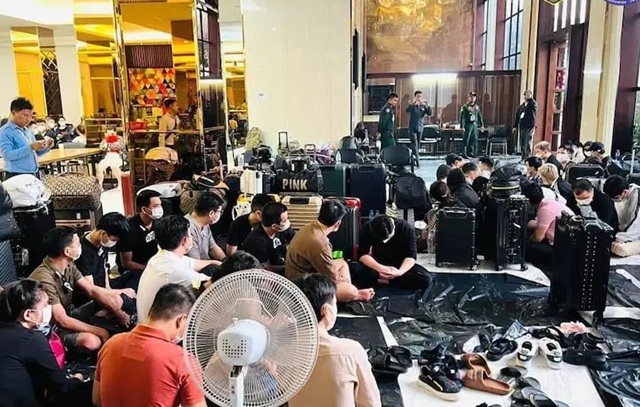
A damning new report has accused senior Cambodian politicians of supporting and profiting from a vast criminal industry that uses trafficked forced labour to run online scam centres targeting lonely individuals in the West.
The report, by the Humanity Research Consultancy (HRC), highlights the alarming growth of transnational cyber fraud operations in Southeast Asia, naming Cambodia as the likely “global epicentre” of what it calls “next-gen transnational fraud” in 2025. The findings echo recent concerns raised by United Nations investigators, who warned that such scam centres are spreading “like a cancer” across the region — despite crackdowns and high-profile raids in Myanmar and other neighbouring countries.
“Cambodian state institutions systematically and insidiously support and protect the criminal networks involved in transnational fraud and related human trafficking,” the HRC report states. It estimates that the scamming industry in Cambodia generates as much as $19 billion a year — equivalent to 60 percent of the country’s GDP, vastly surpassing its legitimate garment and textile exports.
As reported by The Times UK, the industry’s explosive growth traces back to the Covid-19 pandemic, when shuttered casinos turned to cybercrime to maintain revenue. Criminal operators pivoted to online scams, luring recruits — both willing and deceived — with promises of high-paying jobs. Many were instead trafficked, confined under threat of violence, and forced into online scamming roles.
One particularly insidious tactic is known as “pig butchering.” Victims — often elderly or emotionally vulnerable men in Europe and North America — are first groomed on dating apps by scammers posing as attractive women. Once trust is built, the victim is passed to more senior fraudsters who orchestrate the “slaughter,” extracting large sums of money, typically in untraceable cryptocurrencies.
According to the UN Office on Drugs and Crime (UNODC), the scam industry across Southeast Asia now employs more than 350,000 people and is worth an estimated $75 billion annually. Cambodia hosts the largest share of these operations, with major compounds reportedly protected — and in some cases backed — by high-ranking officials.
Among those named is Hun To, cousin of Cambodian Prime Minister Hun Manet, who sits on the board of Huione Group, a company identified by the UNODC as a key facilitator of cyber fraud through its illicit online marketplaces. Another senior official, Deputy Prime Minister and Interior Minister Sar Sokha, is said to have invested in the construction of one of Cambodia’s largest scam compounds.
Jacob Sims, a Harvard-affiliated security expert and author of the HRC report, argues that the deep political entanglement with the fraud industry has created an ecosystem in which criminal networks flourish under official protection.
“It spreads like a cancer,” said Benedikt Hofmann of UNODC. “Authorities treat it in one area, but the roots never disappear; they simply migrate.”
While Cambodian authorities have pushed back against the allegations, the international community is increasingly alarmed. Touch Sokhak, a spokesperson for Cambodia’s Ministry of Interior, dismissed the report as “politically motivated” and claimed it was “a tool to blame smaller countries that are technologically weak.”
Nevertheless, the scope of the problem is undeniable. Victims of the industry include not only the defrauded individuals abroad but also the thousands trapped in scam centres under conditions akin to modern slavery.
As The Times UK has documented in previous investigations, many trafficked workers are subjected to beatings, torture, and psychological abuse if they fail to meet fraud targets — a brutal reminder of the human cost behind this growing global crime wave.