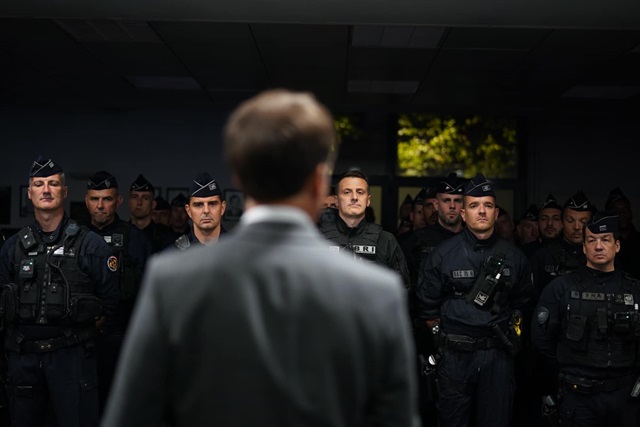
French President Emmanuel Macron has sparked a debate among European leaders about the potential use of France’s nuclear arsenal as a deterrent against Russian aggression, especially if the United States scales back its role in NATO. As the US has increasingly distanced itself from Europe’s security, especially under the leadership of Donald Trump, Macron has invited his European counterparts to discuss the viability of using France’s “force de frappe” to protect the continent. However, this proposition is not without its limitations, and European leaders may find themselves reluctant to rely solely on France’s nuclear capabilities.
The idea of extending the French nuclear “umbrella” has gained urgency as tensions with Russia mount and the US threatens to reduce its presence in Europe. NATO’s nuclear sharing agreement currently includes over 100 gravity bombs under US control, distributed across European countries such as Belgium, Germany, and Turkey. The fear that the US might withdraw its nuclear protection has prompted leaders from nations like Germany and Poland to consider alternative arrangements, including potentially seeking nuclear security from France or even acquiring nuclear weapons themselves. Macron has responded by proposing a months-long discussion to explore possible new cooperations and partnerships.
However, France’s arsenal, while formidable, is significantly smaller than that of the US or Russia. With only around 300 warheads, compared to Russia’s 5,580, experts argue that it is impractical for France to guarantee full protection for Europe. The lack of tactical nuclear weapons, which are more suited for battlefield use, further limits France’s options for gradual escalation in the event of a threat. While Macron’s calls for a strategic dialogue are in line with France’s long-standing stance on maintaining nuclear independence, the country’s limited nuclear stockpile makes it clear that France cannot shoulder the responsibility of European deterrence alone.
In an article published by Financial Times, experts noted that for France to expand its nuclear protection for Europe, it would likely need to integrate its nuclear strategy more closely with that of NATO. Joining NATO’s Nuclear Planning Group (NPG) would allow France to align its nuclear doctrine with the UK and the US, signaling a stronger European deterrence against Russia. However, this would challenge France’s tradition of nuclear independence, a policy established by Charles de Gaulle to ensure French sovereignty over its nuclear decisions.
Despite these challenges, some experts believe there are ways for France to strengthen its role in European deterrence. Marion Messmer, an international security expert at Chatham House, suggests that France could increase joint exercises and training with NATO allies to demonstrate European unity and signal its commitment to security in the region. Another option is for France to clarify its nuclear doctrine, specifically regarding how it would support European allies in times of crisis, though some argue that any answer that requires the allies to “trust” France’s decision-making may not be reassuring enough.
The Financial Times further highlights the complexities involved in expanding French deterrence capabilities. While Macron’s strategy could enhance European security, achieving a comprehensive and credible deterrent would require significant shifts in nuclear strategy, particularly in a scenario where the US is no longer willing to protect Europe.