


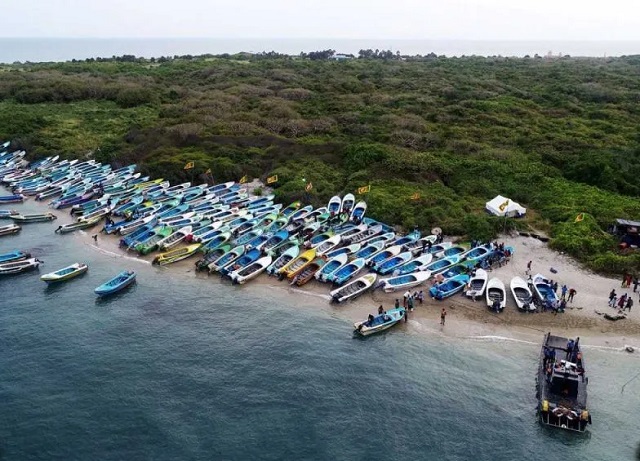
Kachchativu Island is located in the Palk Bay, one and a half nautical miles from the India–Sri Lanka International Maritime Boundary Line (IMBL), on our side of the IMBL. It lies well within Sri Lankan territory, and this boundary line was ratified in 1976 under a trilateral maritime agreement signed by India, the Maldives and Sri Lanka. The agreement, which defined the territorial waters, contiguous zones and exclusive economic zones of the three countries, was subsequently ratified by the United Nations. Therefore, as far as Kachchativu Island is concerned, it is unquestionably Sri Lankan territory, lying well within our territorial waters.
So why has Kachchativu Island—183 acres of land surrounded by beautiful coral reefs and rich fishing grounds—become a contentious issue between India (especially in Tamil Nadu politics) and Sri Lanka?
Tamil Nadu politicians frequently claim that Kachchativu was “gifted” to Sri Lanka by Shrimati Indira Gandhi in 1976. However, I must emphasise to readers that Kachchativu was never part of India. The only historical claim arises from the mid-1800s, during Queen Victoria’s reign (1837–1901), when Kachchativu was leased by the British to Raja Ramnad (the Maharaja of Ramnathpuram) for “chank fishing” around the island.
I encourage readers to consult the book Kachchativu by the late Mr W. T. Jayasinghe, who served as Permanent Secretary of the Ministry of Defence and External Affairs from 1972 to 1977, during the premiership of Hon. Sirimavo Bandaranaike. He was also the father of the late Mr Chrishantha Romesh Jayasinghe, our former Foreign Secretary and later High Commissioner to New Delhi from October 2009 until his passing in August 2011. The book clearly explains how Sri Lanka’s case was advanced by a dedicated team led by Mr N. Q. Dias (Permanent Secretary of Defence and External Affairs from 1960 to 1965, and High Commissioner to New Delhi from 1970 to 1972), with strong support from Mr Jayasinghe himself; Mr Hamilton Shirley Amarasinghe (Sri Lanka’s High Commissioner to New Delhi from 1963 to 1966, later a senior UN diplomat, President of the UN General Assembly in 1976, and a leading figure in drafting the UN Convention on the Law of the Sea); and Mr Moragodage Christopher Walter Pinto (the Foreign Ministry’s first Legal Adviser, sent to Europe to collect historical records of Sri Lanka’s ownership of Kachchativu from Portuguese, Dutch and British maritime archives and museums. He compiled an excellent dossier for the team, and was later awarded the Deshamannya title by President Maithripala Sirisena in 2019. He was also the father of Hon. Milinda Moragoda, a former High Commissioner to New Delhi). The delegation was further strengthened by Hon. Justin Siriwardena, then High Commissioner to India.
In his foreword to the book Kachchativu by Professor V. Suryanarayan, Hon. Thomas Abraham, former Indian High Commissioner to Colombo (1972–1978), wrote:
“The Sri Lankan delegation led by Hon. N. Q. Dias and W. T. Jayasinghe was far superior to the Indian delegation—sharper, more knowledgeable and to the point in their deliberations.”
This is the calibre of Sri Lankan diplomats of that era! It is no wonder that the forefathers of our Foreign Service achieved such great heights, supported by the political leadership of Hon. Sirimavo Bandaranaike, whose charm, grace and friendship with then Indian Prime Minister Shrimati Indira Gandhi helped secure Sri Lanka’s maritime boundary and Kachchativu Island.
As our former Foreign Minister Hon. Ali Sabry, PC, said a few years ago: “Kachchativu is ours—clear as a whistle! The matter was resolved more than 50 years ago!”
Yet…
On 26 August 2014, former Attorney General of India Hon. Mukul Rohatgi told a five-member bench of the Supreme Court of India, presided over by Chief Justice Hon. R. M. Lodha:
“Kachchativu went to Sri Lanka by an agreement in 1974. It is now on the Sri Lankan side of the India–Sri Lanka IMBL. How can we take it back today? If we want Kachchativu, we will have to go to war with Sri Lanka and take it over.”
This clearly shows that the Kachchativu issue is a closed case. I hope today’s political leaders fully understand this.
In 2016, the Sri Lanka Navy, at the request of the Catholic Bishop of Jaffna, Rt. Rev. Dr Bernard Justin Ganapragasam, built a beautiful new St Anthony’s Church on Kachchativu Island, next to the old church. At the time, I was the Navy Commander, and my Commander of the Northern Naval Area was Rear Admiral Piyal De Silva (who later became Navy Commander and Sri Lanka’s Ambassador to Afghanistan). The new church was designed by then-Captain Rohan Joseph—a devoted Catholic and my Naval Assistant at the time, now Rear Admiral and Flag Officer Commanding the Naval Fleet—and constructed by the Navy’s civil engineering staff at a cost of 7.1 million rupees. Contributions came entirely from Sri Lankan naval officers and sailors, most of them Sinhala Buddhists. St Anthony is the patron saint of fishermen and seafarers, protecting them from danger at sea. May he continue to bless and protect our Navy!
Kachchativu Island is no small rock. At 183 acres, it is a sizeable island. Our forefathers secured it for us; now it is our duty to protect it. I warmly invite you to visit Kachchativu during the next St Anthony’s Feast, when thousands of Sri Lankan and Indian devotees gather on the island.
I must also pay tribute to the Navy Civil Engineer, Lieutenant Commander M. Silva, a brilliant graduate of the General Sir John Kotelawala Defence University (KDU). He and his team laboured under trying conditions for four months to complete the new church. Sadly, he passed away a year later due to a sudden illness. It would be a failing on my part not to mention this dedicated officer. We will remember him. May he rest in peace.

In light of Admiral Wijegunaratne’s insightful article, let’s reaffirm why the Kachchatheevu debate is legally and historically settled. From British-era recognition in the 1920s to the 1974 Indira Gandhi agreement (which was in fact a formal ratification, not a “gift”) and the later tripartite accord (among India, Maldives and Sri Lanka), Kachchatheevu’s status as part of Sri Lanka is beyond dispute. Attempts to revive this issue are both unfounded and dangerous.
Admiral Wijegunaratne (former Sri Lanka Chief of Defence Staff, Navy Commander and diplomat) has focused on the Sri Lanka’s historic presence on Kachchateevu, particularly the importance of the church which has been officially a part of the Jaffna Diocese from at least 1921, while being very diplomatic about the absurdity of the claims being made by Tamil Nadu politicians. He quotes the former Indian Attorney General testifying before the Indian Supreme Court, stating that the only way the island could revert back to India would be if India took it in an act of war.
Imagine the scenario in reverse: if Chinese livestock herders decided to push into Indian territory, would India tolerate such incursions? Certainly not. In the same way, Sri Lanka cannot be expected to renegotiate its established maritime boundaries to appease local political pressures from Tamil Nadu.
Moreover, we must acknowledge that Tamil Nadu politicians continue to fan the flames by encouraging Indian fishermen to blatantly violate international maritime boundaries. Each time the Sri Lankan Navy apprehends these fishermen, it seems to give these politicians more political oxygen and leverage, turning a settled issue into a tool for their own local gain. This kind of meddling is a direct infringement on Sri Lanka’s sovereignty and is not something we should tolerate.
Furthermore, India and the rest of Asia rightly oppose China’s expansionism in the South China Sea. It would be deeply ironic—and damaging—if India were to place itself in a similar position by entertaining these baseless claims. Just as the world stands against China’s disregard for international norms, India should avoid mirroring such behavior.
It’s important to remember that Sri Lanka has forgiven, but not forgotten, past instances of meddling in its sovereignty. Continuing to stir this debate is not in anyone’s best interest. Sri Lanka’s neutrality and sovereignty must be respected, and these long-standing agreements are not up for renegotiation to satisfy India’s internal politics. Let’s encourage India not to follow a path that aligns it with the very actions it condemn elsewhere.