


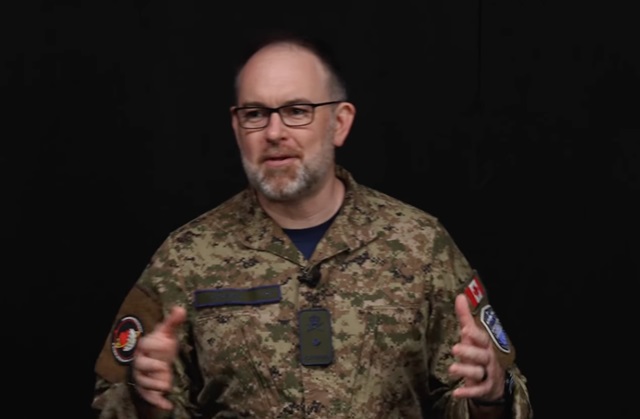
Control of space will be decisive in any future war against a modern adversary, the head of the Canadian military’s space division has warned, describing the first days of such a conflict as a battle for dominance in orbit and cyberspace. Brig. Gen. Christopher Horner, commander of the Canadian Armed Forces Joint Force Space Component, said in an interview with The Japan Times that victory in space could mean the difference between winning or losing an entire war.
“In any major conflict against a high-end adversary, the first 72 hours will be fought in the space and cyber domains,” Horner said. “The ability to be decisive, responsive and resilient in these domains could potentially make the difference between winning or losing a war.”
Horner emphasized that space-based assets — from intelligence, surveillance and reconnaissance systems to early-warning and precision-targeting networks — are the backbone of modern warfare. Without them, conventional forces lose coordination, communications, and their technological edge. “If Canadian warships have access to space-enabled assets, they will have decisional advantage and can deliver effects with fewer casualties. Without them, I don’t know that they’re making it across the Pacific,” he warned.
The general’s comments come amid rising concerns about the growing weaponization of space by major powers, particularly China and Russia. Both countries have tested anti-satellite missiles and developed directed-energy systems and jammers designed to disrupt or destroy orbital infrastructure. Such tests have created hazardous clouds of space debris, putting thousands of satellites — including those used for civilian communications and navigation — at risk.
Horner said defending and protecting that infrastructure is now a moral and strategic obligation for all responsible space powers. “Adversarial countries are rapidly moving away from the rules-based international order and the responsible use of space,” he cautioned.
The general also pointed to the economic risks of losing access to space. Canada, he noted, relies heavily on satellite-enabled technologies for communications, finance, and logistics. A successful attack on the country’s space infrastructure could cost its economy an estimated one billion dollars in gross domestic product per day.
To meet these growing threats, Canada has been accelerating the development of both defensive and offensive space capabilities. It is one of seven members of Operation Olympic Defender — a multinational coalition that includes Australia, the United States, the United Kingdom, France, Germany, and New Zealand — designed to integrate global military spacepower, deter aggression, and defend allied assets in orbit. The coalition declared its initial operating capability earlier this year.
“A year ago, we didn’t even say the words ‘space control’ out loud because that was classified,” Horner said. “But today, those seven nations are all moving toward expanding their capabilities in that realm.”
While Japan is not a member of the coalition, Horner said collaboration with Tokyo’s Air Self-Defense Force Space Operations Group has been “significant and growing.” Canada and Japan have hosted each other’s units for joint training and are expanding data sharing on space domain awareness — a capability he described as essential for tracking threats and debris.
“There’s no one country that can manage all of outer space on its own,” he said. “We’re leveraging each other’s expertise and moving forward as partners.”
Japan’s Defense Ministry recently unveiled new guidelines to strengthen its space defenses, including plans to develop “bodyguard satellites” to protect key assets. Horner welcomed the move and urged closer public-private cooperation in space technology, calling it “absolutely necessary” for countries that want to maintain an edge.
He pointed to commercial Earth-observation satellites as a model of efficient collaboration. “Why would I put a constellation of high-end cameras into orbit if companies have already done it?” he asked. By acquiring imagery from commercial sources, governments can meet up to 80% of their intelligence needs at a fraction of the cost, redirecting savings toward critical military technologies such as space control systems and advanced weapons.
As Horner put it, future conflicts may still be fought on land, sea, and air — but the outcome will likely be decided far above the Earth’s surface.









