


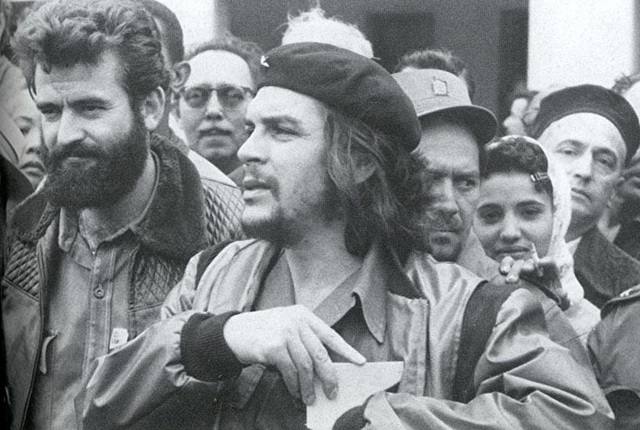
The Italian town of Carrara, renowned for its long-standing tradition of anarchism and the white marble once used by Michelangelo, has unveiled Italy’s first public statue of Che Guevara. The 2.1-meter (6ft 9in) monument, which depicts the iconic image of the Marxist revolutionary, has sparked a political uproar, drawing sharp criticism from right-wing politicians.
Carrara’s mayor, Serena Arrighi, celebrated Guevara as a symbol of the fight for rights and freedom, particularly for those in foreign lands. The statue, unveiled last week in the town’s center, was created by Argentine sculptor Jorge Romeo, and features an ornate white marble base with a metal silhouette that reproduces the famous 1960 photograph of Guevara taken by Alberto Korda in Havana.
While Arrighi praised Guevara’s commitment to combating oppression, the move has ignited backlash from Italy’s right-wing League party. Party members, including MP Andrea Barabotti, have called for the statue’s immediate removal, arguing that it glorifies political violence and promotes an authoritarian ideology. Barabotti condemned Guevara as an enabler of Cuba’s communist dictatorship, which he claimed was responsible for human rights abuses, including executions and violence against political enemies. He pointed to Guevara’s own words in 1967, where he described the “intransigent hatred of the enemy” as essential to transforming revolutionaries into “cold and effective killing machines.”
The statue is the brainchild of Alfredo Helman, an Argentine communist exile who sought refuge in Italy to escape persecution in the 20th century. According to those behind the monument, the statue represents Carrara’s legacy of resistance and rebellion, honoring Guevara as someone who fought against all forms of oppression. They argue that the statue’s installation comes at a critical time when neofascism and antisemitism are rising, and serves as a reminder of the town’s radical left-wing roots.
Carrara has a rich history tied to the labor movement, particularly among stonecutters who worked in the quarries made famous by Michelangelo. The town became a stronghold of anarchism by the late 19th century, with The New York Times describing it in 1894 as “a stronghold of anarchists” with the potential for violent uprisings. This political legacy made Carrara a fitting location for a statue of Guevara, who played a pivotal role in Fidel Castro’s Cuban Revolution in 1959.
However, the unveiling has not been met with universal approval. Susanna Campione, a senator from the right-wing Brothers of Italy party, slammed the monument as an “affront to the victims of communism,” particularly in Latin American countries like Cuba and Venezuela. She argued that the hammer and sickle, Guevara’s emblem, are “symbols of oppression.”
In response, Mayor Arrighi defended the statue, highlighting her party’s condemnation of all forms of totalitarianism, while calling out the hypocrisy of those who tolerate fascist imagery and ideologies. Her comments alluded to recent controversy involving the youth wing of Brothers of Italy, which was caught on film engaging in fascist salutes and singing Mussolini’s anthem.
The installation of the Che Guevara statue in Carrara has thus become a flashpoint in Italy’s ongoing culture wars, exposing deep political faultlines between left and right. While the statue’s supporters celebrate Guevara’s revolutionary legacy, critics continue to decry his violent methods and association with oppressive regimes.









