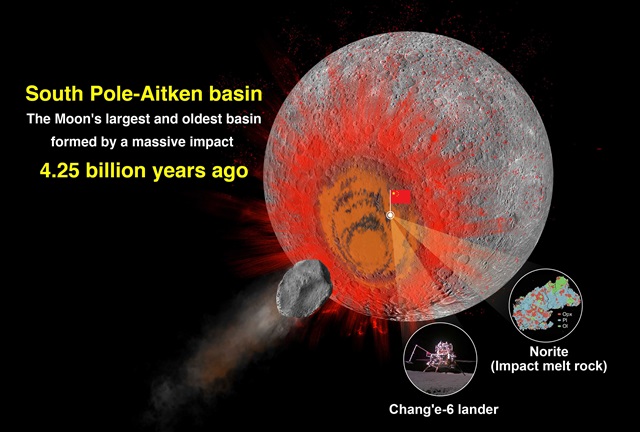
In a groundbreaking discovery, scientists have successfully pinpointed the age of the Moon’s South Pole-Aitken (SPA) basin, the largest and oldest known impact crater on the lunar surface. Led by Prof. CHEN Yi from the Institute of Geology and Geophysics at the Chinese Academy of Sciences, a team of researchers analyzed rock samples returned by China’s Chang’e-6 mission, revealing that the formation of the basin occurred approximately 4.25 billion years ago. Their findings, published in National Science Review, provide crucial insights into the history of the Moon and the early Solar System.
The SPA basin, located on the far side of the Moon, is a vast impact structure believed to have formed during a period of intense asteroid bombardment that shaped much of the Solar System’s early landscape. However, despite its significance, the exact age of the basin has remained a mystery, until now. Previous age estimates for the basin had varied widely, underscoring the need for direct analysis of materials from the SPA region to resolve the uncertainty.
With the successful return of lunar samples from the SPA basin by the Chang’e-6 mission, scientists were able to conduct detailed studies of impact melt rocks within the samples. These rocks are crucial for understanding the basin’s formation, as they contain products of the massive impact that created the SPA. Prof. CHEN explained, “The SPA impact event generated a massive sheet of impact melt. To accurately determine the basin’s age, we first needed to identify the products of this melt within the Chang’e-6 samples.”
The research team analyzed approximately 1,600 fragments from two soil samples, identifying 20 norite clasts with mineralogical and geochemical signatures that were consistent with an impact origin. By using lead-lead dating on zirconium-bearing minerals within these clasts, the scientists uncovered evidence of two separate impact events, dated to 4.25 billion and 3.87 billion years ago. The older norites, dating to 4.25 billion years, indicated they crystallized from varying depths within a common impact melt sheet associated with the formation of the SPA basin.
Prof. CHEN affirmed the significance of the findings, stating, “Our geological surveys and comparative lithological analyses strongly indicate that the 4.25-billion-year age corresponds to the formation of the SPA basin.”
This study marks the first time that direct sample-based evidence has been used to pinpoint the formation of the Moon’s largest impact basin, providing a critical reference point for refining the lunar cratering chronology. The 4.25-billion-year date is vital for understanding the Moon’s early evolution and the dynamic processes that shaped the early Solar System. As such, these findings offer profound insights not only into lunar history but also into the broader context of planetary formation in the Solar System.