For Mahabir Pun, the challenge of connecting Nepal’s remote mountain communities is deeply personal. Long before he entered government as Nepal’s first minister for science, technology and innovation, he was a teacher determined to ensure that children growing up in isolated Himalayan villages would not remain cut off from the wider world. His journey—from pioneering rural internet connectivity to overseeing national technology policy—now places him at the centre of one of Nepal’s most consequential decisions about the future of digital infrastructure.
As reported by Nikkei Asia, the question confronting Kathmandu is whether the country should modify its telecommunications framework to permit the entry of Starlink, Elon Musk’s satellite internet service operated by SpaceX, despite the company’s insistence on full ownership of its local operations.
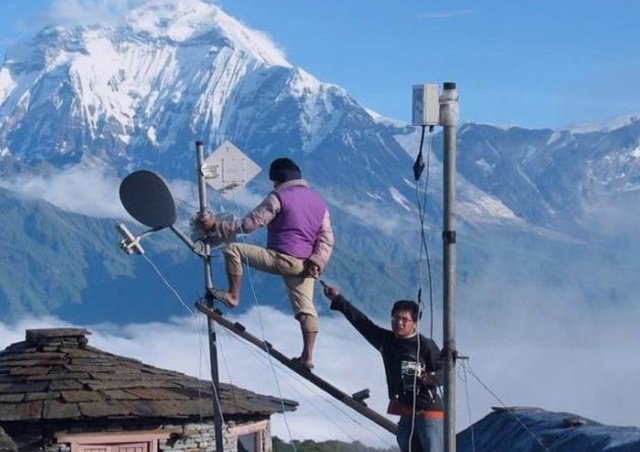
Pun’s commitment to rural connectivity began in the 1990s while teaching in Nangi, the village where he had grown up. Inspired by his own experience studying for a bachelor’s degree in science education in the United States, he wanted his students to access knowledge that extended far beyond the mountains surrounding their community. After returning to America for a second education degree, he began raising funds in 2001 to acquire wireless equipment capable of connecting isolated settlements.
The effort rapidly transformed life in Nepal’s remote Annapurna region. Within five years, 13 communities had gained internet access, allowing students to broaden their learning beyond the limits of local teaching resources. Health workers could consult doctors in urban hospitals about urgent medical cases, while mountain guesthouses gained the ability to receive bookings from international visitors. The initiative ultimately expanded to 175 communities, earning Pun the Ramon Magsaysay Award in 2007—often described as Asia’s Nobel Peace Prize—and induction into the Internet Hall of Fame in 2014.
Yet the digital divide that motivated Pun’s work has not disappeared. Despite those achievements, thousands of Nepalese villages continue to experience unreliable or limited internet access, leaving national internet usage levels below those of nearly every neighbouring country.
That continuing gap is precisely where Starlink presents both an opportunity and a policy dilemma.
Using a constellation of low-earth orbit satellites, Starlink has already expanded internet access to remote communities across Papua New Guinea, Mongolia and Fiji. The technology offers the possibility of connecting settlements where laying conventional telecommunications infrastructure is technically difficult and economically prohibitive. For Nepal, with its mountainous terrain and scattered rural communities, the potential benefits are evident.
However, Starlink’s proposal comes with conditions. According to Nikkei Asia, Elon Musk personally presented the company’s offer to Nepal’s previous government, making clear that Starlink would enter the market only if permitted to retain 100% ownership of its local operations. That position conflicts with Nepal’s existing regulations, which require local shareholders to hold a 20% stake in telecommunications services.
Now serving as minister for science, technology and innovation following the Rastriya Swatantra Party’s surprise landslide election victory, Pun and his colleagues must determine whether Nepal should maintain its existing rules or adapt them to accommodate a new generation of satellite communications.
The debate extends well beyond Nepal’s borders. Governments across the Asia-Pacific region have been grappling with similar questions as Starlink expands internationally. Some countries have amended legislation or regulations to facilitate its entry. Malaysia, Vietnam, Sri Lanka and, most recently, Taiwan have each modified regulatory frameworks to remove barriers. At the same time, Sri Lanka, Vietnam and Bangladesh have required Starlink to adapt its systems to permit local monitoring.
Elsewhere, negotiations continue. Security-related discussions have delayed Starlink’s launch in India and Pakistan, while Thailand has rejected the company’s demand for complete ownership of local operations and instead turned towards China’s Shanghai Spacesail Technologies for satellite internet support. China’s established position on ownership and security requirements has reportedly discouraged Starlink from even seeking a licence there, despite Tesla’s significant investments. Singapore, meanwhile, permits Starlink but limits its services to business users.
Nepal’s position is made more complex by regional geopolitics. According to Kathmandu-based foreign policy scholar Prakash Bhandari, both India and China would view Starlink’s entry cautiously. Reporting by The Kathmandu Post also suggested that concerns over reactions from Nepal’s powerful neighbours prevented the interim government that governed between September 2025 and March from reaching agreement on the issue. During that period, Pun served as minister of education, science and technology.
The geopolitical dimension is reinforced by Nepal’s existing telecommunications infrastructure. Virtually all equipment and systems used by the country’s dominant operators—Ncell and the state-owned Nepal Telecom—are supplied by Huawei Technologies or ZTE.
Against that backdrop, the United States has publicly emphasised its support for expanding what it describes as trusted communications networks. Responding to questions from Nikkei Asia, a U.S. State Department spokesperson said: “The United States encourages the adoption of technology solutions that expand connectivity and promote trusted information and communications technology (ICT) networks. Trusted networks ensure that data remains safe and nations can protect their sovereign interests.”
Senior American officials, including Under Secretary of State Sarah Rogers, Assistant Secretary of State Paul Kapur and Special Envoy to South Asia Sergio Gor, have all visited Nepal’s new government in recent months, with Starlink reportedly featuring prominently in discussions. Rebecca Hunter, Starlink’s global licensing director, separately met Communications Minister Bikram Timilsina shortly after Rogers’ arrival.
Meanwhile, Starlink has already established an unofficial presence in Nepal’s mountains. Expedition operators guiding climbers on Mount Everest and other peaks frequently use the satellite service despite the absence of formal authorisation. Although the Nepal Telecommunications Authority has repeatedly warned companies against providing unlicensed satellite internet services, it has not publicly been known to impose penalties.
For regulators, the concern extends beyond licensing. NTA spokesperson Pradip Paudyal questioned how authorities could obtain user data or investigate illegal activities conducted through unregistered satellite services. “If illegal activities are carried out using such (satellite) services and we need to ask for data, who would we contact? How would we trace the service?” he said. “That is why we need such services to be formally registered in Nepal.”
The growing use of unlicensed satellite internet has also affected Nepal’s licensed providers. According to NTA data, Constellation had only 1,187 subscribers as of June, while rival i4 Technologies had just 16. Representing Constellation, Sanatan Gajurel told domestic media that legal satellite businesses had suffered because illegal satellite phones were increasingly used in Nepal’s high mountain regions.
Publicly, however, Nepal’s government has shown little indication that policy changes are imminent. Pun has not commented on Starlink since assuming office, while Communications Minister Bikram Timilsina stated last month: “It would not be appropriate to amend legislation solely for one company.” Rastriya Swatantra Party parliamentarian Arvind Sah similarly told Nikkei Asia that while Starlink’s interest in Nepal was positive, the company should operate “in cooperation with the government.”
Some specialists argue that the debate reflects outdated legislation rather than resistance to new technology. Former Nepal Telecommunications Authority senior director Ananda Raj Khanal contends that satellite internet providers fall outside existing ownership provisions because they do not construct conventional telecommunications networks. Gaurab Raj Upadhaya, founder of the South Asian Network Operators Group, similarly argues that Nepal’s regulations require modernisation as satellite connectivity becomes increasingly integrated into consumer devices.
Whether those rules evolve remains uncertain. Yet the demand for satellite connectivity is already visible. Telecom and security consultant Prabal Lama believes Starlink could secure as much as one-third of Nepal’s internet access market if authorised, particularly among corporate customers, remote lodges, expedition operators and users seeking backup connectivity.
For photographer Purnima Shrestha, the technology has already demonstrated its practical value. In May, while positioned 7,300 metres above sea level on Mount Everest, she transmitted photographs documenting severe congestion on the route to the summit through a Starlink-powered Wi-Fi connection. “As a photojournalist, sending the photos to the wire was my first priority,” she said. “It would be great if it (Starlink) is legalized in Nepal.”
Her experience encapsulates the wider debate now unfolding in Kathmandu. The country that once looked to Mahabir Pun’s grassroots innovation to bridge its digital divide must now decide whether its next leap in connectivity requires rewriting the rules that have governed its telecommunications sector for decades.