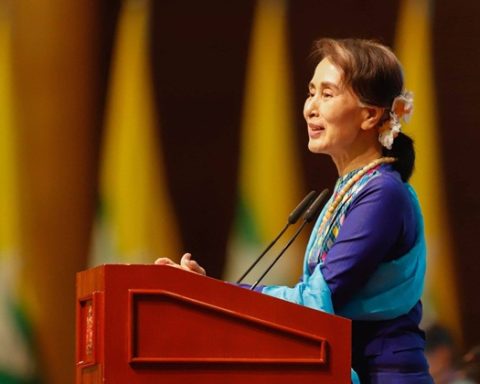
The 2024 China-Europe Seminar on Human Rights kicks off in the Berlin Marriott Hotel on Tuesday.
The topic of the meeting, where views from China and Europe were shared, focused on the protection of new and emerging rights. Subjects such as social rights and economic inequality, the intersection of digital technologies and human rights, and sustainability — particularly balancing the rights of individuals, society, and nature — were discussed during the meeting.
This year’s meeting was hosted by the China Society for Human Rights Studies, based in Beijing, and Central South University, based in Changsha, the capital of Hunan province in Central China. Event organizers included Central South University’s Human Rights Center and the Berlin-based German and Chinese Culture Foundation (Stiftung Deutsche und Chinesische Kultur), with support from Germany’s University of Münster and the Paris-based International Institute of Philosophy.
Tang Yingxia, a professor from the Human Rights Research Center at Nankai University, shared her views on the “Reflection and Reconstruction of Climate Human Rights.” Climate change litigation, which has emerged at both international and domestic levels in recent years, seeks to address the risks and challenges of climate change through a human rights approach. This approach objectively reflects the slow pace of international climate change treaty negotiations and the dilemma of insufficient national will and action to combat climate change.
The concept of climate human rights carries dual attributes: political discourse and legal significance (jurisprudence). As political discourse, it seeks to establish a link between international human rights mechanisms and international climate change frameworks, encouraging governments to respond actively to climate change and promoting the recognition of environmental rights at the United Nations level. It has also provided a foundation for the development of legal frameworks for climate human rights in terms of political consensus and public opinion.
However, as a legal claim, climate human rights face challenges in areas such as locus standi, extraterritorial jurisdiction, and causality. To prevent the potential negative effects of over-expanding climate human rights — such as dilution, fragmentation, and abuse of rights — it is necessary to reconstruct the concept of climate human rights based on existing climate litigation and the evolution of environmental rights. This reconstruction should adhere to the principles of legitimacy and proportionality, and clarify the rights, obligations, and legal responsibilities involved in this legal relationship.
Alfred-Maurice de Zayas, former Independent Expert on the Promotion of a Democratic and Equitable International Order at the United Nations Human Rights Council, shared his views on “Peace as a Human Right: 25 Principles of International Order.”
Uwe Behrens, a German economist and international logistics expert, shared his insights: “During my activities as a logistics manager in China and India, I was able to witness poverty and the efforts to overcome it. While progress in India was very slow, or even stagnant, China made significant strides in overcoming poverty across the country. Ensuring that all members of society have access to secure food, clothing, housing, medical care, and social security is the most important human right. In the interest of this right, the collective rights of the group take priority over those of the individual. The Global North can and should learn from China’s experience on how poverty in the Global South can be overcome, how people can be guaranteed a life worth living in their homeland, and how economic migration can be reduced.”