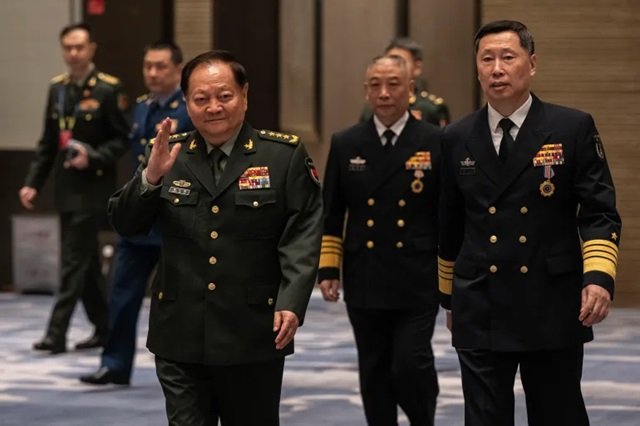
China has expelled two of its most senior military leaders from the Communist Party and the armed forces, accusing former Central Military Commission (CMC) vice-chairman Zhang Youxia and former CMC member Liu Zhenli of disloyalty, corruption and serious disciplinary violations.
The official announcement on Monday marks a major escalation in a continuing campaign against senior figures in the People’s Liberation Army (PLA). Zhang, who served as vice-chairman of the CMC, the supreme command body of China’s armed forces, was long regarded as one of President Xi Jinping’s closest military allies. Liu served as a CMC member and chief of staff of its Joint Staff Department.
Investigations into both men were announced in January, before they were removed from the state CMC in late August. Their formal expulsions were approved at a Politburo meeting chaired by Xi on Monday, according to state media. Their suspected criminal cases are to be handed over to military prosecutors for examination and prosecution in accordance with the law, Xinhua reported.
The allegations go beyond the corruption charges that have accompanied many previous investigations of senior PLA officers. Chinese authorities accused Zhang and Liu of being disloyal to the Communist Party, abandoning party principles, failing to enforce party discipline and neglecting supervision of staff and family members.
Xinhua, citing official documents, said the two men “seriously violated political discipline and political rules, formed cliques and factions, and were disloyal and dishonest to the party”. The agency said they had “crossed red lines and basic limits”, while their “political and economic wrongdoings were intertwined, and corrupt self-enrichment coexisted with dereliction of duty and abuse of office.”
According to the official account, the sums involved were “exceptionally large”, while the nature of their conduct was described as “extremely serious” and its impact “extremely egregious”.
The accusations of political disloyalty have drawn particular attention because of Zhang’s position and longstanding proximity to Xi. Dennis Wilder, a former CIA China analyst and senior fellow at Georgetown University, said corruption allegations against senior PLA officers were not unusual, but described accusations involving the formation of “cliques and factions” as unprecedented.
Wilder said the language recalled the political conflicts of the Mao era and, if substantiated, could indicate that Xi regarded the situation as a serious challenge to his authority and political position. He said the expulsions send “a sharp message to both the elders and the military about challenging Xi”.
Zhang’s removal is especially notable because he was also a member of the ruling Communist Party’s elite Politburo and one of the few senior Chinese military officers with combat experience. Joseph Torigian, an expert in Chinese politics at American University, noted the contrast between Zhang’s earlier portrayal by the party and military propaganda apparatus and his current position.
“What’s most remarkable about this particular moment is that in the 1980s Zhang Youxia was presented by the party and military propaganda apparatus as proof that yet another generation of young Chinese would prove loyal to the revolution,” Torigian said. “And now, Zhang is facing accusations of corruption and materialism that have brought down so many others of his cohort.”
The expulsions come against the backdrop of Xi’s sweeping campaign against corruption and disciplinary violations since he came to power in 2012. Millions of officials across China’s bureaucracy have been investigated to varying degrees, while numerous senior party, government and military figures have been removed.
The PLA has increasingly become a central target of the campaign, with successive investigations and expulsions leaving only two active figures on the formerly seven-member CMC, including Xi himself as chairman.
The timing of the announcement adds further significance. It comes days before Xi is due to travel to the US for talks with President Donald Trump and weeks before a key October party conclave focused on internal party governance and discipline, placing the latest military purge against the backdrop of both high-level international diplomacy and an important period of internal party scrutiny.