The United States, Japan and South Korea have jointly reaffirmed the importance of peace and stability across the Taiwan Strait, delivering a pointed message on Taiwan just days before a highly anticipated summit between US President Donald Trump and Chinese President Xi Jinping in Washington.
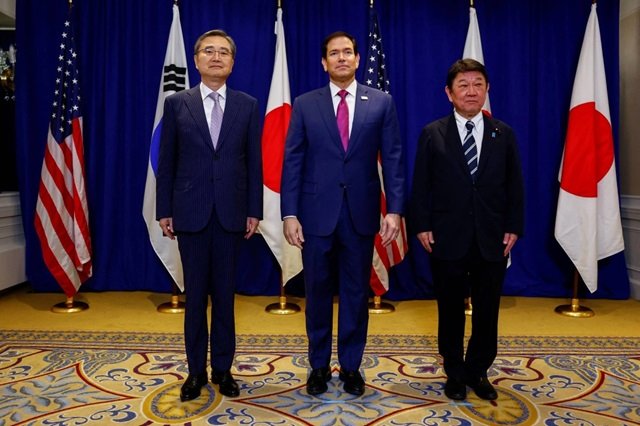
The three countries’ top diplomats made the statement following a trilateral meeting on the sidelines of the UN General Assembly on Monday. In a joint statement issued by Japanese Foreign Minister Toshimitsu Motegi, US Secretary of State Marco Rubio and South Korean Foreign Minister Cho Hyun, the ministers “emphasized the importance of maintaining peace and stability across the Taiwan Strait.”
Although China was not named directly, the statement called for the peaceful resolution of cross-Strait issues and opposed “any attempts to unilaterally change the status quo”. The three diplomats also expressed support for “Taiwan’s meaningful participation in appropriate international organizations”, signalling continued attention to Taiwan’s international role.
China claims Taiwan as its own and has vowed to bring the island under its control, by force if necessary. Beijing describes Taiwan as the “core of its core issues” and maintains that the matter is an internal affair in which other countries should not interfere. It regularly sends military ships and aircraft around the democratic island as part of efforts to pressure Taipei.
The joint position comes as Tokyo closely watches the direction of US-China relations. Japan is concerned that Trump, who has been noticeably more accommodating towards Xi, could reach a broader agreement with Beijing involving US economic concessions in exchange for Washington’s tacit acceptance of at least some Chinese positions on Taiwan.
Japanese Prime Minister Sanae Takaichi is scheduled to meet Trump on Tuesday in New York, with Sino-Japanese relations and Taiwan expected to feature prominently in their discussions.
The three countries also issued broader warnings on economic and strategic security. They reaffirmed support for freedom of navigation and overflight and pledged to stand firm “against economic coercion and nonmarket policies and practices” as well as “arbitrary export restrictions that disrupt supply chains”.
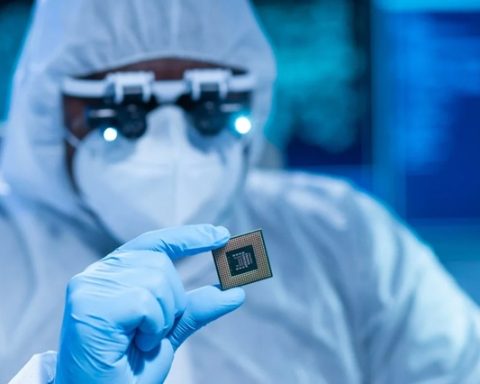
They also welcomed the launch of a new trilateral consultation mechanism on economic security, reflecting efforts to strengthen supply chains and expand cooperation in critical technologies, including semiconductors.
The statement comes amid already strained Sino-Japanese relations. Tensions increased following Takaichi’s remarks last November concerning the possibility of Japanese military intervention in a crisis involving Taiwan. Beijing subsequently imposed export controls on Japanese firms involving dual-use products, ostensibly in response to what it described as Japan’s “remilitarization”.
Against that backdrop, the coordinated statement from Washington, Tokyo and Seoul is likely to attract attention in Beijing as Xi prepares for his state visit to Washington and talks with Trump later this week. The timing places Taiwan, economic security and regional stability among the issues surrounding an increasingly consequential period in US-China relations.
The three diplomats also addressed the security situation on the Korean Peninsula, reaffirming their “resolute commitment to the complete denuclearization” of North Korea while maintaining that the path to dialogue “remains open” and calling on Pyongyang to return to talks.
Trump has previously expressed a desire to meet North Korean leader Kim Jong Un again, potentially as early as this year, after meeting him three times during his first White House stint. However, experts cited in the source material said reviving their previous relationship would be difficult.
North Korea meanwhile continues to demonstrate its military capabilities. On Sunday, it fired two ballistic missiles during a test of what it described as a “new-type weapon”. Experts said the system was likely a short-range weapon equipped with a hypersonic warhead capable of evading missile defence systems.
The trilateral meeting therefore brought together several of the region’s most sensitive security concerns, with Taiwan, economic coercion, critical technology, North Korea and the approaching Trump-Xi summit all forming part of a wider effort by Washington, Tokyo and Seoul to coordinate their positions on regional security.