Sometimes the European Union receives an opportunity without having to create it itself. This time, it has arrived in the person of Canadian Prime Minister Mark Carney, whose appearance before the European Parliament has opened the possibility of a much closer relationship between Canada and the EU. As Die Zeit reported in its account of the speech, the proposal comes at a moment when the pressure exerted by US President Donald Trump has pushed Canada towards Europe in ways that could have consequences far beyond trade.
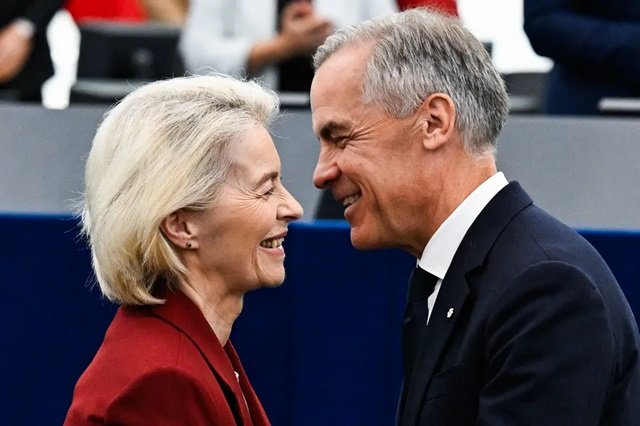
Carney’s appearance was itself a political spectacle. Scheduled to speak at 11.30 on Thursday, he took longer than expected to reach the lectern because of the number of hands he had to shake and the many parliamentarians seeking selfies with the prominent visitor. Terry Reintke, chairwoman of the Greens group, greeted him wearing the jersey of the Canadian national ice hockey team. It was an awkward detail, but also an unmistakable symbol of the political atmosphere surrounding the visit. Much of the Parliament appeared to be in the Canadian supporters’ corner, repeatedly interrupting Carney’s speech with loud applause.
Carney did not mention Trump by name. Yet the circumstances of his address were impossible to miss. His speech came after Trump had treated Canada as an adversary and threatened to annex its neighbour. Carney had resisted that pressure, responding to US tariffs imposed by Trump with counter-tariffs rather than accepting the demands coming from Washington.
Now, in the chamber of the European Parliament, the Canadian prime minister was offering Europe something considerably broader than a conventional commercial relationship. He described the resources and capabilities Canada could bring to a closer partnership, including gas, oil and rare earths, alongside services such as its highly developed banking system. He also outlined a vision in which Canadians and Europeans could move freely across the Atlantic without restrictions.
Yet Carney’s message was not simply a catalogue of Canadian commodities and economic advantages. His argument was about how Canada and Europe might protect their sovereignty in a rapidly changing international environment. “Die geopolitischen Umwälzungen”, he said, “sind ein brutaler Sturm. Ein einzelner Baum kann ihn nicht überleben, ein Wald wird ihn überstehen.” The metaphor was expansive, but his underlying message was direct: “Die Freiheiten müssen jeden Tag verteidigt werden.” In an international environment shaped by Trump, Vladimir Putin and Xi Jinping, the meaning of that warning required little explanation for his audience.
The question now is what the EU intends to do with the opening Carney has created. European Commission President Ursula von der Leyen had offered Canada an “assoziierte Mitgliedschaft” — an “associated membership” — the previous day. The phrase sounds ambitious, but its precise meaning remains unclear. The EU has full members, candidate countries and various forms of cooperation with third countries, but “associated membership” does not describe an established category with clearly defined rules and procedures. Carney, while remaining open to different possibilities, did not himself use the formulation.
That distinction matters because turning the phrase into a formal institutional arrangement could consume precisely what Carney says is most urgently needed: time. Defining the legal status, rules and criteria for an “associated member” would set a large body of European lawyers to work on unfamiliar territory. The process would be lengthy and its outcome uncertain. Carney’s message was the opposite: “Wir müssen sehr schnell auf unseren gegenseitigen Stärken aufbauen!”
A more immediate approach would be to identify concrete areas of cooperation rather than begin by attempting to construct an entirely new category of EU membership. Defence industries could be more closely integrated. Europe could establish arrangements for access to the rare earths it urgently needs, including guarantees and corresponding benefits for Canada. Such sector-by-sector agreements could potentially produce a practical partnership without waiting for the EU to define an entirely new institutional relationship.
The existing framework already demonstrates how difficult such negotiations can become. Under the Comprehensive Economic and Trade Agreement, CETA, between Canada and the EU, almost all industrial goods are already exempt from tariffs. But chicken meat and egg products, among others, remain completely excluded from tariff reductions. Whether those restrictions should change, and whether the relevant tariffs should be removed, would require further negotiation.
The difficulties are visible in CETA itself. The agreement was provisionally implemented in 2017, yet ten EU member states still have not finally ratified it, including France. If an existing trade agreement has remained politically unfinished for years, establishing a new and potentially far-reaching form of partnership between Canada and Europe would plainly require negotiations across individual areas of policy.
Above all of these questions hangs Trump. He has already issued severe threats should closer relations between Canada and Europe have “die Absicht, uns zu schaden” — the intention of harming the United States. That creates a fundamental complication for any European effort to deepen its relationship with Canada. Whatever institutional form the partnership takes, it is difficult to imagine an arrangement that Trump would necessarily regard as benign.
Carney has already faced that confrontation. His next challenge is whether Europe can translate the political momentum generated by his speech into practical cooperation. The opportunity before the EU is therefore not simply about creating a new label for Canada’s relationship with Europe. It is about deciding how quickly concrete interests — trade, resources, defence, services and movement across the Atlantic — can be converted into durable arrangements.
The historical significance of Carney’s intervention lies precisely in that opening. Canada is looking towards Europe at a moment when its relationship with the United States has become profoundly more difficult. Europe, meanwhile, has been presented with an unusually broad offer from a major democratic partner across the Atlantic. Whether that moment becomes a lasting partnership will depend less on the rhetoric of “associated membership” than on whether the EU and Canada can rapidly turn shared interests into workable agreements.