


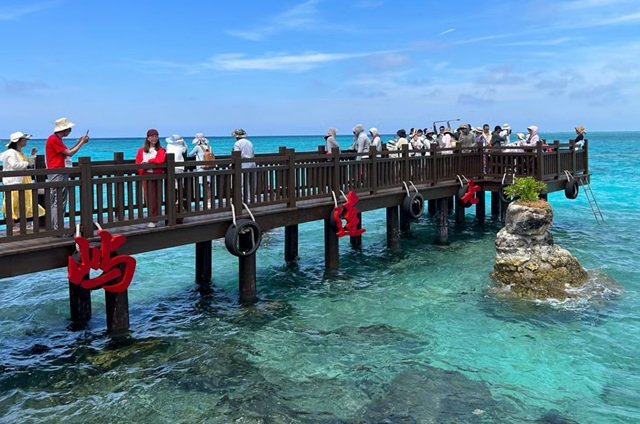
The contested islands of the South China Sea could one day become autonomous defensive strongholds, protected not primarily by soldiers but by coordinated fleets of machines operating across the air, sea and underwater domains.
That possibility is outlined in a defence proposal by the Chinese coastguard, which describes a system in which aerial drones, uncrewed surface vessels and underwater vehicles work alongside fixed nodes on islands and reefs. The proposal comes as the spread of low-cost drone warfare increasingly challenges traditional military assumptions about how naval and island defences should operate.
The plan was detailed in a paper published in July in Command Control & Simulation, a weapons industry and military technology journal supervised by the state-run China Shipbuilding Industry Corporation. Researchers from the China Coast Guard Academy’s ship command department and Dalian Maritime University’s Marine Electrical Engineering College developed the proposed framework.
“In view of the current complex situation in the surrounding sea areas and the practical challenges of low-cost unmanned platform clustering defence, this paper studies the feasible path of uncrewed system defence,” the researchers wrote.
Their proposal centres on collaboration between surface, aerial and underwater drones, combined with what they describe as “fixed nodes of islands and reefs”. The objective is to create a defensive network capable of continuing to function even when individual elements are damaged or communications are disrupted.
“The system can effectively improve perceptual redundancy, cross-domain coordination, rapid response and anti-destruction resilience under complex sea conditions, and provide theoretical reference and technical support for the safety maintenance of islands and reefs,” the paper said.
The researchers argue that the transformation of naval warfare is already visible in the battlefield experience of Ukraine. They point specifically to Kyiv’s development of the Magura V5 maritime strike drone, which they say demonstrates how relatively inexpensive uncrewed systems can challenge conventional fleets.
“Ukraine has built an asymmetric warfare force with uncrewed surface vessels such as the Magura V5 to strike the Russian fleet in a low-cost clustered manner. This has clearly exposed the vulnerability of traditional large manned ships to uncrewed cluster attacks,” they wrote.
For the researchers, the significance extends beyond individual drones. The central problem is the ability of large numbers of relatively inexpensive machines to overwhelm conventional defensive systems.
Real-world combat, they said, showed that under saturation swarm attacks, traditional “linear kill chains suffer from long response links and vulnerability at single points”. On islands and reefs, the problem can be compounded by geography. Narrow passages can restrict troop deployments, while physical features can create detection blind spots.
The paper therefore presents uncrewed systems as a way to address what the authors describe as weaknesses in conventional manned defences, particularly in early warning, cost-effectiveness and the sustainability of combat capability.
“Rapid global advances in uncrewed technologies provide the foundation to realise uncrewed confrontation and defence,” the team said, pointing to Chinese testing of surface, aerial and underwater drones in the northern part of the South China Sea in July last year.
The proposed system is based on Colonel John Boyd’s decision-making model of “observe, orient, decide and act”. Rather than preserving the traditional sequence as a single linear process, the researchers propose redistributing the functions across a network of autonomous systems.
The result, according to the paper, would be a “closed-loop defence mechanism for island-reef uncrewed systems”.
Under the proposed arrangement, the first stage would involve wide-area surveillance. Aerial drones would sweep broad sections of airspace for incoming threats, while uncrewed surface vehicles would monitor low-altitude blind spots. Underwater vehicles would simultaneously observe shallow channels and reef slopes.
Information collected from these different domains would then be merged during the “orient and decide” stages. Artificial intelligence chips installed on individual platforms would allow the systems to analyse local conditions. This would also provide a degree of operational independence if communications were limited.
The final stage would divide the defence of an island or reef into three spatial rings, with different types of uncrewed systems assigned to each.
In the outermost ring, reconnaissance-strike uncrewed aerial vehicles and high-speed surface drones would engage threats with missiles or torpedoes. The middle ring would employ electronic warfare conducted through uncrewed surface vehicles and aerial drones, with the purpose of disrupting an adversary’s decision-making.
Any threats penetrating to the inner ring would encounter close-in defences involving uncrewed surface vehicles, suicide drones and uncrewed underwater vehicles.
The concept is therefore not simply a proposal to deploy more drones. It envisages an integrated system in which machines observe, communicate, analyse and respond across different operational environments, while the loss of individual platforms would not necessarily collapse the overall defence.
The researchers nevertheless present the system as a developing technological pathway rather than a completed capability. They called for further testing of land, sea and air uncrewed swarm collaboration in real marine environments, as well as advances in cross-domain communication, AI decision-making and energy security.
They also called to “deepen military-civilian integration to protect sovereignty and counter uncrewed threats with uncrewed capabilities”.
The proposal comes against the backdrop of a South China Sea increasingly shaped by competing military and technological requirements. Its significance lies not only in the individual weapons described, but in the underlying shift towards defensive systems designed around networks of autonomous machines.
For contested islands and reefs, the paper proposes replacing the vulnerabilities of concentrated human and conventional military deployments with a dispersed web of sensors, platforms and automated decision-making. In that conception, an island would cease to be merely a physical position defended by personnel and become a node within a wider robotic system.
The proposal illustrates how the proliferation of uncrewed technology is forcing military planners to reconsider the basic architecture of defence. The researchers’ central argument is that the next stage of island warfare may depend less on the number of soldiers stationed on a reef than on whether a network of machines can detect, decide and respond quickly enough to survive an attack.
For China’s coastguard researchers, the answer lies in turning the islands and reefs themselves into components of an autonomous, multi-domain defence network.









