A Chinese military publication has revealed bold claims about the country’s next-generation fighter jet, suggesting it could dramatically shift the balance of airpower in a potential conflict over Taiwan. The Shipborne Weapons magazine, affiliated with the state-owned China Shipbuilding Industry Corporation, reported that China’s developing sixth-generation stealth fighter—unofficially dubbed the J-36—could block access to airspace up to 1,000 kilometers from its shores, including near the U.S. base in Guam.
According to the article, the J-36 is designed specifically to address the People’s Liberation Army’s (PLA) vulnerabilities against the U.S. Air Force’s B-21 Raider stealth bomber. The report claims that the Chinese jet could conduct airspace blockades lasting up to two hours, intercept U.S. aircraft attempting to enter the first island chain, and suppress long-range air defense systems from a distance.
“This will make it difficult for the U.S. Navy and Air Force to maintain air superiority over the western Pacific and to intervene militarily in a series of operations by the Chinese military within the first island chain,” the March edition of the magazine stated.
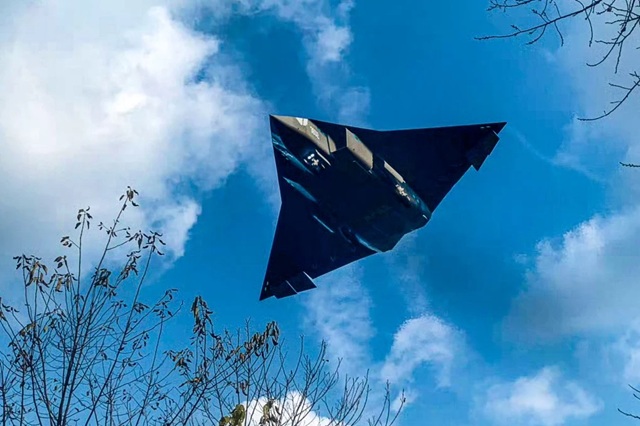
The J-36’s unique ginkgo leaf-shaped design reportedly includes a three-engine configuration for extended range and speed, side-by-side seating for enhanced drone control, and significant power generation for advanced electronic warfare systems. The article suggests that the aircraft could become operational by 2030 and potentially be the first sixth-generation fighter deployed worldwide.
Meanwhile, the United States is also advancing its sixth-generation aircraft. The U.S. Air Force announced the F-47 sixth-generation fighter in March, though details remain limited. The B-21 Raider, developed by Northrop Grumman, had its maiden flight in late 2023 and is touted as the world’s first sixth-generation bomber. With a range of 8,000 km, high stealth capabilities, and drone integration, the B-21 is considered a major strategic asset in the Indo-Pacific theater.
The Chinese article expressed concern that even China’s current fifth-generation J-20 stealth fighter could not match the B-21’s capabilities. Limitations in range, stealth, weapon load, and situational awareness were cited as critical gaps.
The report underscores that in a Taiwan scenario, the key battleground for air superiority would be approximately 1,000 kilometers from the Chinese coast—an area where U.S. bombers and strike forces could potentially operate with relative impunity unless challenged by a next-gen Chinese aircraft.
Repeated sightings of a new stealth aircraft undergoing test flights near Chengdu, where the Chengdu Aircraft Industry Corporation is based, suggest rapid progress in development. Analysts say this could be the J-36 moving closer to prototype or pre-production stages.
If the J-36 fulfills its projected capabilities, it could alter strategic calculations in the Asia-Pacific region and raise questions about the future of U.S. military deterrence in the area. The article concluded by suggesting that the aircraft may force external powers to reconsider the feasibility of military intervention near China’s borders in the coming decade.