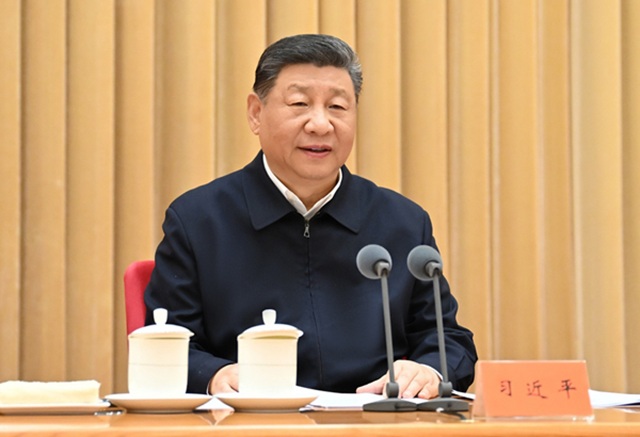
The Chinese Central Conference on Work Relating to Foreign Affairs was held in Beijing from Wednesday to Thursday. Xi Jinping, General Secretary of the Central Committee of the Communist Party of China, President of China, and Chairman of the Central Military Commission, delivered an important speech at the conference.
The Chinese leader systematically reviewed the historic achievements and valuable experiences of China’s diplomacy with Chinese characteristics in the new era. He elaborated on the international environment and historical mission of China’s foreign affairs work, and laid out comprehensive plans for both current and future diplomatic efforts.
The conference proposed building a world of lasting peace, universal security, common prosperity, openness and inclusiveness, and a clean and beautiful environment.
It was also noted that, in this new era of Chinese diplomacy, a wealth of valuable experience has been accumulated. On major issues concerning the future of humanity and the direction of the world, China must adopt a clear and firm position, uphold the international moral high ground, and unite and rally the overwhelming majority of countries and peoples, according to the meeting.
The conference further stated that China must advocate the spirit of independence, promote peaceful development, and contribute to global stability and prosperity.
It emphasised the importance of adhering to the fine traditions and fundamental direction of China’s diplomacy, while also striving for innovation in both theory and practice. It called for the rejection of all acts of power politics and bullying, and for a vigorous defence of national interests and dignity.
It was highlighted that, on this new journey, diplomacy with Chinese characteristics will enter a new stage in which much more can be accomplished.
The conference urged a stronger focus on the central tasks of the Communist Party of China and the country, seeking progress while maintaining stability, breaking new ground while upholding core principles, and firmly safeguarding China’s sovereignty, security, and development interests.
The meeting stressed that China will explore new frontiers in its diplomatic theory and practice, foster new dynamics in China’s international relations, and elevate the nation’s international influence, appeal, and ability to shape global events.
China aims to create a more favourable international environment and provide more robust strategic support for building itself into a great modern socialist country in all respects. This is part of the broader objective of advancing the great rejuvenation of the Chinese nation through the Chinese path to modernisation, according to the meeting.
It was also emphasised that building a community with a shared future for mankind is the core tenet of Xi Jinping Thought on Diplomacy. This concept provides China’s answer to the questions of what kind of world to build and how to build it, based on a deepening understanding of the laws governing the development of human society.
This notion reflects the worldview, perception of order, and values of the Chinese Communist Party, aligns with the common aspirations of people in all countries, and charts a direction for the progress of global civilisations.
Promoting an Equal Multipolar World
As part of building a community with a shared future for mankind, the goal is to construct an open, inclusive, clean, and beautiful world of lasting peace, universal security, and shared prosperity. The pathway involves promoting global governance based on extensive consultation, joint contribution, and shared benefit. The guiding principle is the application of common human values, with the foundational basis being the development of a new type of international relations. Strategic guidance is provided through the implementation of the Global Development Initiative, the Global Security Initiative, and the Global Civilization Initiative, with high-quality Belt and Road cooperation serving as the main platform for action.
The conference noted that, in light of the many major challenges facing the world today, China advocates for an equal and orderly multipolar world and a universally beneficial, inclusive economic globalisation.
To ensure that the movement towards greater multipolarity remains stable and constructive, the purposes and principles of the United Nations Charter must be upheld by all nations. Universally recognised norms governing international relations must be respected, and true multilateralism must be practised.
It is important to resolutely oppose any attempts to reverse globalisation or misuse the concept of security, as well as to reject all forms of unilateralism and protectionism. The meeting affirmed China’s commitment to promoting the liberalisation and facilitation of trade and investment, addressing structural challenges hindering the healthy development of the global economy, and advancing economic globalisation that is more open, inclusive, balanced, and beneficial to all.
The meeting concluded that China’s external work must be guided by principles of self-confidence and self-reliance, openness and inclusiveness, fairness and justice, and win-win cooperation.
Focusing on the central theme of building a community with a shared future for mankind, China must strengthen strategic planning in step with the changing times, enhance and optimise its diplomatic framework, adopt a problem-oriented approach, and apply a systematic mode of thinking, the meeting concluded.