Colombia has yet to activate international rescue assistance offered by several countries following Monday’s devastating earthquake, with the newly installed government of President Abelardo de la Espriella declining or delaying requests for foreign personnel despite mounting offers of support.
The decision has left most international assistance in limbo at a moment when rescue operations remain critical. No international rescue teams have so far been seen on the ground, while offers from governments and the United Nations have yet to translate into deployments, with the notable exception of the United States.
One of the earliest warnings about difficulties in coordinating international assistance came from China’s ambassador to Bogotá, Zhu Jingyang. China has been among the countries with which De la Espriella has marked political distance as he places Washington at the centre of his foreign policy. On Tuesday, Zhu urged the Colombian government to immediately identify an official responsible for coordinating international assistance.
“We hope that the Colombian government will immediately announce the name of the official and his official liaison to coordinate international assistance, for the benefit of those affected by the earthquake,” Zhu wrote, adding an urgent appeal for the message to be circulated.
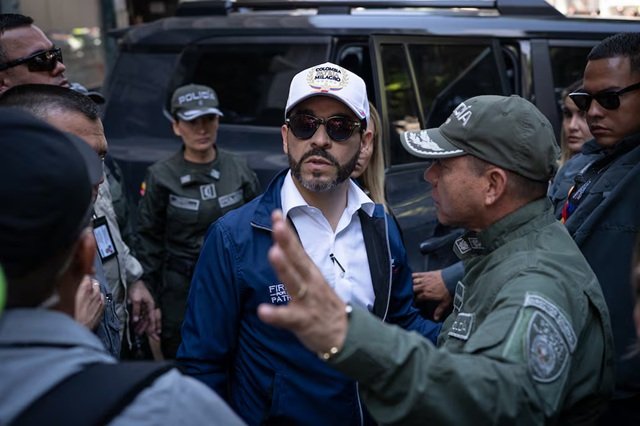
Soon afterwards, El Salvador’s President Nayib Bukele confirmed that Colombia had declined offers of personnel assistance. Bukele said the Colombian government had requested humanitarian aid only in the form of supplies for families affected by the earthquake. Colombian authorities had told El Salvador that rescue teams, medical personnel and other emergency services were already deployed and that additional personnel were therefore not required.
El Salvador will consequently send two cargo aircraft carrying 100 tonnes of humanitarian assistance, Bukele said, while leaving open the possibility of providing other forms of support if Colombia requests them.
Mexico has similarly prepared assistance but is awaiting formal approval from Bogotá. President Claudia Sheinbaum said a package of humanitarian aid and a specialised Mexican team experienced in earthquake rescues was ready to be sent to the areas hardest hit by the 7.4-magnitude earthquake. The disaster has left more than 200 people dead across cities including Cali, Pereira, Manizales and Quibdó, where rescue workers continue searching through rubble for survivors.
Sheinbaum said Mexico was waiting for a formal request from the Colombian government before deploying the operation. Chilean President José Antonio Kast has made a similar offer. Other governments have also expressed their willingness to help, including those of Argentina, Ecuador, Brazil and Spain. Their leaders include Javier Milei, Daniel Noboa, Luiz Inácio Lula da Silva and Pedro Sánchez. While some are politically aligned with De la Espriella and others are not, none of these offers has been publicly accepted beyond expressions of gratitude.
The most significant exception has been the United States, which announced $15.5 million in assistance for emergency shelter, food, protection and assessments of earthquake damage. The US Department of State also said it activated a Disaster Assistance Response Team, or DART, on Monday to support critical operations, programming and overall coordination of the Colombian government’s response.
The United Nations has also said it is prepared to assist as required. Colombia issued a diplomatic note on Tuesday requesting international support to complement its response, although the measure does not formally constitute an international appeal. The government appears to be distinguishing between immediate rescue assistance and supplies intended for medium- and long-term relief. UN Secretary-General António Guterres said the organisation remained in close contact with Colombian authorities and was supporting the government-led response as requested.
The difficulties have been compounded by an incomplete transition within the new administration. De la Espriella had not yet appointed the heads of some key disaster-response bodies, although he had indicated that geologist David Suárez Tamayo would be appointed director of the National Unit for Disaster Risk Management, or UNGRD, on Tuesday.
The situation was further complicated by the breakdown of the traditional handover process with the previous government of left-wing President Gustavo Petro. Under the existing system, the UNGRD is expected to determine when national capacities have been exhausted before requesting international assistance in coordination with the Foreign Ministry.
Sandra Borda, an international relations scholar, said the mechanism was legally complex and highly centralised, requiring the national government to establish needs and transmit requests through the Foreign Ministry. Drawing on her experience dealing with a crisis caused by forest fires in Bogotá, Borda said the government was “learning on the march” how the mechanism operates. For cities, she added, the process is even more difficult because international assistance can only be channelled through the national government.