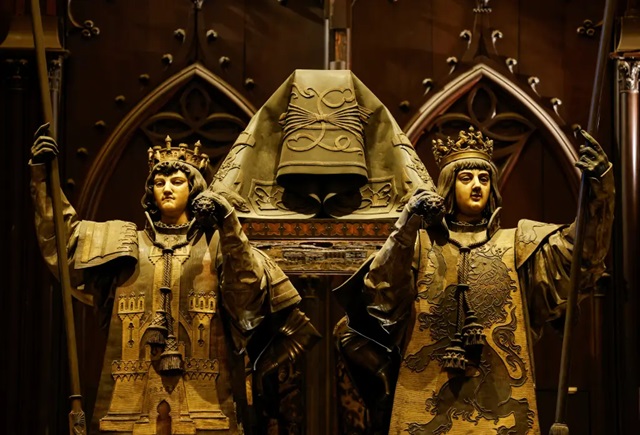
Recent revelations regarding Christopher Columbus’s heritage—suggesting that he may have been a Sephardic Jew from Spain rather than an Italian Catholic—have reignited debates about his legacy and the historical narratives surrounding his expeditions. A new genetic study has not only challenged the established beliefs about Columbus’s origins but also prompted a reconsideration of the broader implications of his voyages on Indigenous populations in the Americas.
For centuries, Columbus has been portrayed as a heroic explorer, credited with “discovering” America in 1492. This narrative, however, has been increasingly scrutinised and contested. While his voyages undoubtedly opened the door for European exploration and colonisation, they also marked the beginning of a dark chapter in history for Indigenous peoples. Reports from the time depict Columbus as a figure whose actions led to the enslavement, violence, and exploitation of native populations. Historical accounts document horrifying practices such as mutilating natives on Hispaniola for failing to meet gold quotas and facilitating the sexual exploitation of young girls as young as nine or ten. Such atrocities demand a critical examination of how history remembers and commemorates Columbus.
The genetic study, conducted over nearly two decades by Spanish scientists, suggests that Columbus concealed his Jewish identity. Traditional theories have labelled him an Italian, claiming he was born in Genoa in 1451. However, the latest research proposes that he was likely born in Valencia, Spain, and that he either converted to Catholicism or hid his Jewish heritage to escape the Inquisition that persecuted Jews in Spain. This revelation is significant for several reasons. It challenges the simplistic understanding of Columbus’s identity, illustrating how personal backgrounds can be obscured in the pursuit of power and acceptance. Furthermore, it prompts us to consider the historical context of religious persecution in Europe, which forced many to hide their identities to survive. For instance, in 1492, the same year Columbus embarked on his first voyage, the Catholic monarchs Isabella and Ferdinand ordered the expulsion of Jews from Spain, marking a turning point in the nation’s treatment of its Jewish population.
The implications of this genetic discovery resonate deeply within the ongoing debate over Columbus’s legacy. Many scholars and activists argue that the traditional celebration of Columbus Day fails to account for the suffering inflicted upon Indigenous peoples. In the United States, this federal holiday, celebrated on the second Monday of October, has been met with increasing opposition. The call for a shift to Indigenous Peoples’ Day reflects a broader societal movement toward recognising the impact of colonialism and honouring the voices of those who have been marginalised. This shift is not merely about changing a name; it is about confronting uncomfortable truths about history and acknowledging the diverse experiences of those affected by European expansion.
Critics of Columbus have long argued that the narrative of his “discovery” is a misrepresentation of history. The term “discovery” implies a sense of ownership over land that was already inhabited by Indigenous peoples with rich cultures and histories. The arrival of Columbus marked the beginning of a violent and exploitative relationship between European colonisers and native populations. As new perspectives emerge, there is a growing recognition that history should not glorify figures like Columbus without acknowledging the consequences of their actions.
Columbus’s legacy is entwined with the tragic fate of Indigenous peoples. According to some estimates, the population of Indigenous peoples in the Americas decreased by as much as 90% following European contact, primarily due to the spread of diseases like smallpox and the violent conflicts that ensued. Columbus’s expeditions ushered in a new era of exploration that led to the establishment of European settlements, often accompanied by bloodshed and forced labour. Reports from the time detail horrific practices, such as the brutal treatment of Taino people on Hispaniola, where Columbus’s men cut off the hands of natives for failing to provide gold, a resource he had hoped to exploit.
In light of these discussions, it is essential to consider the perspectives of Indigenous peoples themselves. The impacts of colonisation have been profound, leading to the loss of land, culture, and lives. Many Indigenous communities continue to grapple with the legacies of colonialism, facing social, economic, and political challenges rooted in the historical injustices perpetrated during Columbus’s time. Recognising Indigenous voices and experiences is crucial to understanding the full scope of history and moving toward a more equitable society. For example, many Native American tribes and Indigenous organisations actively work to reclaim their histories and promote their narratives, fostering a more inclusive understanding of the past.
The findings about Columbus’s Jewish heritage also evoke discussions about identity and belonging. For centuries, individuals have hidden their true identities to escape persecution, a theme that resonates throughout history. The possibility that Columbus concealed his Jewish identity invites us to reflect on the broader implications of identity in the context of colonialism and exploration. It highlights the complexity of human experience and the ways in which personal and collective identities can intersect and influence historical narratives. The word Sephardic itself derives from “Sefarad,” which means “Spain” in Hebrew, illustrating the intricate relationship between Jewish identity and the Spanish landscape.
Moreover, the new genetic research underscores the importance of using modern technology to investigate historical figures. Advances in forensic science have allowed researchers to uncover details that were previously obscured, enabling a more nuanced understanding of the past. The study, which began in 2003 with the exhumation of Columbus’s remains from Seville Cathedral, is a testament to how science can illuminate historical mysteries. However, while genetic testing provides valuable insights, it should be approached with caution. History is not solely defined by genetics; cultural, social, and political contexts play pivotal roles in shaping identities and legacies. As we learn more about historical figures through genetic studies, it is essential to integrate these findings with a comprehensive understanding of the broader historical context.
The debate surrounding Columbus’s legacy is not without its complexities. While many advocate for renaming Columbus Day in favour of Indigenous Peoples’ Day, others, particularly within Italian-American communities, argue for the preservation of Columbus’s legacy as a symbol of their heritage. They assert that his explorations laid the groundwork for the settlement of the Americas by Europeans. This perspective highlights the intersection of identity and nationalism, demonstrating how history can be appropriated to serve various narratives. In 1937, Columbus Day was officially declared a national holiday in the United States, partially as a way to honour Italian-American contributions to the nation, which complicates discussions about the appropriateness of celebrating a figure whose actions resulted in profound suffering.
However, the challenge lies in finding a balance between honouring cultural heritage and acknowledging historical injustices. The celebration of Columbus must be scrutinised in light of the violence and suffering his actions caused. As societies evolve, it is crucial to engage in conversations that challenge dominant narratives and consider the perspectives of those who have historically been silenced. For instance, movements such as “Decolonize This Place” actively advocate for the reclamation of public spaces and monuments associated with colonial figures, fostering a more inclusive dialogue about history and its implications.
One of the key factors driving the re-evaluation of Columbus’s legacy is the growing awareness of social justice issues and the need for equity in historical representation. Movements advocating for racial and social justice have illuminated the importance of acknowledging the impact of colonialism on contemporary society. The ongoing struggle for Indigenous rights and recognition further emphasises the need for a critical examination of historical figures like Columbus. In 2020, a survey indicated that 55% of Americans believed that Columbus should be celebrated as a national holiday, while 44% felt that the day should instead honour Indigenous peoples, reflecting the deeply divided opinions on this issue.
As discussions continue about the implications of Columbus’s heritage and legacy, it is vital to engage in constructive dialogue that fosters understanding and empathy. Rather than dismissing differing perspectives, society should strive to create spaces for meaningful conversations about history and its impact on various communities. Education plays a crucial role in this process, as it can equip individuals with the knowledge needed to critically analyse historical narratives and their relevance today. Teaching about the complexities of Columbus’s expeditions and their consequences can help foster a more informed and empathetic society, one that recognises the multifaceted nature of history.