


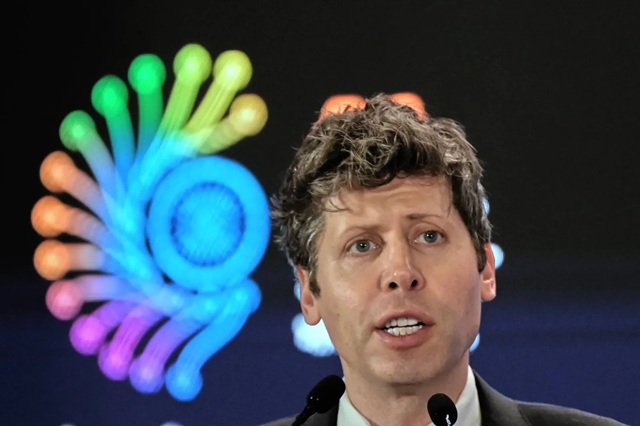
Soon after the AI Impact Summit in Delhi, Sam Altman of the OpenAI sat down with a journalist from the Indian Express for a conversation that spanned the past, present, and future of artificial intelligence. The discussion was at once candid, wide-ranging, and occasionally startling, touching on geopolitics, education, human creativity, environmental concerns, and the very structure of global power. From the outset, Altman did not mince words, framing the stakes of AI in stark terms: “You can totally imagine a world where AI massively concentrates power, where say a single company or country is able to hold on to AI and use that to amass a gigantic amount of power and wealth in the world.” The sentence hung in the air like a warning, conjuring a dystopia in which artificial intelligence becomes the ultimate tool for dominance. Yet he immediately tempered the pessimism with a vision of democratization, emphasizing the potential for distributed power: “I personally think something way more towards the democratized version of that is good. We of course will need some regulation. We of course will need some guardrails. But I think putting this technology in the hands of lots of people is possible.”
Altman illustrated this principle with the rapid emergence of small AI startups, noting how quickly the landscape had shifted: “The clearest example of this you can see…is in the last six and especially three months the power that a one or two or three person company can have. This just didn’t happen a few years ago. It was impossible. In this new world of things like codecs and general purpose knowledge working agents, we’re going to have to get used very quickly to one person startups that have enormous amounts of success or two person, three person startups. And I think this is great.” He envisioned a world where economic power could be more decentralized than ever before, where innovation could emerge from anyone with a bold idea and the technical ability to execute it, rather than solely from entrenched corporate giants.
The discussion quickly turned to the nature of competition in AI. Altman acknowledged the commercial rivalry but highlighted the interconnectedness of the AI ecosystem: “It is definitely competitive, but I will say that it’s also very incestuous. I mean, you guys, because all you know, a lot of people were building out stuff or working with you at one point and everybody knows everybody.” In this small, intensely networked world, he explained, even competitors often collaborate on matters of safety and alignment: “Almost all of the efforts that have a very advanced model…they’re very committed to getting safety and alignment right and willing to cooperate there.” He praised Google’s resurgence as a powerful example of focus and execution, recalling that “the first thing I admire about Google is Demis and the Google team started working on AI before anyone else in the modern era with a lot of conviction…without their inspiration we certainly wouldn’t be here. A second thing more recently is their relentless focus and execution and ability to really scale the model after being pretty far behind is quite impressive.”
Regulation, Altman insisted, would be a balancing act. While he emphasized the need for guardrails, he also welcomed experimentation by different countries: “Countries are trying different approaches and I think this is a good thing about many sovereign powers in the world…we will get to observe over the next few years very different approaches and see what works and what doesn’t…and very quickly I believe the world will move towards more of what works.” He drew a line between real dangers and exaggerated fears, particularly regarding the concentration of AI power: “Fair, unless we push super hard to democratize and I think everyone in the world needs to hold countries and companies to this threshold…you don’t get to say concentration of power in the name of safety. We don’t want that trade; it’s got to be democratized.”
Environmental concerns, often cited as a critique of AI, also came under scrutiny. Altman was blunt in debunking exaggerated claims: “Water is totally fake…This is completely untrue. Totally insane,” he said, referring to myths about AI data centers consuming vast amounts of water. Yet he acknowledged the real energy footprint of AI: “We need to move towards nuclear or wind and solar very quickly…probably AI has already caught up on an energy efficiency basis.” He made a striking comparison to human learning, noting that the energy required to train a single human mind over decades far exceeds the computational energy consumed by AI models once trained. The goal, he argued, is not to demonize AI but to harness it responsibly while transitioning to sustainable energy.
The conversation turned to AI’s impact on children and education, a topic that elicited both concern and optimism. Altman admitted that for some students, AI might act as a shortcut: “True for some kids…there are definitely some kids who are like, ‘This is great. I cheated my way through all of high school. I never did any homework. Thank you.’” Yet, he emphasized that most young people are discovering the creative and productive potential of these tools: “Most kids say, I can’t believe what I can accomplish now. Look at this thing I’ve just made. I’ve built these incredible new workflows…we will need to find new ways to teach and evaluate in school to make sure every kid is brought along.” He drew a parallel to the early days of Google’s influence on education: “When I was in school, Google had just come out…my middle school teacher was like, ‘This is the worst thing ever. Why do you have to memorize the date that someone in history was born if you can just look it up on Google?’ And I said, I think it’s a complete waste of time to memorize what year someone was born. I will just go look that up on Google if I ever need to know it again.” His point was clear: new tools disrupt old paradigms, but they also expand possibilities for learning and creativity.
Geopolitics, naturally, was a recurring theme. Altman carefully distinguished between real and imagined fears surrounding Chinese dominance in AI: “The imagined fear is…the Chinese military is going to send a billion humanoid robots marching through the streets and overpower the US army…The real fear is a new kind of war between nations that gets fought over the internet where you influence people and hack into a bunch of critical infrastructure and that feels totally possible.” He expressed concern about the misuse of AI as justification for surveillance states: “Increasingly so, people are using fear of AI going wrong to justify a surveillance state and I don’t think that people doing that have fully thought through the downsides of the surveillance state.” Yet despite these global risks, his prescription remained consistent: democratize AI. “I would say the same thing to everyone, which is you got to democratize this technology and put it in the hands of people,” he said, noting that this advice applies to heads of state as much as it does to private companies.
Turning inward, Altman spoke candidly about OpenAI’s strategic evolution, particularly the shift from a nonprofit to a capped-profit structure. “The need to democratize AI and the need to stay at the forefront of research…both of those require huge amounts of capital,” he explained. Despite the change in structure, he emphasized that OpenAI remains research-first: “The coolest thing about AI…is that the great majority of making a good product is doing good research. We make a great model, the product is already pretty good. The early version of ChatGPT was almost no product at all. It was like a text box that fed into a model and then put the output on the screen.” When reflecting on personal criticisms, he acknowledged that most have little effect on him, but some strike a chord: “At some point none of them bother you because they’ve gotten so insane, so detached from truth. I guess the one that makes me the most sad is that, ‘He’s just doing it for the power. He doesn’t really care about trying to do something that’s going to be helpful to the world.’”
The conversation shifted to the future of work, creativity, and human relevance in an AI-dominated landscape. Altman rejected the idea that AI would render humans passive, particularly for creators: “Watching what creators are doing…where they can use these tools to help have a quicker, tighter iteration loop from idea to feedback to idea to feedback…we’ll get better stuff. We’ll get more creative podcasts, better writing, better images. I don’t think humans will become too passive.” He predicted disruption in many traditional professions, citing his own background in software engineering: “The way I learned to write software is now effectively completely irrelevant…writing C++ code by hand, that’s over.” Yet he was quick to underscore the irreplaceable human touch in fields where empathy, care, and personal judgment matter: “I really cared about the nurse that was taking care of me. If that were like a robot, I think I would have been pretty unhappy no matter how smart the robot was.”
Altman also reflected on the limitations of current computing interfaces and the opportunities AI presents for reimagining human-computer interaction. “AI is stuck in that same form factor…AI, you can now talk to a computer in natural language and it can do incredibly complex things for you…it can understand a huge amount of context and the form factor of computers does not quite work for this. We may fail at this. This is very hard. But I think we have a chance to make a new kind of products, a new family of products that were really designed around AI that are kind of participating in your life and not in the way of it.” He promised that more concrete details about these innovations would emerge later in the year, hinting at the transformative potential of AI-integrated devices.
Safety and responsibility remained central to his vision. “Sometimes we overdo it, sometimes we’re too conservative…there is a tension between democratizing AI and enough safety. But our principle of starting conservative and then broadening access has served us well and we plan to continue to do that.” On talent and team dynamics, he predicted a shift in the research landscape: “As AI does more and more of research and engineering, I suspect teams will do much more with smaller amounts of people. And so you’ll have small teams in research labs doing a huge amount of work.”
Altman touched on timelines for advanced AI, including AGI and superintelligence. He argued that while AGI feels near, the rapid acceleration of capabilities means the takeoff toward superintelligence could be faster than anticipated: “If you had asked most people six years ago…what would you think if we had systems that could do new research on their own…you could have one system that could act as an AI doctor, lawyer, a computer scientist…that sounds pretty general and pretty intelligent. We get used to it…given what I now expect to be a faster takeoff, I think super intelligence is not that far off.”
Throughout the interview, Altman repeatedly returned to the human dimension of technological progress. He highlighted the enduring importance of relationships, empathy, and connection in a world of abundance created by AI: “There will be some people who will like fall in love with an AI…but for almost everyone…human connection, human attention, human warmth will be one of the most valuable commodities and we…I bet we will care much more about that in a world with AI.” His advice to global leaders was consistent and simple: “You got to democratize this technology and put it in the hands of people.”
He also addressed the challenges and opportunities for creators. When asked whether AI could make humans passive, he insisted that it would instead accelerate creative cycles: “Watching what creators are doing…we’ll get better stuff. We’ll get more creative podcasts, better writing, better images.” At the same time, he acknowledged the real disruptions AI will bring to many professions, from traditional software engineering to other knowledge work: “A lot of professions will almost go away…writing C++ code by hand, that’s over.” But human empathy, judgment, and craft remain irreplaceable: “I really cared about the nurse that was taking care of me. If that were like a robot, I think I would have been pretty unhappy no matter how smart the robot was.”
Throughout the nearly three-hour conversation, Altman was unflinchingly honest about the opportunities, risks, and responsibilities inherent in the rise of AI. He praised Google’s resurgence, reflected on the importance of responsible innovation, offered guidance for heads of state, and envisioned a future in which AI could both amplify human creativity and democratize power in unprecedented ways. From the potential for one- or two-person startups to reshape industries to the need for sustainable energy solutions and regulatory experimentation, Altman’s perspective combined bold optimism with a grounded sense of urgency. As the conversation drew to a close, it was clear that for Altman, the story of AI is not just about technology—it is about the future of society, work, creativity, and human connection. “The coolest thing about AI,” he said, “is that the great majority of making a good product is doing good research…we make a great model, the product is already pretty good.”
The decisions made today about democratization, safety, and governance will define the next era of human and technological development. Altman’s message was both clear and urgent: AI is a tool of immense power, capable of concentrating wealth and influence or spreading opportunity and creativity—but only if guided wisely. “You can totally imagine a world where AI massively concentrates power…or you can imagine a world where everybody on Earth has a super intelligence with no rules whatsoever…we will need some regulation…but putting this technology in the hands of lots of people is possible.” In his vision, the future of AI is inseparable from the future of humanity, and the responsibility lies with those who build, govern, and use it.










