by Luxman Aravind
Politics is war by other means, and war thrives on enemies. Sri Lanka’s history since the introduction of the Executive Presidency is a brutal evidence to this truth. Leaders who have ruled without a clear adversary have inevitably collapsed under the weight of their own complacency, arrogance, or internal betrayal. Those who thrived, manipulated the emotions of a politically unsophisticated yet sentimentally charged electorate by crafting powerful narratives of conflict. Governing without an enemy is not merely a political failure—it is an invitation to doom.
This dynamic is not unique to Sri Lanka. History is rife with examples of leaders who understood the necessity of enemies. The Roman Empire thrived when external threats, such as Carthage or barbarian tribes, rallied its people under the banner of imperial unity. But when Rome’s external enemies were subdued, internal factions and rivalries ripped the empire apart. Leaders struggled to maintain control as the lack of a common enemy exposed underlying weaknesses. Julius Caesar himself rose to power in part by manipulating the Senate’s fear of external foes, only to be betrayed by those closest to him when his internal enemies grew too powerful.
Centuries later, Napoleon Bonaparte followed a similar trajectory. He ascended to prominence by positioning himself as France’s saviour against external threats, from Austria to Britain. His genius lay not just in battlefield strategy but in fostering the perception that France’s survival depended on his leadership. But when his enemies were crushed or neutralised, Napoleon’s regime faltered. Without a unifying external threat, internal dissent grew, culminating in his eventual exile and the undoing of his empire. The lesson is clear: without an enemy, even the most formidable leaders fall prey to division and collapse.
In modern times, the Cold War exemplifies the power of enemies in shaping governance. The United States and the Soviet Union built entire political systems around opposition to each other. Their military, economic, and cultural policies were defined by the need to outmanoeuvre their rival. When the Soviet Union collapsed in 1991, the United States faced a new challenge: the lack of a clear adversary. Without the Soviet threat, American politics became increasingly polarised, as internal divisions—racial tensions, economic inequality, and ideological rifts—took centre stage. The ‘enemy within’ proved harder to manage than the ideological war against communism. The end result: Trump 2.0. Americans are set to stage some very interesting drama over the next four years, following the disastrous failure of the Biden administration.
Sri Lanka offers a microcosm of this broader truth, where the presence or absence of enemies has repeatedly defined the rise and fall of leaders. When J.R. Jayewardene introduced the Executive Presidency in 1978, he did so with a Machiavellian understanding of political necessity. Jayewardene’s tenure was marked by a shrewd exploitation of external and internal conflicts. The rise of Tamil militancy in the North, the JVP insurgency in the South, and the interventionist tendencies of India provided him with a trifecta of adversaries to navigate. These enemies allowed him to consolidate power, present himself as the defender of Sri Lanka’s sovereignty, and maintain his grip on the Sinhalese majority. Jayewardene was no unifying statesman; he was a master manipulator who thrived on division.
R. Premadasa inherited a country defined by these adversarial dynamics and used them to his advantage. The LTTE in the North, the remnants of the Indian Peacekeeping Force, and the JVP insurgency provided him with a chaotic but effective backdrop for governance. Premadasa’s ruthlessness was legendary. He not only fought these enemies but also attempted to co-opt and manipulate them to serve his purposes. His clandestine support of the LTTE to undermine India’s influence was a high-stakes gamble that ultimately backfired, as the Tigers turned on him and assassinated him in 1993. Yet, for much of his tenure, it was these enemies that kept him politically relevant, allowing him to consolidate his authority despite widespread unrest.
Chandrika Kumaratunga came to power on the promise of peace but quickly learned that enemies were essential for survival. Initially viewed as a conciliator, Kumaratunga’s political strategy shifted as the LTTE escalated its attacks. The Tigers became her primary adversary, allowing her to justify military crackdowns and deflect criticism of her administration’s failings. Every failure could be blamed on the war, every political manoeuvre framed as necessary for national survival. Without the LTTE as an enemy, her political relevance would have faded far sooner.
Mahinda Rajapaksa’s tenure was perhaps the most glaring example of the necessity of enemies in Sri Lankan politics. His rise to power was defined by the war against the LTTE. By presenting himself as the leader who could end decades of Tamil insurgency, Rajapaksa captured the imagination of the Sinhalese majority. When the LTTE was defeated in 2009, he was hailed as a hero. But the very victory that cemented his legacy also sowed the seeds of his downfall. With the LTTE gone, Rajapaksa struggled to find a new enemy to rally the country around. His administration descended into corruption, nepotism, and arrogance, culminating in his defeat in 2015. Rajapaksa’s downfall was not just the result of poor governance; it was the inevitable consequence of losing the unifying power of an adversary.
Physics dictates that what rises too quickly crashes just as fast, and politics follows the same law.
After that, the Maithripala Sirisena administration, a direct product of the internal rot within the Rajapaksa regime, came to power. Ironically, it faced the same scenario, with Ranil Wickremesinghe, once seen as the daring guardian of the coalition government, turning into an adversary. Sirisena, in a blatant violation of the constitution, appointed Mahinda Rajapaksa as Prime Minister. However, the crisis only deepened, marking the beginning of his downfall.
Gotabaya Rajapaksa’s presidency was a similar story of hubris. He came to power with overwhelming support, bolstered by the memory of his role in the war against the LTTE. But governing without an enemy proved disastrous. Without a unifying external threat, his administration faltered under the weight of economic mismanagement and internal dissent. The collapse of his government, amidst the country’s bankruptcy and mass protests, was a vivid illustration of the dangers of governing without a clear adversary.
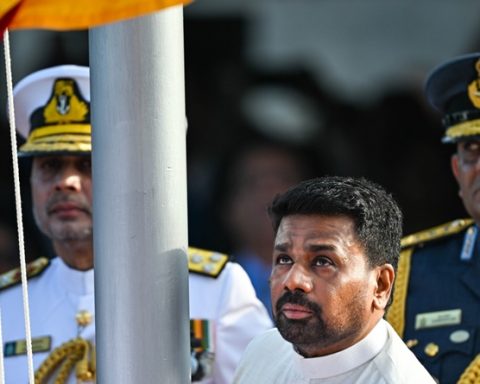
The current JVP/NPP-led government offers a fascinating but perilous experiment. Their rise to power was not based on ethnic or religious divisions but on the economic anger of a disillusioned populace. They campaigned against corruption and mismanagement, positioning themselves as the moral alternative to Sri Lanka’s entrenched political elite. But this strategy, while effective in opposition, is insufficient for governance. The JVP/NPP has no clear enemy to unite the nation against. Corruption, as a campaign theme, is a finite resource; it cannot sustain long-term governance. Public expectations are sky-high, and the absence of a unifying adversary will only hasten the emergence of internal enemies.
The JVP/NPP must learn from history. Without a unifying enemy, their meteoric rise will be followed by an equally swift fall. Physics dictates that what rises too quickly crashes just as fast, and politics follows the same law. To sustain their grip on power, they must find—or create—a cause that unites the nation. This need not be a war or ethnic conflict; it could be an economic vision, a battle against climate change, or a campaign to position Sri Lanka as a regional leader. The challenge lies in focusing national attention outward, rather than allowing internal divisions to fester.
However, such strategies are fraught with danger, as manufacturing enemies for political gain risks long-term societal damage, exemplified by Sri Lanka’s history of ethnic conflict. The challenge for the JVP/NPP is to craft a narrative that unifies without dividing, that inspires without scapegoating. It is a delicate balance, one that few leaders have managed to achieve.
In politics, as in war, the absence of an enemy is the greatest enemy of all.