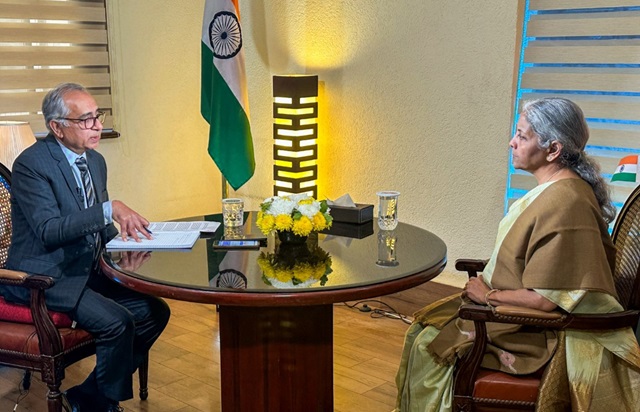
In an interview with PTI, Finance Minister Nirmala Sitharaman elaborated on the highlights of the 2024 budget and the thought process behind it. The interview, conducted by PTI’s Editor-in-Chief Vijay Joshi, touched upon several crucial aspects of India’s fiscal policy, tax reforms, and economic strategy. Here are the key takeaways from the conversation:
A Revolutionary Budget for the People
Vijay Joshi began by congratulating Finance Minister Nirmala Sitharaman on the successful presentation of her eighth consecutive budget, a record unmatched by any other Indian finance minister. Praising the budget’s reception, Joshi described it as a “people’s budget,” with many calling it “revolutionary.” Sitharaman thanked PTI for the recognition, acknowledging the positive public response.
The Tax Restructuring: A Bold Move
The most striking feature of this year’s budget is the significant reduction in tax rates, which Sitharaman described as a long-awaited move. When asked what motivated the decision to reduce the tax burden, she explained that the reform was driven by a combination of factors. The government had been working on simplifying direct taxes, making the system more user-friendly, and ensuring compliance. The Finance Minister highlighted the need for a simpler and safer tax code that would reduce the burden on taxpayers.
Sitharaman also addressed the concerns voiced by the middle class, which had been feeling the strain of high taxes. “We heard the voice of the middle class,” she said, emphasizing that the new tax regime had been designed to ease the tax burden on this demographic. The policy was not solely about rate restructuring but also about creating a tax system that would foster greater compliance while ensuring a more inclusive approach.
In collaboration with Prime Minister Narendra Modi, Sitharaman revealed that the government had worked on these tax changes after careful deliberation with various stakeholders, including the middle class. She pointed out that this year’s tax reforms are just the first step towards the new tax regime, with further plans to widen the tax net in the future.
Fostering Economic Growth and the Role of Tax Cuts
When asked how these tax changes would affect India’s growth trajectory, Sitharaman mentioned that the tax cuts would provide citizens with more disposable income, which could spur both consumption and savings. However, she cautioned against viewing the tax cuts in isolation, as other initiatives laid out in the budget would also play a critical role in fostering economic growth. She underlined that India’s path to sustained growth would rely on various factors, including capital expenditure, enhanced manufacturing, and technological advancements.
Capital Expenditure: The Key to Sustainable Growth
Sitharaman highlighted the government’s focus on capital expenditure, which she noted had remained robust despite challenges posed by the election cycle. The Finance Minister acknowledged that capital spending slowed down during the election year, but assured that it would pick up pace in the coming years. She also pointed out that the government had extended a 50-year interest-free loan to states, which had contributed to a significant increase in capital expenditure.
Sitharaman was quick to reject criticisms of the budget’s allocation to certain states, such as Andhra Pradesh and Bihar. She explained that every state received its due share under central schemes and that investments in large infrastructure projects like expressways, freight corridors, and airports continued irrespective of specific announcements in the budget.
Managing Debt and Deficit: A Long-Term Strategy
Addressing concerns about India’s rising fiscal deficit, Sitharaman reiterated the government’s commitment to managing its debt. She provided a roadmap to reduce India’s debt-to-GDP ratio to around 50% by 2030, with a clear framework laid out in the budget to achieve this goal. This, she emphasized, would be done without compromising on essential social welfare schemes, health, and education.
Sitharaman also responded to the criticism of the government’s borrowing strategy, especially after the pandemic-induced fiscal stimulus. She clarified that the government had borrowed to support the economy during the COVID-19 crisis and had planned to bring down its debt burden gradually without hampering key development projects.
The State of the Rupee and Economic Pressures
The depreciating value of the Indian rupee, which has lost nearly 3% of its value against the dollar in the past year, was another topic discussed in the interview. Sitharaman explained that the volatility of the rupee was tied to the strengthening of the U.S. dollar, a global trend that had affected several currencies. She stressed that the Reserve Bank of India (RBI) was closely monitoring the situation and intervening where necessary to stabilize the rupee.
She also pushed back against political criticisms of the rupee’s depreciation, stating that such arguments often lacked a deeper understanding of the underlying economic factors. Sitharaman suggested that those offering criticism should focus on a more nuanced analysis of the global economic environment.
Public Sector Undertakings and Disinvestment
In the interview, Sitharaman also addressed the ongoing debate about public sector undertakings (PSUs) and the government’s disinvestment program. While acknowledging the challenges faced by PSUs in the past, including issues with management, she highlighted that several public sector companies were now performing well, thanks to professional management and repeated government support.
She mentioned the example of BSNL, which had been struggling in previous years but had recently made significant strides in adopting indigenously developed 4G technology and was now gearing up for 5G. Regarding disinvestment, Sitharaman confirmed that the government would continue with the program, despite setbacks caused by the pandemic and geopolitical tensions.
Artificial Intelligence: A Key Area of Focus
Sitharaman shared the government’s plans to foster the growth of Artificial Intelligence (AI) in India, particularly in sectors like agriculture, healthcare, and urban development. In the July 2024 budget, she had announced the creation of three centers of excellence for AI, and in this budget, another center would be dedicated to AI for education.
The Finance Minister emphasized that AI would not only drive innovation but also create skilled jobs for India’s youth. She revealed plans to set up skilling hubs across the country to train young Indians in AI, with overseas training partners providing certification for these skills.
Finance Minister Nirmala Sitharaman’s detailed interview with PTI shed light on the government’s multi-faceted approach to economic growth, tax reforms, fiscal responsibility, and technological advancement. The budget, as Sitharaman pointed out, is a step toward a more inclusive and growth-oriented India, one where citizens benefit from lower taxes, a stable economy, and access to cutting-edge skills in emerging fields like AI. Her plans for reducing the debt-to-GDP ratio, bolstering capital expenditure, and managing public sector undertakings reflect the government’s long-term vision for India’s economic future.