


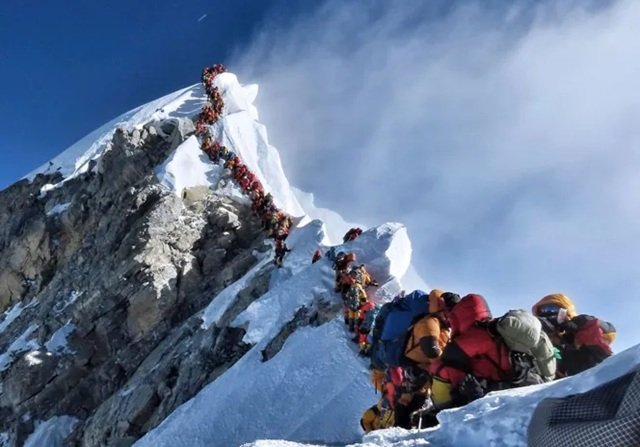
Mount Everest has always been synonymous with danger. Climbers face the Khumbu Icefall, with its shifting seracs and yawning crevasses, the 8,000-metre death zone where every step drains the body, and the summit ridge, a narrow scramble over steep rock. Yet in 2026, authorities in Nepal are warning of a new threat, one that Sir Edmund Hillary and Tenzing Norgay never encountered: the possibility that climbers may be deliberately made sick as part of a sophisticated insurance scam.
Investigators have revealed what they describe as a vast criminal network operating on the “roof of the world.” The scheme, authorities say, involves helicopter rescue pilots charging for flights that never occurred, doctors billing for procedures that were never performed, and in some instances, climbers falling ill not from altitude, but because of substances covertly added to their food. Some reports suggest that baking soda or other compounds were used to induce symptoms of altitude sickness, creating excuses for costly helicopter evacuations.
Everest has become far more accessible than it was in 1953, when The Times UK reported Edmund Hillary and Tenzing Norgay’s first successful ascent. Satellite communications mean messages can reach the outside world immediately rather than being carried on foot. Electricity now reaches the start of the trekking route, replacing the old practice of heating with hot potatoes under armpits that Hillary and Tenzing witnessed in Namche Bazaar. But while logistics have improved dramatically, fraudsters are exploiting gaps in oversight.
This spring, Nepal expects around 500 climbers attempting the summit, with many thousands more trekking to base camp. The teams of “icefall doctors” have already begun preparing fixed ropes and ladders, while authorities are tightening regulations after reports of systemic abuse. According to the Kathmandu Post, the mechanics of the scheme are straightforward: a climber is staged as a medical emergency, a helicopter is summoned, the tourist is admitted to hospital, and an insurance claim is filed that bears little resemblance to the actual events. If multiple trekkers are put on the same flight but billed individually, the profit can reach thousands of pounds per trip.
One key tactic involves guides persuading climbers at base camp that they must descend by helicopter. Some of these tourists may not be genuinely ill, but are convinced by guides that immediate evacuation is necessary. Others may experience mild altitude sickness, which would normally improve with rest and gradual descent, yet guides allegedly exaggerate symptoms to justify a costly rescue. In more extreme cases, investigators claim illness was deliberately induced through drugs administered incorrectly or food tampered with to create the appearance of sickness.
The first intimation of such fraud surfaced in 2018 when the Kathmandu Post uncovered similar schemes, prompting a 700-page government report. However, Nepal police’s central investigation bureau reopened the case last year and concluded the problem had worsened. Between 2022 and 2025, more than 300 fake rescues were confirmed, resulting in nearly $20 million in fraudulent insurance claims. Authorities have now filed 33 charges, some under organised crime laws, signalling a crackdown on the network.
The revelations have caused embarrassment for Nepal, a country that prides itself on mountaineering heritage. Manoj Kumar KC, assistant inspector general involved in the investigation, said that the perpetrators had “tainted the country’s image.” Nevertheless, authorities are determined to restore integrity to Everest expeditions. New regulations this season require that all rescue operations be formally reported to both the tourism department and the tourist police, a move aimed at curbing fraudulent claims and ensuring that actual emergencies are properly managed.
Despite the shadow cast by these scams, the climbing season proceeds. The brief spring window remains the only period when weather conditions are sufficiently warm and dry for safe ascents. Expeditions are already arriving in Kathmandu to take advantage of the limited climbing period. Among the high-profile attempts is that of Australian climber Oliver Foran, who plans to achieve the fastest ascent from sea level to the summit. Foran, who will cycle from the Indian Ocean to Everest base camp, will encounter a mountain now governed by tighter bureaucracy and stricter oversight, reflecting the lessons learned from past abuses.
Himal Gautam, a director at Nepal’s Department of Tourism, emphasised that the reforms aim to restore the spirit of mountaineering, ensuring that climbs are based on skill, endurance, and courage rather than deception. “We hope they follow the rules this time,” he said, underscoring the challenge of preserving the integrity of the Everest experience in a modern era of technology, tourism, and opportunistic fraud.
As climbers prepare to tackle the world’s highest peak, they now face not only the natural perils of altitude and ice, but the very human dangers of deceit and manipulation. The combination of extreme environment and lax oversight has created fertile ground for exploitation, and Nepalese authorities are determined to ensure that future expeditions are measured by climbing ability rather than the scale of a criminal enterprise. In the shadow of Everest’s towering summit, the struggle to maintain safety, honesty, and adventure continues, even as the mountain’s age-old allure remains undiminished.
This year’s developments serve as a reminder that the challenges of Everest are no longer only physical or environmental. They now include navigating the complex web of modern commercial pressures, insurance schemes, and criminal opportunism, adding a new dimension to the enduring saga of humanity’s engagement with the roof of the world.









