


by Our Political Affairs Editor
We believe no introduction is necessary for Ali Sabry. His name is already tied to one of the most dramatic and painful chapters in Sri Lanka’s modern history. He was not a spectator watching the country’s economic collapse from a safe distance. He was among the people placed directly at the centre of the storm when Sri Lanka was staring at bankruptcy, political instability and a frightening loss of public confidence.
At a moment when responsibility was becoming something many wanted to avoid, Sabry accepted one of the most difficult assignments in government. He took over the Finance Ministry at a time when the country was running out of options, foreign reserves had collapsed, public anger had reached breaking point and every economic decision carried a political price. He entered a position where there were no easy victories, no popular choices and no guarantees that those who made difficult decisions would ever receive public appreciation.
Looking back today, Sabry believes his greatest contribution was not a ministerial title, a political achievement or a personal gain. It was the decision to accept responsibility when others stepped away.
“Single biggest achievement, I would say, was that during the time of the economic crisis, when nobody wanted to take the Finance Ministry and take responsibility for the situation, I am happy that I had the courage to take over and do those reforms which were long overdue.”
For Sabry, that moment defined leadership. He believes that when a country faces an existential crisis, leadership cannot be measured by popularity. It must be measured by the willingness to take decisions that may be unpopular but necessary.
His argument is straightforward. Sri Lanka was standing at the edge of a much deeper collapse, and the reforms introduced during that period prevented the country from becoming another example of a nation trapped in permanent economic disaster.
“As a result, this country did not go down the path of so many other countries which have no return, like Venezuela, Lebanon, Zimbabwe and Zambia. Sri Lanka is back. That is because of the foundation we laid at that time.”
This remains the foundation of Sabry’s defence of his time in government. He does not claim that the decisions were easy. He does not claim that people were happy with them. Instead, he argues that governments sometimes have to choose between temporary pain and permanent damage.
When he accepted the Finance Ministry portfolio in April 2022, he says he already knew that the decisions ahead would damage his political future. He says he was fully aware that the public might reject him and others associated with those reforms.
“If you remember my speech when I took over finance in April 2022, I said that the next two years were going to be very crucial for the country, and I was putting my political future on the line, and that was the right thing to do.”
For him, public office is not protection against criticism. It is a responsibility that requires sacrifice.
“Some of the very unpopular decisions need to be taken, and people will not realise it, but that’s the right thing to do. I’ll put my future on the line in politics in order to serve the nation.”
He compares those difficult economic decisions to medicine that nobody wants to take but which becomes necessary for survival.
“Some of those difficult decisions are like bitter medicine at that time. But then that was necessary for you and the country.”
Sabry believes that history has often been shaped by people who accepted responsibility during difficult moments rather than those who protected themselves from criticism.
“So many people in the past have put themselves in the firing line to protect the country. So what was the big deal about that? So I am happy with that.”
However, the political consequences came quickly. After the economic stabilisation process began, many people who had supported or implemented the reforms faced public rejection. Sabry says this was expected.
“That’s the way it is. I mean, we kind of expected that.”
According to him, the public mood was influenced by political narratives and promises that ignored economic realities. He argues that many voters were encouraged to believe that the country could quickly reverse painful reforms without consequences.
“People have misunderstood that, and all sorts of false promises are being given. So they got carried away, and none of those promises can be carried out now.”
Sabry is particularly critical of political promises made during election campaign periods. He argues that several commitments were unrealistic and designed to attract public support rather than provide practical solutions.
“They told us that they would abolish the executive presidency. They told us that they would have the devolution of power. They told us that they would repeal the PTA. They said they would chase away the IMF. They told us that they would reduce electricity prices. They told us that they would reduce petrol prices. None of those things have been happening.”
For him, this reflects a deeper problem in Sri Lankan politics. He believes the country continues to struggle because political competition often rewards promises rather than responsibility. Leaders who explain difficult realities may lose public support, while those who offer simple answers to complex problems often gain popularity.
This, according to Sabry, is one of Sri Lanka’s biggest political weaknesses. The country requires a more mature political culture where national interest comes before electoral advantage.
The economic crisis itself, he argues, was not unavoidable. It was the result of a series of mistakes that accumulated over time. In his view, Sri Lanka had opportunities to prevent the collapse but failed to act.
“I think leading up to the economic crisis, there were a lot of mistakes. We could have avoided that.”
The first major mistake, according to Sabry, was delaying engagement with the International Monetary Fund.
“We should have known that there was no other plausible approach other than going to the IMF, and going to the IMF at least one year in advance.”
He describes that delay as a fundamental error.
“That was a cardinal mistake.”
Sabry believes that Sri Lanka lost valuable time by refusing to acknowledge the seriousness of the economic situation earlier. By the time the country approached the IMF, the crisis had already become much more severe.
His second criticism focuses on tax policy. He argues that reducing government revenue weakened the country’s financial position at exactly the wrong time.
“I also thought reducing the taxes cut your own revenue. So, 600 billion a year. If you cut that for three years, it’s 2 trillion.”
According to Sabry, a government cannot maintain essential services, manage debt obligations and respond to economic shocks without adequate revenue.
His third criticism concerns the sudden introduction of organic fertiliser policies. He believes the decision created unnecessary disruption to agriculture and should have been implemented more carefully.
“Thirdly, things like introducing this organic fertiliser overnight. Uncalled for and unnecessary.”
However, Sabry also identifies what he considers the correct decisions taken during the crisis. He believes the most important step was immediately engaging with the IMF and beginning negotiations.
“The right things that we did was immediately getting into the IMF, talking to them.”
He argues that the debt moratorium provided the country with crucial time to prepare a recovery strategy.
“Then go for a debt moratorium so that we have some space for us to get ready with our country.”
Another important step, according to him, was introducing cost-reflective pricing. Although unpopular, he believes it was necessary to correct distortions in the economy.
“We also decided to introduce cost-effective pricing.”
Sabry also defends the decision to allow the rupee to adjust instead of artificially maintaining an exchange rate that the country could no longer afford.
“We floated the rupee so that we were not artificially holding on to the rupee, and that allowed the rupee to be stabilised and people to send their funds through the banks.”
For him, the recovery process was not only about policies but also about institutions and people. He highlights the appointment of experienced officials and technocrats as one of the most important elements of stabilisation.
“We got the current Governor appointed, the former Secretary to the Treasury appointed, and a new breed of technocrats running that ministry, which made a big difference.”
Sabry believes that capable institutions are essential because economic recovery cannot depend only on political leadership. It requires expertise, credibility and professionals who can implement difficult decisions.
But his time in government was not defined only by economic decisions. It was also marked by controversies that tested his political position, particularly the COVID burial issue involving Muslim victims.
Sabry openly admits that he strongly disagreed with the government policy at the time and says he expressed that disagreement both publicly and internally.
“I was very, very upset about it. Everybody knows that. I have been very open about it, both in public as well as within the Cabinet.”
However, he says he made a conscious decision to remain inside the government rather than resign because he believed he could still influence the outcome.
“But I have to fight while being in the government. I can’t just walk out.”
He describes the decision to prevent Muslim burials as deeply wrong.
“Therefore, I think that was a very, very unwise decision.”
According to Sabry, the committee responsible for recommendations on burial and cremation did not understand the issue properly and acted with prejudice.
“They were racist. They didn’t understand anything. So, they just didn’t want to allow Muslims to bury.”
He says the situation was made more difficult because public opinion, media coverage and institutional responses at the time did not support his position.
“The media was in support of that policy. The Supreme Court did not grant relief against it. So, what can one person do at that point in time?”
Despite those limitations, Sabry says he continued to fight until some burials were eventually permitted.
“I fought and fought and fought, and ultimately at least got some burials to be carried out in Oddamavadi, Batticaloa.”
For Sabry, that episode represents one of the hardest moments of his political career because it required balancing personal conviction, community expectations and his responsibility as a government minister.
He says the criticism he received, including from sections of the Muslim community, was something he had to accept. His guiding principle, he says, came from advice given by his father.
“My father had told me to try to control what is controllable. And listen to your conscience and the God above. That’s my biggest strength.”
He says he understood that leaving the government would not necessarily solve the problem.
“I knew that if I moved out, what would happen? No one in the community.”
After consulting trusted people close to him, he decided that remaining within the system gave him a better opportunity to make a difference.
“All of them told me to fight by being in the system.”
For Sabry, his actions were not driven by personal ambition or political survival. He insists that holding ministerial office was never a privilege.
“Some people think holding a Cabinet portfolio is a big gift or something. For me, no. It’s a responsibility.”
He says he sacrificed his legal career and personal income to serve in government.
“I don’t think I would have probably earned 5% of what I’m earning as a lawyer.”
Therefore, he says he never viewed political office as a reward.
“I never considered it a privilege. I never considered it something for me to show off to the world. I considered it a massive responsibility cast upon me.”
Sabry’s understanding of leadership extends beyond economic management. He believes Sri Lanka’s survival and future progress depend on how intelligently the country manages its relationships with the outside world. For a small country located at the centre of major geopolitical competition, balancing relations with powerful nations such as India, China and the United States is not simply a diplomatic exercise. It is a question of protecting national interest without becoming dependent on any external power.
Having served as Sri Lanka’s Foreign Minister, Sabry views international relations not only through the lens of diplomacy but also through economic necessity. He argues that foreign policy must ultimately serve the national interest, attract investment and protect Sri Lanka’s independence in decision-making.
When asked how Sri Lanka should maintain relationships with major powers without compromising its sovereignty, Sabry acknowledges that it is not an easy question. However, he says the guiding principle must be clear.
“That is a difficult question to answer. But one thing is for sure. All decisions must be taken case by case in the interest of Sri Lanka. Not at the behest of anyone else. Not under duress.”
For Sabry, Sri Lanka’s foreign policy should not be shaped by pressure from powerful countries or by ideological alignment with one side of global politics. Instead, every decision must be measured against what benefits the country.
“Any decision should, at the end of the day, be for the betterment of our nation. Every country does that.”
He strongly rejects the idea that Sri Lanka should become an extension of another country’s strategic interests.
“We should not be an extension of any other country’s foreign policy.”
According to him, respect from other nations comes when a country demonstrates confidence and consistency in defending its own interests.
“Once you take those decisions in that way, people will start respecting you. And they will know that this country is like that.”
Sabry’s approach reflects his broader political philosophy. Whether dealing with economic policy, foreign relations or domestic issues, he repeatedly argues that Sri Lanka must act with confidence rather than dependency.
However, when assessing the current government, Sabry offers a mixed evaluation. He acknowledges areas where he believes progress has been made, while also expressing serious concerns.
“There are some positives. Some negatives. Like any government.”
One area where he sees improvement is the treatment of minority communities. As a Muslim politician who interacts regularly with minority communities, he believes there has been a change in the sense of security felt by many people.
“One area which I see as positive is being a Muslim. And I meet a lot of Muslims as well as some Tamils. The minorities feel absolutely safe. Secure.”
He believes this is partly because the government has taken a stronger position against racism.
“These guys have stood up against racism in a big way. That’s a plus point, I would say.”
Sabry also believes there is an effort to promote a stronger Sri Lankan identity rather than ethnic division.
“They are trying to promote the Sri Lankan identity, which others missed the bus on from 1956.”
However, he remains critical of the government’s understanding of economic priorities.
“But the economy, I don’t think they understand.”
He also raises concerns about the use of law enforcement institutions for political purposes.
“I don’t like them abusing law enforcement for their political advantage.”
For Sabry, this is especially concerning because of his background as a lawyer. He argues that institutions responsible for justice must remain independent and cannot become instruments of political competition.
“As a lawyer, what touches us every day is the abuse of the law enforcement process for their political gain, which is not expected from these guys. It’s very disappointing.”
One of the key legal issues he discusses is the Prevention of Terrorism Act, commonly known as the PTA. Sabry believes the existing legislation requires replacement and argues that a more balanced legal framework should be introduced.
“Obviously, it has to be repealed.”
However, he does not believe national security should be ignored. Instead, he argues that Sri Lanka needs legislation that protects both national security and individual rights.
He points to the anti-terrorism law prepared during his time as Justice Minister as an alternative.
“In fact, we did a law called the anti-terrorism law. So, that law is much more reasonable.”
According to Sabry, the proposed law provided safeguards while still allowing authorities to respond to genuine security threats.
“Which only allowed detention for 60 days without magistrate supervision. So, that law can be introduced.”
For Sabry, reforming the justice system is not only about changing laws. It requires modernising the entire structure of justice delivery.
He explains that when he served as Justice Minister, he focused on five key areas.
“We had five pillars of that.”
The first was improving infrastructure.
“That means more courthouses, more judges.”
He argues that delays in the legal system cannot be solved without strengthening basic capacity.
The second major reform area was technology.
“Introduction of technology. Online hearings, online filing, not to have these briefs and all those things.”
Sabry believes the legal system must move away from outdated practices and embrace modern technology.
“Use the technology to do that.”
He notes that some progress has already taken place.
“Which is happening to some extent now. The new Chief Justice is good at that.”
The third area was continuous legal reform. Sabry argues that laws cannot remain unchanged in a rapidly changing world.
“The law cannot be stagnant. It changes fast. The world is changing fast. Technology is changing fast. Along with that, the law also must change fast.”
To achieve this, he created specialised committees focusing on different areas of reform.
“I had five sub-committees: the Criminal Law Reform Committee, the Civil Law Reform Committee, the Commercial Law Reform Committee, the Infrastructure Reform Committee and the Technology Reform Committee.”
His objective, he says, was to bring Sri Lanka’s justice system closer to international standards.
“That’s the five areas in order to bring the Sri Lankan legal system at least to world-class standards.”
Another issue raised during the interview was public criticism that lawyers charge high fees, making justice inaccessible for ordinary citizens. Sabry rejects the argument that lawyers alone should face restrictions.
“No, I don’t agree with that.”
He argues that legal services operate like any other professional service.
“That’s a choice people have.”
According to him, those who cannot afford private legal representation already have access to government legal assistance.
“For the people who don’t have money, there is a legal aid system in the country.”
He compares legal services with other professions.
“If you want to buy a better brand of shoe, you have to pay more. So, if you want a better brand of bread, you have to pay more. So, if you want a better doctor, you have to pay more.”
Therefore, he questions why lawyers should be treated differently from other professional service providers.
“So why only lawyers need to be restricted? That’s the nature of commerce. You should allow that. Only lawyers cannot be restricted.”
When discussing Sri Lanka’s future political leadership, Sabry returns to one of his strongest themes: the need for intelligent but compassionate leaders.
He believes education alone is not enough. A leader must also possess humanity and empathy.
“I think they should be intelligent and also compassionate.”
He refers to the philosophy of Nelson Mandela, arguing that the combination of intelligence and empathy creates powerful leadership.
“As Mandela says, a good brain and a good heart, a good mind and a good heart is a formidable combination.”
For young Sri Lankans entering politics, diplomacy and public service, Sabry says integrity must remain central.
“They should be smart, educated and future-ready while having their heart at the right place.”
He believes leaders must reject racism and division.
“Personal integrity, treating people with equality, humanity above everything else, country above everything else, resist this racism, resist any sort of division and work for the national flag.”
According to him, Sri Lanka does not require hundreds of extraordinary leaders. It needs only a small number of genuine people with the right values.
“We just need ten of them.”
He believes that if such people reach positions of influence, Sri Lanka could transform itself.
“If somebody is on top, thinks on that line and transforms that, if you have a little luck, Sri Lanka could transform this place.”
When asked what single policy priority he would recommend for the next five years, Sabry immediately returns to the economy.
“For me, always the most important thing is the economy.”
He believes that many of Sri Lanka’s other problems are connected to economic weakness.
“You must get the economy right; most of the problems will be resolved on their own.”
For Sabry, economic growth requires creating an environment that attracts foreign direct investment.
“You’ve got to create an environment which is conducive to foreign direct investment. That’s how you do it.”
He argues that Sri Lanka cannot reach the next stage of development without significant external investment.
“Without foreign direct investment coming in a massive amount of capital, Sri Lanka lacks the capital to take the country to the next level.”
Investment, according to him, creates a chain reaction.
“With investment comes a new market, with a market comes new technology.”
Without those elements, he believes Sri Lanka will remain trapped.
“Without new technology, and without new investment, and new capital, and new markets, Sri Lanka cannot take that. Coming to the next level is difficult for us.”
His economic argument is ultimately about transformation. Sri Lanka, in his view, cannot simply stabilise itself and remain where it is. It must move towards a more competitive economy capable of generating opportunities for future generations.
The most politically sensitive part of the conversation, however, comes when Sabry discusses the Easter Sunday attacks, the investigations that followed and the continuing debate over accountability.
He says that after studying the available reports and evidence, he believes the focus should move towards those who remain responsible rather than reopening issues that have already been investigated extensively.
“In my opinion, having gone through all these reports and studied everything, the fellows who planned and carried out are dead and gone.”
However, he believes attention should be given to the second layer of individuals involved.
“The second layer is before being indicted. They should be pursued.”
Sabry argues that continuing political debates around the issue prevent closure for victims.
“Some interested parties just want to keep it going for different reasons.”
For him, the most important concern remains justice for the victims.
“I think it’s very unfair to the victims because they are not allowing closure of the whole thing.”
He believes the government should appoint independent individuals without political interests to review all available findings.
“The government must not only listen to opinionated prosecutors. They must be good enough to appoint some independent people who are apolitical to go through everything that they have done so far.”
He refers to multiple investigations and reports that examined the attacks.
“There is this Janak De Silva report. There is the Malalgoda report. There is the Parliamentary Committee report. Then there is the Imam Committee report. There is the Jayaki De Alwis Committee report.”
His argument is that all available information should be examined together before reaching conclusions.
“Collate all those things, sit and find out, and then it is very clear.”
Sabry believes political pressure has complicated the process.
“Some people have some people in their mind they want to somehow or other fix them. So this is unfair. For that purpose, they are politicising the whole investigation process.”
Sabry’s strongest criticism in the discussion comes when he speaks about what he sees as the politicisation of law enforcement and investigations connected to the Easter Sunday attacks. For him, the credibility of any investigation depends not only on the evidence collected but also on the independence and neutrality of those conducting it.
Asked whether he stands by his previous criticism of the current leadership of the Criminal Investigation Department, Sabry does not hesitate.
“There is nothing to stand. There is no object.”
He argues that the issue is not personal but institutional. His concern, he says, is about the integrity of the investigative process.
“That man went to the Supreme Court and told that I am no longer in police service. I am a politician now. He came back as a politician to the CID. Never happened in Sri Lanka. Never.”
According to Sabry, this creates a dangerous situation where investigations can be influenced by political motivations.
“And he is doing a political job. He is going after people every day for personal vengeance. Pure personal vengeance.”
He says his criticism is based on what he believes are contradictions between previous investigations and current actions.
“The CID has been found to be at fault by three different committees.”
Sabry points to findings from several commissions and judicial processes that examined failures related to the Easter Sunday attacks.
“The Janak D’Silva Commission came out with clear findings on that. The Jayaki De Alwis Commission came with clear findings on that. The Supreme Court came out with clear findings on that.”
His argument is that responsibility for security failures should not be selectively examined based on political convenience.
“Against the IGP. IGP means police. Police means investigative agency. Investigative agency means CID. So how can that man carry out the investigation?”
He believes that any person placed in such a position would naturally face a conflict of interest.
“Naturally, he will do everything to safeguard himself.”
For Sabry, this is why institutional independence is so important. He argues that justice cannot function effectively if investigators are perceived as politically connected or personally motivated.
However, he also raises another question. He asks why organisations and groups that strongly criticised previous governments have remained relatively silent on some of these issues under the current administration.
“But had it happened under a previous government, there would have been a lot of statements from NGOs, Western embassies and other communities and so on and so forth. But why the remarkable silence in this case?”
He says part of the answer lies in what he describes as inconsistency within civil society.
“One reason is that the previous government also would have antagonised the general public and civil society, seeing all of them as enemies rather than listening to them.”
However, he also accuses some sections of civil society of applying different standards depending on political preferences.
“The double standard of those so-called civil societies.”
According to Sabry, some groups are less interested in universal principles of justice and more focused on protecting particular individuals or political interests.
“Their interest is not about due process. Their interest is not about the truth. They have certain people, favourites and others.”
He argues that genuine justice requires consistency, regardless of who is being investigated or accused.
“As long as their favourites are under pressure, they will stand for them. As long as they are enemies or somebody whom they see as such, they will keep quiet.”
The discussion then moves to the controversy surrounding the former head of the country’s top intelligence agency, Major General (Retired) Suresh Sallay, and allegations made against him by certain groups regarding the Easter Sunday attacks. Sabry is careful to separate the individual from the broader issue.
“No, I mean, it’s not about Suresh Sallay.”
He acknowledges that Suresh Sallay has both supporters and critics but argues that every individual deserves due process and fair treatment under the law.
“Suresh Sallay personally had done a lot of work for the country.”
Sabry strongly condemns what he sees as unfair treatment in the absence of credible evidence.
“No one in this country deserves that kind of treatment. Number one is detaining him under the PTA, keeping him in custody and subjecting him to torture.”
He also criticises what he describes as attempts to create evidence rather than follow the evidence.
“Number two is just concocting evidence when everything else is somewhere else.”
For Sabry, the central question must always be whether there is credible and verifiable evidence to support any allegation.
“There is no evidence at all.”
He argues that several major investigations conducted by respected international and domestic institutions did not produce evidence supporting certain allegations.
“All the other commissions and everything else have gone in one direction, and this one man is saying the other way around. So everything else has been disregarded.”
He highlights the scale and depth of previous investigations.
“The Janak De Silva Commission interviewed more than 400 witnesses and held 214 days of sittings. Not an iota of evidence against anyone.”
He also refers to international investigations conducted following the Easter Sunday attacks.
“Investigations were immediately carried out by the FBI, the Australian Federal Police and Scotland Yard.”
For Sabry, the involvement of such internationally recognised investigative bodies strengthens the argument that conclusions must be based on evidence rather than political narratives.
“Now, these are world-class organisations, not even a symbol of anything when it comes to local institutions.”
His defence of due process is also connected to a broader message he wants to deliver to the Muslim community. Sabry says defending individuals from unfair accusations does not mean denying problems that exist within the community itself.
He strongly rejects the idea that the entire Muslim community should carry collective blame. At the same time, he argues that the community must honestly confront extremism wherever it exists.
“Muslim community must understand one thing. They have found a refuge in this just to palm off the blame to someone else. You can’t do that.”
For Sabry, honesty is essential.
“Whether we like it or not, you must understand that the eight fellows who went and blasted themselves were from our community. People who have been charged are from our community.”
He says denying this reality would be dangerous.
“So there is a section who went astray and became extreme.”
According to him, the answer is not collective punishment but internal reform.
“So you need to have reforms within the community.”
His objective, he says, is to ensure that such extremism never emerges again.
“So we will never have that kind of extremism in our community ever.”
Sabry warns that refusing to acknowledge uncomfortable truths can create greater problems in the future.
“If you live on this self-denial, it is a dangerous thing.”
He says his position is not driven by political calculation or personal advantage.
“It is out of love that I stand for this because I see the future.”
He says criticism does not influence his decisions.
“I don’t care what noises are being made. I’ve never been bothered about it.”
He says politics itself is not something he wants to continue simply for the sake of remaining relevant. When asked whether he has any plans to return to politics, Sabry gives a direct answer.
“No. I’m done.”
He says he has returned to his legal profession and is content with that decision.
“Politics is not a place for us to be in this.”
He says he continues to enjoy being a lawyer and believes younger people should take responsibility for the country’s future.
“I love this profession. I continue to enjoy that.”
Sabry rejects the idea that Sri Lanka depends on a few individuals.
“There are a lot of people out there. I’m sure good young people will come one day, and then we will come out of this.”
Looking back at his own political journey, he says he has no regrets.
“Everybody has a limit, and for a good five years I have kept sacrificing for the nation.”
He accepts that some people may appreciate his contribution while others may not.
“Some will realise it, some will not realise it.”
But personally, he says he can look back with satisfaction.
“Within my conscience, I can only say that I’m more than happy.”
For Sabry, the defining moment was stepping forward when the country needed someone to take responsibility.
“At a very, very difficult time, I was able to be there, take the bull by the horns and do what I could do at that point in time.”
He believes many Sri Lankans underestimate how close the country came to a much longer economic disaster.
“People don’t understand this.”
He compares Sri Lanka’s experience with countries that suffered similar or even worse crises but took many years to recover.
“Some of the countries which went through our kind of 94% of food inflation and 70% of general inflation took a good 10 to 11 years to come back after announcing a moratorium on foreign loans. Some countries never came back.”
He also compares Sri Lanka’s experience with Greece, which required more than a decade to emerge from its financial crisis.
“Greece took 11 years to come back.”
Sabry highlights that Greece had major international assistance.
“After the EU funded them with 95 billion euros, subject to their conditions, reforms and all those things, it took 11 years to come out of their debt moratorium and bankruptcy.”
By comparison, he argues that Sri Lanka achieved stabilisation much faster.
“We came out in two years.”
This is the strongest argument he presents in defence of the decisions taken during his short period as Finance Minister.
He says the foundation for recovery was created quickly because urgent decisions were made without delay.
“The foundation was laid during my 45 days of the reign.”
He lists the major actions taken during that period.
“Going to the IMF, getting financial advisers and legal advisers, introducing cost-reflective pricing, appointing the Governor, appointing the Secretary to the Treasury, announcing the debt restructuring and debt moratorium — all happened during that period of time.”
According to Sabry, decisions that normally could have taken years were accelerated because the crisis demanded urgency.
“Something which could have been done in a period of two years, I took it in 30 days.”
For him, that period was about making decisions when delay itself could have been disastrous.
“Decisions need to be taken. That’s how it is.”
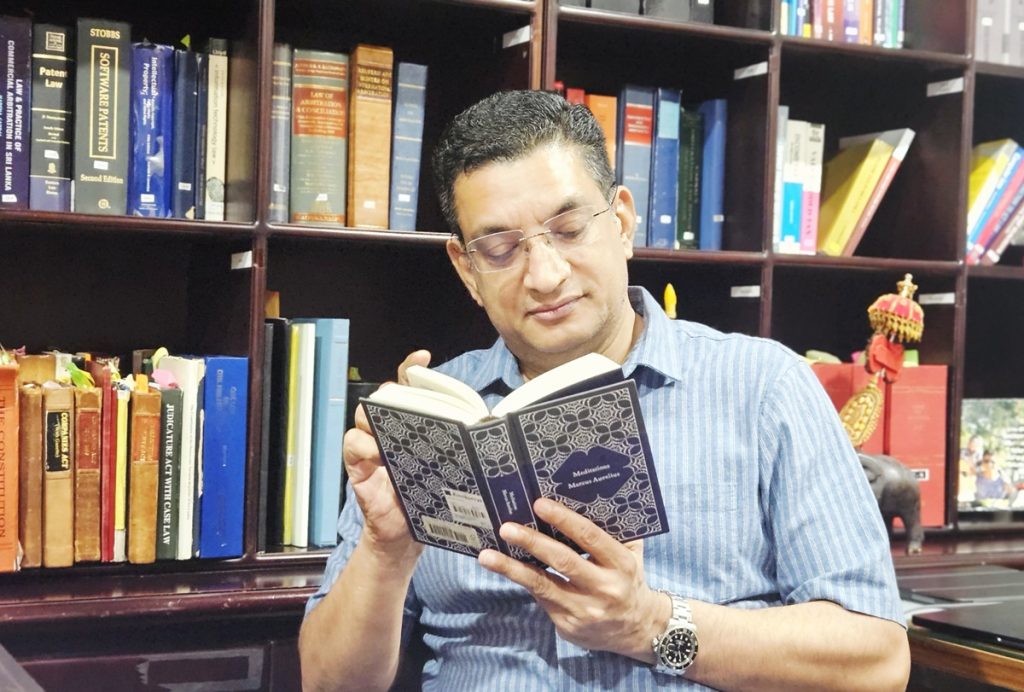
The final reflection in the conversation moves away from politics and economics towards philosophy. Asked about the best book he has read, Sabry mentions Meditations by Marcus Aurelius, the writings of the Roman emperor and Stoic philosopher.
“I like this. I like Meditations by Marcus Aurelius. It’s fantastic.”
He says he repeatedly returns to the book because its lessons remain relevant.
“I go back again and again and try to kind of refresh myself.”
The central lesson he takes from it is one that has guided his public life, similar to the advice he received from his father.
“Control what is controllable.”
He also believes people should avoid living only for public approval.
“Don’t live for others, don’t compare with others, try to improve yourself every day from today to tomorrow rather than comparing with others.”
That philosophy captures the essence of Sabry’s own defence of his political journey. He believes individuals cannot control how history immediately judges them. They can only control their decisions, their intentions and their commitment to what they believe is right.
Ali Sabry’s account of his time in government is therefore not simply a story about economic reform or political controversy. It is a story about responsibility during a national emergency, the loneliness of unpopular decisions and the difficult balance between public opinion and national interest.
Whether history ultimately accepts his interpretation or challenges it will depend on how Sri Lanka continues to evolve. But his central argument remains unchanged. At the moment when the country needed someone to accept responsibility, he believes he stepped forward.
And for Sabry, that is the measure that matters most.
“I was able to be there, take the bull by the horns and do what I could do at that point in time.”
For a politician who says he has already left politics behind, that remains the legacy he wants to be remembered for.









