
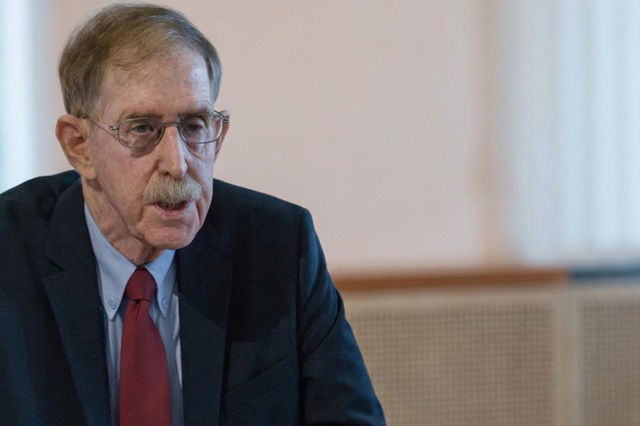
What does it mean to grow up in a state before it becomes a state, and to watch it expand beyond recognition within a single lifetime? How does a person who describes himself as largely self-formed come to influence generals, intelligence officials, and political leaders? And what happens when an academic rejects not only institutional constraints but also the intellectual fashions that define his field? These questions framed the opening phase of my conversation with Dr. Dan Schueftan, whose responses moved quickly from personal history to structural observations, often bypassing the expected narrative detail.
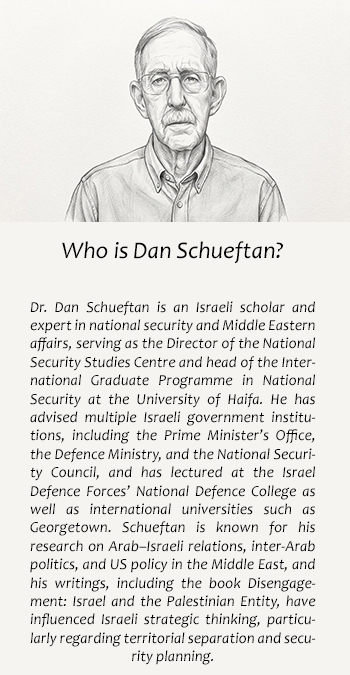
Dr. Schueftan’s career has developed across academic, advisory, and policy-oriented roles, with sustained involvement in Israeli national security discourse. He has written extensively on Middle Eastern affairs, Israeli domestic politics, and broader strategic questions, while also working closely with decision-makers. His professional trajectory includes teaching, research, and direct engagement with political and military institutions, and he describes his role as maintaining “one foot in the analytical domain and the other foot in the more practical domain, so that the two can feed each other”. His influence has extended to consultations with prime ministers, defence officials, and intelligence leadership. At the same time, his views have drawn criticism, particularly in relation to his language on Arab societies and his rejection of prevailing academic trends in parts of the West. He does not moderate these positions. Instead, he presents them as necessary conclusions drawn from observation. I sat down with him recently to talk not only about the ongoing geopolitical and security ramifications in the region but also his early life, which he was reluctant to discuss, and the academic culture and how it has evolved.
He began by situating himself within a long arc of change. “I was born in Israel before the establishment of the state,” he said, before immediately shifting to scale and transformation. “In my lifetime, Israel grew 20 fold… I was born in a country that had less than half a million Jews… today… about 10 million citizens.” The contrast, as he framed it, was not only demographic but structural. “Israel used to be a small and poor country… today, Israel is very well off, and by far the most important regional power in the Middle East.” He returned to this idea of radical change more than once, treating it not as a point of pride but as a factual baseline for understanding everything that followed.
When asked about his childhood, he did not construct a conventional account. Instead, he described distance, both linguistic and social. “My parents could not even speak Hebrew,” he said, adding that this meant “they did not fully understand what was going on”. He characterised his upbringing as largely independent: “I grew up, more or less on my own… they loved me… but they did not speak the language that we spoke.” That distance widened early. “I left home at a very early age of nine, with their consent,” he said, describing a shift into a different social environment. “I grew up with children who were born to Jews who were killed in the ghettos in Europe… so they grew up alone.” He presented this not as an emotional account but as a description of conditions, noting that it produced “a very different life experience than the experience of children who grow up in Israel today”.
I think sending my children to Gaza is less dangerous than sending them to Harvard… they may come back analytically retarded and morally twisted.
He also described a level of personal autonomy that he framed as both unusual and enabled by the broader environment. “I made full use of the fact that in Israel, you give people a lot of freedom to do whatever they see fit,” he said. This extended to formal education. “I decided not to go to school most of my early years… so I was illiterate until a late stage.” He described himself as having “grown up a bit wild”, adding that he “enjoyed growing up this way”. The account was not framed as regret or disruption but as a different path that he later integrated into his intellectual development. “Even for people who are different, Israel is very open for this kind of experience,” he said, returning again to the idea of environment as enabling condition.
His description of identity followed a similar pattern, defined less by inheritance than by selection. “For me, being a Jew is a choice,” he said. While acknowledging that he was “born a Jew”, he dismissed that as “a technicality”. What mattered, in his account, was a chosen affiliation. “I feel a very strong identity as a Jew, but not to the Jewish religion,” he said, making a clear distinction between religion and what he called “peoplehood”. “I don’t keep anything religious… from a religious point of view, I’m neither this nor that.” Instead, he located his identity in continuity and participation. “The Jewish past is something that I have chosen to be my heritage … I’m trying to contribute… to be among the shapers of the Jewish present… and I’m very concerned with the Jewish future.” He reiterated that this identity is “cultural… not religious”, and that its significance lies in attachment rather than doctrine.
His transition into formal structures came through military service. “Between the age of 18 and 21, I served in the Air Force Intelligence in Israel,” he said, adding that he continued in reserve service “for decades and decades to come”. He described this period without elaboration but with a clear sense of satisfaction: “feeling very good about my service in the army.” Academic work followed, but not in isolation. He described teaching in Israeli universities, as well as periods abroad, including at Georgetown University and in Europe and an unnamed Arab country. His account of academic life was not centred on institutional affiliation but on range and exposure. “My academic involvement goes beyond Israeli universities,” he said, presenting this as a matter of fact rather than achievement.
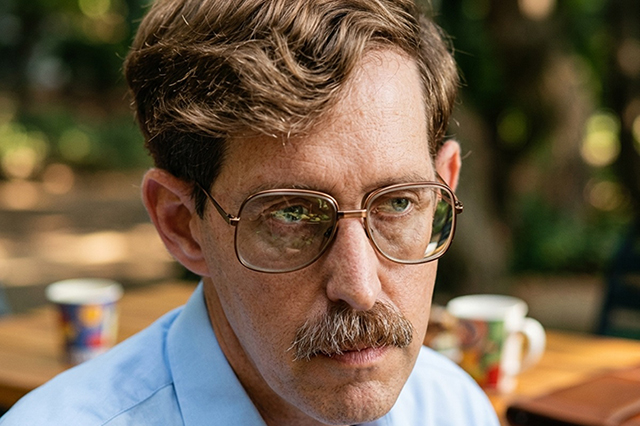
When asked about intellectual influences, he rejected the premise of mentorship. “I don’t think I had a mentor,” he said. Instead, he pointed to proximity to political figures. “I had the privilege of knowing Ben-Gurion and Golda Meir,” he said, later adding names such as Yitzhak Rabin, Ariel Sharon, and Ehud Olmert. He described these relationships as sources of observation rather than guidance. “I have learned a lot from these people… sometimes I agreed with them… sometimes I very strongly disagreed.” What he emphasised was not alignment but access. “I always had the opportunity to tell them what I think, even when I very, very strongly disagreed with them.” The emphasis remained on independence of judgement.
His account of entering academia did not include the difficulties often associated with early career stages. “I don’t think that I had any challenges that I could not easily deal with,” he said. Instead, he focused on method and position. “I found my own way in teaching that is somewhat unconventional… I am much more outspoken than most professors in academia.” He described his approach to writing in similar terms. “I have written books the way I saw fit, very often disregarding the kind of rules that people try to impose.” This refusal to conform extended to institutional incentives. “I had no interest whatsoever in being promoted,” he said, adding that promotion, when it occurred, was “of almost no significance”. What mattered was autonomy. “As long as I could do what I saw fit, that’s what I did.”
He contrasted this with what he sees as constraints in other academic systems. “I would not have had this freedom in American academia, in European academia,” he said, before adding that even within Israel, his approach was not typical. “Even by Israeli standards, I carved my own way more than most others.” The emphasis again was on independence rather than affiliation, and on the ability to maintain a direct style without institutional limitation.
When asked about advice to younger academics, his response shifted from description to critique. “I insist… that they don’t use their education instead of their common sense, but to improve their common sense,” he said. He argued that academic training can create distance from reality rather than clarity. “Many academians become detached from reality because they are very impressed by models and by theories and by academic mumbo-jumbo.” He described this as leading to “a total disregard for reality”, a phrase he repeated in different forms. His criticism was not limited to method but extended to institutions.
“What happened in many universities in America is alarming,” he said, before moving to a comparison that he framed deliberately. “I think that sending my children to Gaza is less dangerous than sending them to Harvard.” He specified that this applied particularly to humanities and social sciences, stating that students “could come back analytically retarded and morally twisted.” He described this outcome as systemic rather than isolated. “They produced a generation of people who I have no respect for reality” he said, adding that the issue was not only hostility to Israel or Jews but “a completely twisted… understanding of the world and… moral yardsticks.”
He did not present this as universal. “Of course, it is not true of all universities… and it is not true of all students,” he said, but he maintained that the pattern is concentrated in influential institutions. He described some universities as “a place where you bring up the most twisted kind of people”, framing this as a departure from their original purpose. “People were not allowed to think freely in these universities,” he said, attributing this to what he called “progressive” dominance. His language became more categorical at this point. “For me, progressives are often just a fancy version of fascists,” he said, outlining three elements: “they are racists, assuming that white people are responsible for all wrongs… they oppress free thinking and expression… and… they’re very often also anti-Semitic.”
He returned again to qualification, noting that “it is not true about everybody”, but maintained that the trend is significant. He identified the shift as relatively recent. “In the last generation, after the collapse of the Soviet Union,” he said, adding that the spread of these ideas was enabled by others. “The problem is not that the progressives are so widespread… it is that… liberals are increasingly listening to progressives.” He described this as a form of distortion. “When a liberal considers a progressive a better liberal,, he is prostituting liberal values, like a patriot who believes that a fascist is more committed to nationalism than he is”
As the discussion moved towards security, he began with contrast rather than immediacy. “Israel is facing a very difficult war with a multitude of enemies,” he said, but immediately added that the broader trajectory is one of improvement. “Israel’s situation has improved since its establishment in a radical way.” He described Israel’s early decades as defined by coordinated regional state-level threats. “The existential threat… was Arab states coming together under the leadership of Egypt,” he said. The response, in his account, combined force and compromise. “A combination of the application of force… and willingness to compromise… finally gave us more than 50 years of no regional war, when Egypt realized in the late 1970s that it cannot sustain an everlasting war with Israel.”
He contrasted this with the current phase. “What we faced since October 7th is only war with the remnants of Arab radicals… Palestinians, Hezbollah, Syria, and the Houthis, led by… Iran.” He described Israeli actions in this period as decisive. “Israel managed to hit very, very hard all the radical forces that were fighting.” He then extended the frame to include the United States. “It is now engaged with the United States… being very hard… Iran.” His conclusion returned to hierarchy. “The outcome of this war in the regional context is already that Israel is by far the most important regional power in the Middle East.” He did not describe this as resolution. “We are still having major problems,” he said.
He returned to the point that no decisive end state is to be expected soon in the region, reinforcing his earlier framing of conflict as a condition rather than an episode. “In this region, you cannot have a once and for all victory that gets rid of your enemies,” he said, before adding that relative advantage still matters. “In terms of the balance of power, it never tilted as much to the side of Israel as it does today.” This assertion was immediately qualified by caution. “We are still having serious problems that we should not underestimate.” The emphasis remained on proportional assessment rather than finality.
When the discussion moved to the events of October 7, his response was direct and layered. “Yes,” he said when asked whether it constituted a failure of Israeli intelligence, before expanding the scope of that failure. “Not only of Israeli intelligence… it was deeper than just the failure of the intelligence.” He identified three distinct dimensions. “It was a failure of intelligence… a failure of the operational response of the Israeli army… and it was a conceptual failure.” The last of these, in his account, was the most significant. “Assuming that Hamas are people like us,” he said, describing what he saw as a flawed premise underlying policy. “That you can have a long term arrangement with them by giving them the Gaza Strip as we did in 2005… by tolerating their aggression… and by improving their standard of living and their quality of life.”
In this region, you cannot have a once and for all victory… but the balance of power has never tilted as much to Israel as it does today.
He described this as a misreading of intent. “Our mistake was the assumption that they have a limited grievance,” he said, adding that this led to a belief “that you can give them something so that they will not want to kill us.” He rejected this entirely. “What we did not understand… that the only reason these people live is to kill us… they have no positive objective in their life.” He continued in the same register, describing an absence of what he termed a constructive framework. “They don’t have a constructive bone in their national body… and they are obsessed with killing Jews.” From this premise, he derived a conclusion about policy. “We must violently prevent them from getting anything that will give them the hope of extinguishing us… we must constantly beat them and not wait for them to initiate the confrontation.” He closed that segment with a summary: “This was our mistake.”
His earlier writing on disengagement from the Palestinians was raised in this context, and he responded by situating it within what he sees as present constraints. “Between Israel and the Palestinians, the prospect of a historic compromise is nonexistent at the moment… there is something profoundly wrong with the Palestinian people,” he said, before clarifying that his claim referred to collective behaviour. “what every individual Palestinian wants does not matter strategically… as a collective, the only kind of education, the only kind of leadership they have selected… is committed to killing Jews.” He framed this as the defining characteristic of the political system as he understands it. “In terms of their national objectives, this is what they are about.” On that basis, he rejected integration. “I don’t want to incorporate them into Israel.”
He then described a position he characterised as reluctant. “I would have loved if I could leave the overwhelming majority of the West Bank… and all of the Gaza Strip,” he said, before adding that this is not viable under current conditions. “But I realise that I must constantly destroy whatever they have that can [harm us].” He repeated the premise of motivation. “I know that this is the only reason they get up in the morning.” When asked whether this condition can be changed, he rejected the possibility. “I can’t… I can’t change it because there is something wrong with their political culture.” He framed the issue as fixed for the foreseeable future rather than contingent. “I would not try to change the ways of a rapist,” he said, using an analogy to describe what he sees as immutable behaviour at this historical stage. “He is a rapist… I can only prevent him… I cannot change him.” He extended this reasoning to the political sphere. “They don’t want to be changed.”
He also linked this to external support. “There are so many fools and antisemites who support [them]… that it pays for them,” he said, referring to financial aid and ideological support. “When they get billions of dollars… they spend every penny of it on war and corruption.” He described Palestinian education as reinforcing this pattern. “They educate their children with only one role model, somebody who killed Jews… they don’t have any other role model.” He acknowledged variation at the individual level but maintained his generalisation at the collective level. “Is it true about all Palestinians? Probably not. But… about the collective Palestinian political community? Yes.”
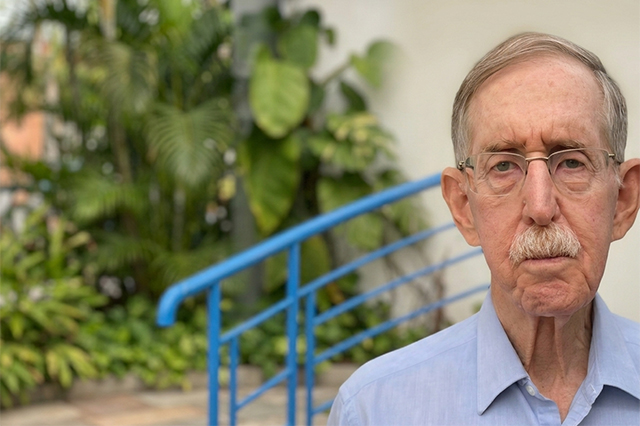
From this, he restated his preference for disengagement.. “I don’t want to live together with them, but alongside them.” He described proximity without integration. “Bringing Jews into centres of population of Palestinians is a major mistake,” he said, while also noting operational necessity. “Unfortunately, I must come into the places they live in… to catch terrorists… and to destroy their weapons.” The distinction he drew was between presence for security purposes and permanent cohabitation.
On the question of Arab citizens of Israel, he was not optimistic about the political integration of the two national collectives. t arguing that identity remains distinct. “ they want to keep their Palestinian identity.” He linked political participation to this identity. “If you become any kind of leading figure… you will subscribe to a concept that undermines the legitimacy of the Jewish state.” From this, he drew a conclusion about coalition politics. “They cannot be my political partners in a government.” He allowed for individual exceptions. “I don’t have a problem with an individual Arab who accepts Israel as the nation state of the Jewish people,” but he maintained that Arab parties, as organised entities, “have all rejected the legitimacy of the Jewish state.”
When asked to reflect on conflicts over the course of his lifetime, he declined to single out any as uniquely challenging in personal terms. “I have every day a very welcome intellectual challenge,” he said, referring to analytical disagreement rather than the act of war. “I enjoy it… it is very fruitful.” He framed challenge as a constant rather than an exception. “Anybody engaged in any intellectual activity should enjoy such a challenge.” He did not identify a moment that he found difficult to handle. “I didn’t have any analytical challenge that I could not meet.”
In discussing the evolution of Israel’s conflicts, he drew a distinction between past and present adversaries. “so far, we have not been in direct war with a non-Arab Muslim power,” he said, marking Iran as a departure. He also distinguished between regimes and populations. “We have not had before… a country whose society I respect very much, and whose leadership is barbaric.” He contrasted this with Arab states. “The overwhelming majority of the Arab population… are very radical, anti-Israeli and often anti-Semitic,” he said, describing those conflicts as involving both state and society. “In Iran… I don’t have a confrontation with the people… I have a confrontation with the regime.”
He extended this distinction into a projection. “When the Iranians get rid of the barbarians that are in power today, Israel and Iran will again become close allies,” he said, expressing what he described as “tremendous respect for the Iranian society.” He contrasted this explicitly with other societies. “Which I don’t have for the Libyan society, the Syrian society, and certainly not for the Palestinian society.” He then introduced a historical comparison. “Israel has today excellent relations with the German society,” he said, referencing the period between 1933 and 1945 as one in which “barbarians [were] ruling a people that I could respect.” He applied the same distinction to Jordan. “We have peace with Jordan… I very much respect [the monarchy and parts of the elite ]… but most of the Jordanian-Palestinian society and the supporters of the Muslim Brotherhood … I don’t respect at all.” He referred to the Muslim Brotherhood as “the catastrophe threatening the Arab world.”
Returning to Iran, he described the potential for re-alignment in the absence of the current leadership. “Not only Israel, but also the United States and Europe and the United Arab Emirates… will be delighted to have excellent relations with Iran, when the barbaric regime is not there anymore.” His assessment of the current confrontation was framed in absolute terms. “We need to break and humiliate this regime,” he said. He described incompatibility between the regime’s objectives and what he termed acceptable standards. “Whatever this regime can accept should be unacceptable to civilised people.” He characterised the dynamic as zero-sum.
Our mistake was assuming you can give them something so that they will not want to kill us… you cannot reason with that, you can only prevent it.
On the duration of the conflict, he declined to predict. “We don’t know… ask me in a few weeks,” he said, indicating uncertainty in operational timelines. On the relationship between deterrence and diplomacy, he prioritised force. “If we have deterrence, diplomacy can work,” he said, before adding that deterrence alone may be insufficient. “In some extreme cases you need more than deterrence, you need destruction.” He described deterrence as preferable to its absence but not as a complete solution.
Regarding regional actors, he described most Arab states in the gulf as constrained by fear. “They are too frightened to participate in the war,” he said, attributing this to concern over retaliation if the Iranian regime remains intact. He did not assign them an active balancing role, instead presenting them as cautious observers.
On Lebanon and Syria, he returned to the theme of limiting threats rather than restructuring states. “Regrding Hezbollah… we need to destroy them enough so that the Lebanese government can re-establish its sovereignty,” he said. In Syria, he identified a different risk. “We could face a major threat if the new regime will be dominated by Turkey,” he said, describing Erdogan’s Turkey as “an enemy… not only of Israel, but… also of the United States and essentially to NATO,” despite its formal alliance status.
When asked about Israel’s relations with Western countries, he attributed tensions to ideological shifts. “We have a problem with people who have been contaminated by progressive thinking,” he said, extending this critique to “good liberals who are confused.” He argued that this leads to misjudgement. “They focus on the imperfections of civilized societies… while practically and objectively supporting evil regimes.” He included some media within this pattern. “Many mainstreem media are a part of it,” he said, describing a combination of “shallowness, laziness, and the twisting of liberal values.” He distinguished between the blessings of liberalism and what he sees as its distortion. “Liberalism is absolutely essential,” he said, but “when [it is] prostituted by progressives… it is counterproductive and dangerous.”
He framed the issue as one of consequence. “Had we listened to progressives, Israel would cease to exist,” he said, presenting non-compliance with their dictates as necessary despite costs. “Not listening to them is unpleasant… disregarding them is penalised… but listening to them would be catastrophic.” He extended this argument to past scenarios, referencing Iraq and Syria in relation to nuclear development and framing European positions as insufficiently responsive to threat. He summarised the opposing view as “capitulation to barbarism.”
In his closing remarks, he shifted to Israel’s broader strategic position. “Even if Israel is today much less liked than before, it is dramatically more appreciated and respected,”. He pointed to relationships beyond the West. “I think that Modi understands it,” he said, referring to Narendra Modi, and noting engagement during wartime. He added that “The new government in Japan understand it, and people in Singapore understand it,” while acknowledging limits to his own scope. “I’m not knowledgeable enough about what is happening in countries in Asia… beyond India, Japan and Singapore.”
On future alignment, he expressed a clear preference. “We would like very much to work with the Indians and the Japanese,” he said, before adding a conditional reference to Australia. The statement remained consistent with his broader framing: strategic partnerships are determined by alignment of interests and capabilities rather than sentiment.