
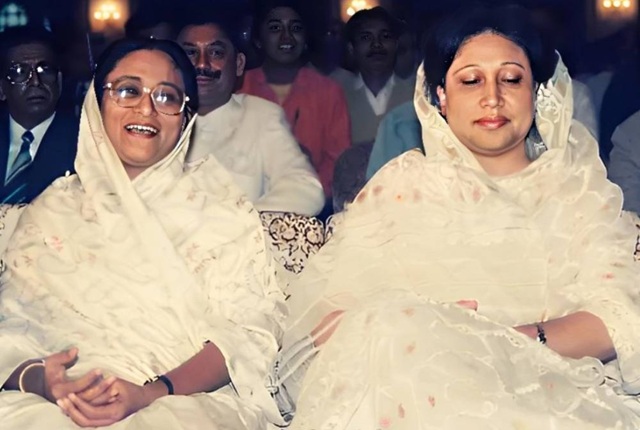
Dynastic politics is inherent to our South Asian genes, be it in Bangladesh, India, Pakistan, or Sri Lanka. We have the occasional accidental leaders, but at the core, the persistent stranglehold of familial power endures; is it a curse or a benediction? One need only gaze at the streets to witness the outcome, observe our countries’ reputations on the global stage, and contemplate the brazenness of politicians or self-proclaimed magnates who have exiled their fortunes to Australia, Europe, or North America, while their progeny are nourished by the structural miseries of the societies they purport to serve.
Today, Bangladesh is preparing for yet another landmark election, tentatively scheduled for February 2026, though political instability could postpone it, and if held, the likelihood of renewed violence remains alarmingly high. The combustible fervour of students, whipped into frenzy by social media algorithms devoid of substantive political ideology or historical comprehension, has already ejected Sheikh Hasina, now manoeuvring from India, forging temporary alignments with Islamist parties of notorious repute.
Meanwhile, the Bangladesh Nationalist Party, long ostracised, watches as its matriarch’s mantle passes to the next generation. Khaleda Zia’s death at the age of 80, a few days after her son Tarique Rahman returned from nearly two decades of exile, crystallises a peculiar historical symmetry and invites reflection on the interplay of personal loss, dynastic inheritance, and political agency.
In August 1960, Ziaur Rahman’s marriage was arranged to Khaleda Khanam Putul, the fifteen-year-old daughter of Iskandar and Taiyaba Majumder from the Feni District, then part of Noakhali. A girl of tender years, below the age for matrimony as stipulated by the Child Marriage Restraint Act of 1929—though such unions were socially tolerated at the time—she was thrust into the intimate sphere of a national figure, her childhood subsumed by obligations that would eventually entwine with the destiny of a nascent nation. Khaleda, from these humble origins, would ascend to serve as Prime Minister three times, each term marking the consolidation of her own authority within the BNP and the wider political theatre of Bangladesh.
Similarly, Sirima Ratwatte Dias, later Sirimavo Bandaranaike, was twenty-four when she married Solomon Bandaranaike in October 1940; he was forty-one, a seasoned political operator whose ambitions she would ultimately inherit and transform. Born in April 1916, Sirimavo’s early life bore none of the privilege that often characterises dynastic heirs; yet, following her husband’s assassination in 1959, she emerged as the world’s first female Prime Minister, commanding both party and state apparatus with a dexterity that belied her initial domestic seclusion.
Both Khaleda and Sirimavo illustrate the paradox of dynastic politics: they were ordinary housewives, subjected to patriarchal expectation, and yet catapulted into the epicentre of national governance. The circumstances of their political genesis were harrowing. Ziaur Rahman’s assassination in May 1981 left Khaleda, a thirty-five-year-old mother of two, in a vortex of political uncertainty, with the BNP fractured and rudderless. Similarly, the Bandaranaike assassination in 1959 left Sri Lanka’s Freedom Party without a steward, and Sirimavo, previously relegated to the domestic sphere, assumed leadership. Their rise was less a product of ambition than of necessity, yet necessity in these contexts was alchemised into political acumen.
The ensuing trajectories of their leadership illuminate the interplay of personal fortitude, strategic vision, and systemic antagonism. Khaleda Zia’s tenure was punctuated by relentless contention with Sheikh Hasina, whose political heritage and operational ruthlessness provided a formidable counterweight. Hasina’s regime, particularly prior to her ousting, exercised judicial and institutional mechanisms to marginalise Khaleda, notably restricting access to medical treatment under the pretext of pending litigation. Observers widely interpreted these manoeuvres as politically motivated vendettas. Ironically, the tables have inverted: Hasina now contends with forces previously mobilised against her, confronting Islamist alignments and student unrest, the same instruments she once directed.

Sirimavo, conversely, contended with the formidable authority of J. R. Jayewardene, whose constitutional innovations in 1978 endowed the Sri Lankan presidency with near-impunity and concentrated power in the executive. After assuming office, Jayewardene even stripped Sirimavo of her civic rights, legally barring her from contesting elections and directly constraining her influence. Her tenure was constrained by structural authoritarianism, yet she steered party coherence, sustained alliances, and articulated policy within the confines of a system that was, by design, inimical to opposition.
Both women also exemplify the intertwining of dynastic continuity and political survival. Khaleda’s son, Tarique Rahman, returned from exile with the implicit expectation of inheriting his mother’s mantle; Chandrika Bandaranaike Kumaratunga’s presidency in 1994 epitomised the fulfilment of her mother’s political inheritance. These successions are not mere familial continuities; they reflect the institutionalisation of power within kinship networks, the cultivation of political capital that is both personal and structural, and the embedding of family as both symbolic and operative locus of governance. As BNP observers note, Khaleda transformed herself into an “institution,” her persona enmeshed with the machinery of the party and the broader expectations of governance, while Sirimavo’s stewardship similarly blurred the boundary between individual leadership and party identity.
The human dimension of these narratives is as compelling as the political. Khaleda endured repeated incarceration, the deaths of her husband and younger son, and the exile of her eldest son, all while orchestrating party strategy from confinement or under siege. She remarked with characteristic resolve, “I have no address outside the country; this country, the soil and people of this country are everything to me.” Sirimavo, while operating within a different temporal and cultural milieu, faced analogous pressures: her authority was contested, her policies scrutinised, and her personal life inexorably entwined with the fate of the Sri Lankan polity. Both confronted patriarchal suspicion, systemic marginalisation, and the exigencies of office, converting adversity into political endurance.
The parallelism extends to marriage and early socialisation into political life. Khaleda’s arranged union at fifteen contrasts with contemporary legal standards, yet mirrors a regional pattern wherein early matrimonial alliances facilitated entry into political hierarchies. Sirimavo’s marriage, though at twenty-four, similarly positioned her within a nexus of political ambition. Both women internalised domestic expectations while simultaneously cultivating public authority, demonstrating that personal resilience and political dexterity are deeply interdependent.
It is within these crucibles of personal tragedy and political contestation that their legacies crystallise. Khaleda’s orchestration of coalition politics, from seven-party alliances against Ershad to four-party and later twenty-party formations, evinces a capacity for strategic compromise without forfeiting core authority. Sirimavo’s manoeuvres within a constitutional framework designed to limit opposition reflect a parallel adaptability, balancing ideological fidelity with the imperatives of governance. Both demonstrate that dynastic politics in South Asia is not merely inheritance but a negotiated mastery of circumstance, charisma, and calculation.
Yet the moral valence of these trajectories is ambiguous. The centralisation of familial authority and the intergenerational transfer of political capital raise questions about equity, meritocracy, and democratic integrity. Dynastic politics simultaneously stabilises party structures and entrenches hierarchical privilege. In observing Tarique Rahman’s return to Bangladesh, one cannot ignore the historical resonance of dynastic succession and the attendant tensions between legitimacy derived from electioneering versus inheritance. Similarly, Chandrika’s rise in Sri Lanka illuminates the duality of continuity: it preserves political memory but also concentrates authority in familial hands.
The adversarial relationships they faced further sharpen the narrative. Khaleda’s enmity with Sheikh Hasina, crystallised over decades, illustrates how personal animosity intertwines with structural opposition, judicial contestation, and electoral rivalry. Sirimavo’s dealings with Jayewardene demonstrate how constitutional design can be weaponised to circumscribe opposition, compelling tactical adaptation and alliance-building. In both cases, female leadership confronted patriarchal, authoritarian, and institutionalised barriers, converting constraints into arenas for strategic innovation.
Their stories, taken together, provoke reflection on the enduring paradox of South Asian politics: the simultaneous necessity and peril of dynastic continuity, the moral ambiguities of inherited power, the interplay of personal tragedy and public duty, and the capacity of individuals to shape institutional legacies. Khaleda and Sirimavo exemplify the extraordinary consequences of circumstance meeting agency, the alchemy of personal resilience into national leadership, and the inescapable entanglement of family and statecraft. Their lives suggest that in the subcontinent, dynasties are not mere relics of privilege but enduring instruments of governance, capable of both stabilising and destabilising the polity, embodying the contradictions, ambitions, and pathos of modern South Asian history.