
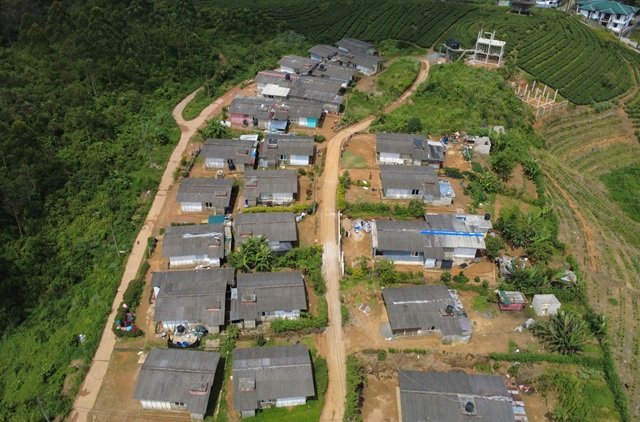
The lack of adequate and dignified housing has been one of the primary human rights and infrastructure issues faced for decades by the estate community, who are the producers of Sri Lanka’s plantation sector. Transitioning away from the colonial-era “Line Rooms” culture and realizing the dream of becoming permanent homeowners, the Government of India (GoI) is providing remarkable financial and technical assistance to Sri Lanka. According to official data documents, 4,000 houses constructed under Phase I of the Indian Housing Infrastructure Project have been distributed across plantation districts and regional estate levels. It is a notable feature that these distributed houses are not limited solely to the plantation sector, but arrangements have also been made to distribute them to homeless people in the Southern Province of Sri Lanka.
When examining how the houses are distributed at the district level, Nuwara Eliya District has been provided with 1,312 houses (32.8% of the total) covering 9 major estates including Dunsinane, Linden, Mornington, and Liddesdale. Similarly, within the Badulla District, 865 houses (21.6% of the total) have been provided for 13 estates including Ledgerwatte, Sarnia, Warwick, Spring Valley, Telbedde, Kumarawatte, and Glenanore. Another 823 houses (20.6% of the total) have been provided for 15 estates in the Kandy District including Helboda, Rookwood, Hantana, Kaleabokka, Hagala, and Elkaduwa; 730 houses (18.3% of the total) for 9 estates in the Hatton region including Bogawantalawa, Lethenty, Fetteresso, Wanarajah, and Welioya; and for the Galle District in the Southern Province, 270 houses (6.7% of the total) have been provided for estate premises including Ensalwatte, Indola, Talgaswela, Beverly, and Walahanduwa.
Examining this data reveals that while priority is given to the Central region where the highest plantation population resides, a special highlight is that plantation people in the Southern Province (Galle) have also been included in this project. Furthermore, priority lists for the next phases (Phase IV – 3,225 houses and 4,700 houses under the 10,000-unit proposal) are already being prepared, and remote plantation areas such as Ampara (Cosmeena, Melwam), Gomagalla, Kanawaralla, Kingsley, and Pingama have also been integrated into this development process.
Special Support of the Indian Government and Institutional Responsibilities
This project is not limited merely to providing financial allocations, but is a comprehensive bilateral program featuring direct supervision and joint implementation with the Sri Lankan government and local institutions. According to the official Project Description, institutional responsibilities are divided as follows:
Supervising the overall project on behalf of the Government of India regarding these houses, releasing financial allocations in installments, and ensuring the quality of the Implementing Agencies are carried out by the High Commission of India (HCI). Furthermore, fully funding common infrastructure including internal roads, storm-water drainage systems, water supply, and electricity supply is also carried out by the High Commission of India (HCI). Additionally, selecting suitable land for housing construction in collaboration with Regional Plantation Companies (RPCs), land surveying work, and obtaining necessary approvals through the Urban Development Authority (UDA), Central Environmental Authority (CEA), and National Building Research Organisation (NBRO) are performed by the Plantation Human Development Trust (PHDT).
In addition, organizing beneficiary families, deploying skilled workers, procuring building materials, and managing dedicated Individual Ledger Accounts for the beneficiaries are carried out by the Estate Worker Housing Cooperative Societies (EWHCS). A unique feature of this project is the direct involvement of beneficiary family members in the process of building their own homes while enhancing the technical skills of local artisans.
This financial and infrastructure grant from the Government of India is an approach that offers a sustainable solution to the challenges faced by the plantation community. Although these housing projects, implemented with strict transparency, environmental approvals, and direct contribution from the beneficiaries, are an important step taken to elevate the living standards of the estate population and to further strengthen Sri Lanka-India bilateral friendship, managing these funds properly and utilizing them for the long-term well-being of the people is the duty of the government of this country as well as state officials.