Germany is preparing for the possibility of ordering soldiers to join its permanent military deployment in Lithuania as it struggles to secure enough volunteers for the mission aimed at strengthening NATO’s eastern flank against Russia.
Defence Minister Boris Pistorius said the government’s initial plan to increase the German armoured brigade stationed in Lithuania entirely through voluntary participation may not be realistic. While the armed forces continue to prioritize voluntary service, Pistorius said some personnel may ultimately have to be assigned to the mission if operational requirements cannot be met.
“The German Army continues to rely on voluntariness,” Pistorius said during a visit to Lithuania this week. However, he added that he was certain “in the end some will not go there because they want to.”
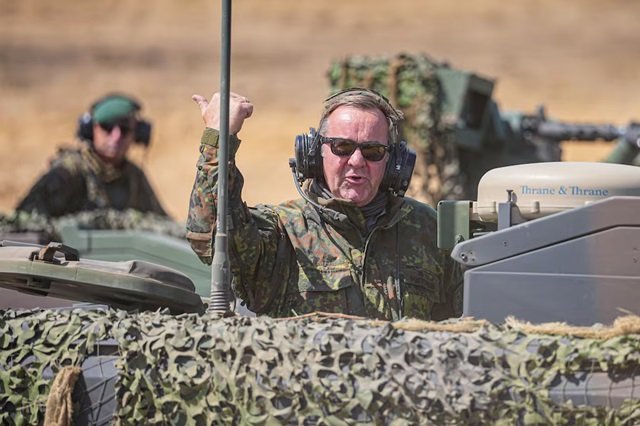
The minister’s visit coincided with the Freedom Shield 2026 exercise at the Pabradė training area near Lithuania’s border with Belarus. The drill marks the first major combat exercise for Germany’s 45th Armoured Brigade on Lithuanian territory and is intended to prepare the unit for future exercises planned twice a year.
“For me, it is essential that the brigade is ready and able to fulfil its mission,” Pistorius said alongside his Lithuanian counterpart, Robertas Kaunas.
The 45th Armoured Brigade represents Germany’s largest permanent overseas military deployment since the Second World War. The unit entered service in April 2025 after Berlin decided in 2023 to establish a permanently stationed combat force near the Suwałki Gap, a strategically important area connecting Poland and Lithuania between Belarus and Russia’s Kaliningrad enclave.
Germany plans for the brigade to reach full operational capacity by the end of 2027, with approximately 4,800 soldiers and 200 civilian employees. Around 1,800 Bundeswehr personnel are currently stationed in Lithuania, with the number expected to rise to 2,000 by the end of the year before additional forces are deployed to create five battalions.
Before travelling to Lithuania, Pistorius had already indicated that compulsory assignments could become necessary. In an interview with German public broadcaster ARD, he said there would likely be a percentage of personnel who would have to be required to take part in the foreign deployment.
The staffing challenges are particularly significant in specialized fields, including engineering, logistics and ABC defence, which covers protection against nuclear, biological and chemical threats. Pistorius said the pool of potential candidates in these areas was considerably smaller than among combat troops.
The Defence Ministry said that voluntary participation would remain the first option, but operational readiness would take priority if staffing levels proved insufficient. The ministry said personnel would first be consulted, but deployment orders could be issued if necessary.
The Lithuania mission carries particular importance because of its location on NATO’s eastern border. The Suwałki Gap, which is about 65 kilometres wide at its narrowest point, is considered a vulnerable area in European defence planning. Germany’s armed forces describe it as a potential starting point for a Russian military attack against NATO territory. If the corridor were controlled by Russian forces, Estonia, Latvia and Lithuania could be isolated from the rest of the alliance.
The possibility of mandatory assignments has already triggered political reactions in Germany. Green Party security policy spokeswoman Sara Nanni called on the Defence Ministry to examine why it was failing to attract enough volunteers. She suggested officials should speak directly with soldiers who had previously served in Lithuania and those who had declined to volunteer.
Meanwhile, parliamentary military commissioner Henning Otte called for greater clarity over who would serve in Lithuania in the future.
The debate comes as Germany continues a broader military expansion effort. Berlin has increased defence spending in recent years with the goal of building what Pistorius has described as Europe’s strongest conventional military force, including at least 460,000 active personnel and reservists. The government expects defence spending to reach 3.5% of gross domestic product by 2029.
Germany also reintroduced military service this year, initially on a voluntary basis, while keeping open the possibility that compulsory service could return in the future. For now, authorities are registering all citizens born from 2008 onward as part of preparations for the expanded system.