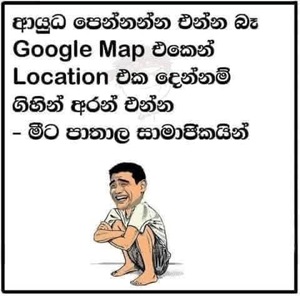
Ah, the charming world of law and order, a veritable comedy of errors where the stakes are high, the players illustrious, and the plot thickens with every legal drama. In the latest act of this spectacular farce, social media has decided to weigh in on the fine art of extrajudicial killings, no less, offering sage advice to the beleaguered police force of Sri Lanka. One would think this was a matter for the great philosophers or at least a moderately competent legal counsel, but no! It falls squarely on the shoulders of internet sages, who, in their infinite wisdom, have decided that, if underworld members are to be apprehended, they should simply ping the police with a Google location. Oh, what a novel idea! Why, for centuries, we’ve been muddling through vague descriptions, breadcrumbs, and tenuous police leads when all along, the answer was as simple as pressing “send location” on your mobile app. One cannot help but applaud such brilliance, for in the midst of the chaos that is Sri Lanka’s law enforcement, surely, it is just the sort of clarity we need.

Let us revisit the alleged incident that sparked this wave of online wisdom. Two alleged gunmen were brought to the gallows—or more accurately, a hail of bullets—by the police, who, according to their narrative, had no choice but to unleash the full force of their firearm might. The brave gunmen, handcuffed, with heavy security in tow, were apparently so overcome by the urge to escape their fate that they made a valiant attempt to wrestle the Officer-in-Charge’s (OIC) pistol. A move that, naturally, left the police with no option but to respond in kind, or so the story goes. Truly, one can only marvel at how these dramatic exchanges play out in the streets of Sri Lanka, where police officers are perpetually at the mercy of would-be desperadoes—each situation more dangerous than the last.
And yet, here lies the problem. The narrative, as it is described, provides a wonderfully theatrical twist, but lacks the requisite details to verify these claims. Who’s to say what truly transpired in the shadow of those dimly lit alleys? For the Sri Lankan police, these extrajudicial killings have, it seems, become an integral part of the theatre of law enforcement. Why bother with pesky little things like due process when you can stage an impromptu performance of Death and Glory on the streets?
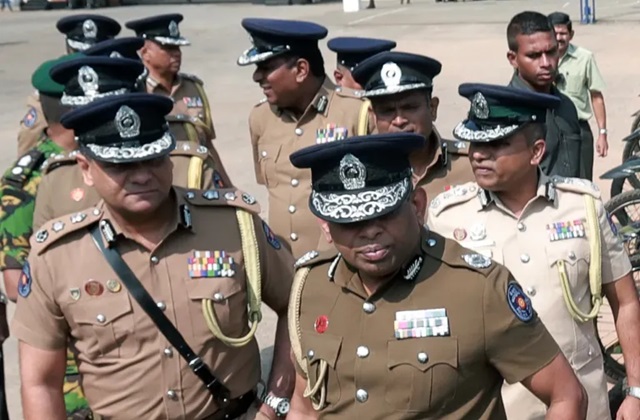
The police, naturally, have an answer to this. According to the Acting Inspector General of Police (Acting IGP)—who, in an unfortunate parallel to the current state of affairs, is apparently embroiled in a rather unseemly tug-of-war with the Police Commission—the killings were entirely necessary. Well, of course they were! Who in their right mind would question the moral certitude of those entrusted with upholding the law? Just as no sane person would challenge a Shakespearean villain’s desire for dramatic flair, surely we must all accept that these necessary actions were but the natural consequence of a crime-ridden society. Perish the thought that there may be other ways to subdue suspected criminals, ways that involve a tad more finesse and a modicum of legal propriety.
But I digress. Let us return to the larger-than-life courtroom drama that unfolds over the appointment of Deshabandu Tennakoon as the Inspector General of Police. Ah, the appointment, the pièce de résistance of Sri Lanka’s administrative theatre! A decision so fraught with legal complexity that it necessitates not one, but nine Fundamental Rights Petitions. These petitions, filed by the Archbishop of Colombo himself—whose presence in a legal battle is surely the mark of a truly epic tale—seek to challenge the very constitutionality of Tennakoon’s appointment. One can only wonder: What is the cause of this righteous outcry? Is it simply the pesky little matter of a legal oversight in the selection process? Or is there something more? Is this an attempt to remove a figure of great power and influence from his lofty perch? The petitions are as murky as a mist-laden morning, but the courtroom drama promises to be equally riveting.
Now, I must confess that I am captivated by the legal legerdemain unfolding before us. How delightful it is to watch a five-member Supreme Court bench preside over a case involving the potential illegalities of a police appointment! What a fine ballet of jurisprudence it is—five justices, each performing a delicate pirouette in their interpretation of the law. The petitioners, with their noble and lofty intentions, have banded together in an alliance so fraught with gravitas that one could almost hear the epic music swelling in the background. I imagine the proceedings might include dramatic pauses and sweeping gestures as President’s Counsel Romesh de Silva, acting on behalf of Tennakoon, takes the stage. His claim that the interim injunction should be expedited is delivered with all the fervour of a courtroom starlet demanding justice. But no, alas, the plot thickens, and the bench decrees that the hearings shall be held not today, not tomorrow, but in May, as though to stretch the suspense further. What a delicious touch! We wait with bated breath.
In the meantime, we, the audience, are left to ponder: What is the true meaning of justice in Sri Lanka? Is it a swift execution on the streets or a constitutional showdown behind closed doors? Should the police be lauded for their heroism, or are we witnessing the tragicomic fall of an institution desperate to reclaim its former glory? Ah, the questions, the riddles, the nuances! I dare say, dear readers, we are but players on this grand stage of legal and social absurdities, where every act leads to a new crescendo of farce.
Shakespeare, were he to see this spectacle, would doubtless say, “All the world’s a stage,” but in Sri Lanka’s case, perhaps the world is a bit more of a circus. And as we watch these clowns juggle guns, law, and constitutional rights, we can only marvel at the brilliance of the performance. Bravo, Sri Lanka, bravo.