by Eric
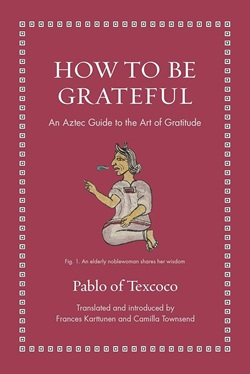
To read How to Be Grateful: An Aztec Guide to the Art of Gratitude is to encounter gratitude not as a soft moral sentiment but as a cultural force powerful enough to outlive conquest, trauma, and the slow erosion of memory. The book opens with a simple scene: “One mid-sixteenth-century day, a Nahuatl-speaking woman stopped by to visit some family members on her way to market.” What seems at first like an ordinary moment becomes the foundation upon which Pablo of Texcoco constructs an entire philosophy of human interdependence. This passing visit—so unremarkable on its surface—becomes a master class in how the Nahuas conceived gratitude: as obligation, as respect, as recognition of what ties people together across generations. She addresses her elders “in a polite and formal register intended to convey her respect for them as well as her gratitude for all they had done in their younger years.” In that gesture, Pablo sees a whole world.
The power of this book lies in the way it exposes gratitude as an organizing principle of Aztec society, one that contemporary individualistic cultures might find radically foreign. The editors capture this when they observe that, for the Nahuas, attaining wisdom meant learning “to understand oneself as a small part of a greater interdependent whole, not only of a community of living people, but also of a collectivity constituted across generations.” It is not self-actualization that makes a person wise in this tradition; it is the recognition of debt—to parents, to ancestors, to the divine, even to those not yet born. Gratitude is a way of maintaining cosmic balance.
Pablo’s dialogues, preserved through a remarkable chain of transmission, amplify this ethos. The text we have today survives from a Jesuit copy made by an Indigenous aide known only as “don Miguel,” who inserted careful notations marking vowel length and glottal stops. This attention to linguistic fidelity underscores how intensely the Nahuas valued the spoken art. As the editors note, Pablo was trained in “the Nahua art of rhetoric,” a ceremonial performance practice still found in modern Nahuatl-speaking communities. The rhetorical crescendos in his dialogues—wedding speeches, greetings, blessings, lamentations—are reminiscent of ancient oratory, but they also feel startlingly alive. Even the most formulaic phrases pulse with emotional charge.
In one wedding speech, a mother addresses the governor who presides over the ceremony: “Are we his vassals so fortunate as to enjoy his lordship and rulership? Is he indeed lending himself to us for a while?” The language is deferential but not servile; it communicates a deep awareness of mutual dependence and reciprocal obligation. She ends with a wish that sounds almost like a prayer and a command at once: “Let us rejoice that our Lord has brought us together here.” Here gratitude is not passive acknowledgment; it is a performative act that creates social harmony.
But Pablo’s most provocative contribution is not the grandeur of his ceremonial rhetoric; it is the way he smuggles gratitude into the most ordinary moments. Two mischievous boys, after being fed, proclaim, “The heart of our Lord has granted things,” a phrase that amounts to “I give thanks to our Lord,” but with a cosmic register entirely absent from modern expressions of thanks. When an elder is visited, the visitor says, “You have befriended us by visiting,” or, in more idiomatic English, “We thank you.” This formulation—“you have befriended me”—captures gratitude as personal relationship, not transaction. It suggests that gratitude is not something one offers; it is something one embodies.
The dialogues also show that the Nahuas possessed no direct equivalent for our word “gratitude.” Instead, they described its effects, its sensations, its relational contours. The book notes that speakers frequently describe receiving something as “enjoying it, deserving it, being so lucky to get it.” Another phrase—“to acknowledge as very dear”—is used in the line, “I acknowledge as very dear your inquiry, your greeting.” This, the editors explain, is the ancestor of the modern Nahuatl term tlazocamati, still used today to say “thank you.” Gratitude here is framed not as duty owed but as affection recognized.
This linguistic subtlety is matched by the text’s narrative ambition. Pablo creates a triptych: scenes in the present, scenes in the past, and a return to the present. The middle section transports the reader into preconquest Texcoco, where emissaries negotiate marriage alliances that bind noble families across altepetl. The rhetoric is ornate, but the stakes are grounded in the reality of how communities sustain themselves. A speaker addressing a new bride and groom declares, “What will the Giver of life desire for them? Let us be awaiting of Him whether He will give them health, whether He will give them a good portion of His time.” The line acknowledges the fragility of human life and simultaneously affirms the sacred obligation to hope, to work, and to endure.
The book’s most moving reflection on gratitude occurs in the editors’ commentary on the Nahua worldview: “Life on earth is hard, they thought, and there is very little room for selfishness if humans are to avoid disaster.” This stark insight unsettles modern readers accustomed to thinking of gratitude as a therapeutic practice, something to boost happiness or resilience. Pablo’s world does not flatter us with such comforts. Gratitude is not a tool for personal well-being; it is a foundation of collective survival. The dialogues insist repeatedly that individuals “will be loved and honored if they exert themselves and do their utmost to repay those who have always worked on their behalf.” Gratitude is expressed through action—through “paying it forward,” through fulfilling one’s duties, through raising the next generation with care and seriousness.
This sense of continuity across generations becomes poignantly clear when the text describes how people in Pablo’s time looked back to the era before the Spaniards arrived: “People in the 1560s or ’70s harken back to the 1490s or early 1500s, seeking guidance and expressing gratitude.” The ancestors, in turn, are imagined as speaking to posterity, conveying “their expectation that as people of the past, they will be appreciated.” Gratitude flows backward and forward, binding the living and the dead in a ritual chain of mutual acknowledgment.
The book is also refreshingly candid about the hybrid nature of the surviving text. Pablo was baptized, Christianized to an extent, and clearly influenced by European rhetorical traditions. The dialogues occasionally refer to “our Mother the holy church” and to “our Lord the Giver of life,” demonstrating a fusion of Catholic and pre-contact metaphysics. Yet the editors emphasize that the core of the work remains profoundly Indigenous. Christian elements appear but do not dominate; they sit alongside Nahua concepts of duty, community, and the sacredness of speech.
What emerges is a text that resists easy categorization. It is not a pristine relic of preconquest thought, nor is it a colonial catechism cynically shaped for missionary purposes. It is something far more challenging: a work of Indigenous art created in a moment of historical rupture, using new tools to preserve old values. Pablo may have adopted alphabetic writing from European friars, but he used it to record “the values of his people and the mental world they inhabited.”
The most provocative aspect of this book is the way it forces modern readers to confront their own impoverished assumptions about gratitude. In our world, gratitude is often instrumentalized: a technique for self-improvement, a social nicety, a hashtag. Pablo’s world instead understands gratitude as the connective tissue of moral life. It is not about feeling good—it is about doing good. It is not about the self—it is about the community. It is not about positivity—it is about responsibility.
In its insistence that our lives are inseparable from those who came before and those who will come after, How to Be Grateful offers a philosophy that is both ancient and urgently needed. The Nahuas remind us that gratitude is not an emotion but a practice, not a sentiment but a structure. It binds the living, honors the dead, and secures the future. In a fragmented world that worships autonomy, Pablo’s dialogues confront us with a more demanding truth: we are indebted beings, and our freedom depends on recognizing those debts with humility, action, and, yes, gratitude.