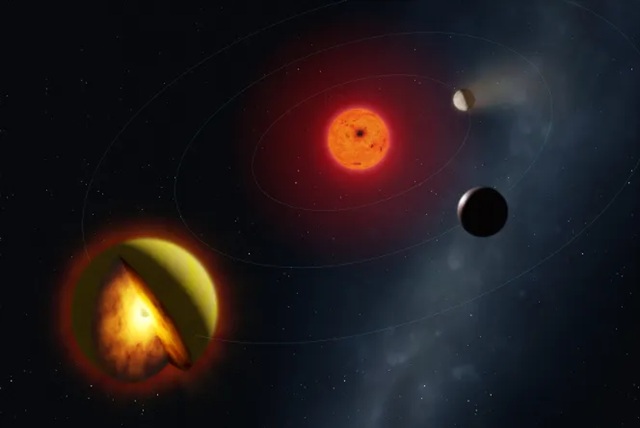
Astronomers at the University of Oxford have announced the discovery of a planet so extreme it evokes visions of literal hell. Known only as L 98-59d, the world is cloaked in a global ocean of molten rock beneath an atmosphere rich in hydrogen sulphide, reaching temperatures as high as 1,500 degrees Celsius. The finding, described by the researchers as a “new class of molten planet,” challenges the traditional categories of exoplanets and hints at a far more diverse universe than previously imagined.
“This discovery suggests that the categories astronomers currently use to describe small planets may be too simple,” said Dr. Harrison Nicholls of Oxford’s Department of Physics. “While this molten planet is unlikely to support life, it reflects the wide diversity of the worlds which exist beyond the solar system. We may then ask: what other types of planet are waiting to be uncovered?”
Exoplanet discoveries have surged in recent decades, surpassing 6,000 confirmed planets as of last September. Yet L 98-59d stands apart. Orbiting a small red star roughly 35 light-years from Earth—a journey that would take nearly a million years at the speed of the Apollo spacecraft—the planet is about 1.6 times larger than Earth but unusually low in density. Observations from the James Webb Space Telescope revealed that its thick atmosphere contains high levels of hydrogen sulphide, likely giving the air a pervasive odor reminiscent of rotten eggs.
Traditionally, planets of this size and composition would fall into one of two categories: either rocky “gas-dwarfs” with light hydrogen atmospheres or water-rich worlds with deep oceans and icy layers. L 98-59d defies both definitions. Instead, it hosts heavy sulphur molecules suspended above a mantle of molten silicate rock, forming a magma ocean thousands of kilometres deep. “It appears to belong to an entirely different class of planet,” Oxford researchers said, signaling the recognition of a new population of sulphurous, lava-drenched worlds.
The discovery was made possible through collaboration with teams from universities in Leeds, Groningen, and Zurich, who reconstructed the planet’s history over five billion years. Unlike early Earth, which once had a molten surface but eventually cooled to form a solid crust, L 98-59d’s evolution appears markedly different. Its iron core is smaller relative to its size than Earth’s, and the planet’s thick, greenhouse gas-laden atmosphere prevents the surface from ever solidifying. The result is a planet trapped in a state of eternal magma, glowing under the light of its nearby red star.
The extreme conditions on L 98-59d highlight how planets may evolve under circumstances alien to the solar system. While Earth cooled to form habitable environments, this super-Earth seems fated to remain a fiery, molten world. “This is not a juvenile version of Earth,” Nicholls explained. “It formed and evolved in a way strikingly different to the planets in our solar system.”
The implications of the discovery reach beyond the planet itself. Astronomers often define a “habitable zone” around stars, sometimes called the Goldilocks zone, as the region where temperatures allow liquid water to exist—an essential condition for life as we know it. L 98-59d orbits within a region that might otherwise be considered temperate for habitability, yet its surface is molten. The finding suggests that proximity to a star alone may be insufficient to identify planets capable of supporting life, and that the diversity of worlds in our galaxy may challenge longstanding assumptions about habitability.
Beyond its scientific significance, L 98-59d captures the imagination with its nightmarish landscape. Picture rivers of glowing lava stretching across a planet-wide ocean, under a sky dense with clouds of sulphurous gas. Volcanic activity likely rages continuously, fueled by the planet’s internal heat and persistent greenhouse effect. It is a world that, while inhospitable to life, offers a stark reminder of the extremes possible in the cosmos.
The team’s findings not only expand the taxonomy of planets but may also guide future observations. As instruments like the James Webb Space Telescope and upcoming exoplanet missions refine their ability to probe distant worlds, astronomers will search for more planets that defy conventional categories. L 98-59d may be the first recognized member of a broader population of lava-covered, gas-rich planets—worlds whose discovery could redefine our understanding of planet formation, atmospheric chemistry, and the sheer scale of planetary diversity in the universe.
“This is just the beginning,” Nicholls said. “If a planet like this exists only 35 light-years away, it raises the exciting possibility that many more exotic worlds are waiting to be discovered. Some may even challenge our assumptions about what conditions are necessary for life—or reveal entirely new planetary phenomena we have yet to imagine.”
In a universe teeming with more than six thousand known exoplanets, L 98-59d reminds us that the cosmos is not just vast—it is profoundly strange. With molten oceans, sulphur-laden skies, and temperatures far beyond anything experienced on Earth, it is a planet that embodies extremes. For scientists and dreamers alike, it offers a vision of a world both terrifying and awe-inspiring, expanding the boundaries of what we know about the planets that orbit stars far beyond our own.