MIT Technology Review explores the rise of co-creativity in the age of generative tools
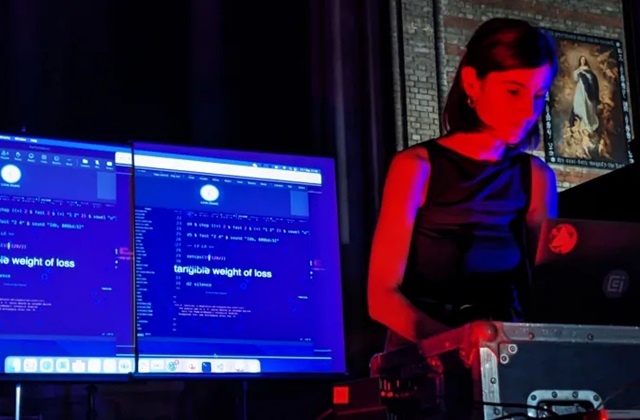
In a low-lit loft in East London, techno music pulses through the speakers as Lizzie Wilson types code on a glowing screen. But this isn’t your average DJ set. Wilson, a researcher at the Creative Computing Institute at the University of the Arts London, is live coding—an avant-garde performance where she composes electronic music in real time, line by line. Her co-performer? An artificial intelligence model generating beats and loops of its own.
This striking image of human-machine collaboration is part of a broader creative movement explored in MIT Technology Review’s recent feature on how AI is being used not to replace, but to supercharge human creativity. The article delves deep into what researchers and artists are calling “co-creativity”—a vision of AI as a creative partner that adds friction, unpredictability, and inspiration to the artistic process.
Wilson’s AI “sidekick,” trained on a community’s shared code, often throws unexpected elements into her live sets—beats she wouldn’t have imagined herself. Sometimes, those surprises are brilliant. Sometimes, they’re chaotic. But that’s the point. “You just have to go for it,” she says. Mistakes, crashes, even failure are welcome—applauded, even—by audiences who crave the rawness of imperfection.
As MIT Technology Review points out, this approach stands in stark contrast to the polished output of commercial generative tools like Midjourney, DALL-E, or Google DeepMind’s models, which offer quick results but little opportunity for creative dialogue or iterative refinement. The one-click nature of such tools may democratize access to content creation, but some researchers worry they also diminish the creative process itself.
“You don’t become an artist by clicking a button,” says Jeba Rezwana, a co-creativity researcher at Towson University. She, along with others like computational creativity expert Mike Cook from King’s College London, argue that meaningful creativity requires effort, reflection, and—crucially—failure. Generative AI, they caution, can shortcut that learning curve in a way that leaves users passive and creatively stunted.
Instead, researchers and artists are exploring tools that provoke, question, and even challenge their users. Cook has developed game design AIs like Puck and Pixie that offer strange, sometimes unusable results—not because they’re broken, but because they force designers to think differently. In one case, Pixie reimagined a video game level by freezing all moving parts, turning an action game into a tense, strategic puzzle. It wasn’t what Cook asked for, but it gave him an idea he’d never considered.
The idea of AI as a collaborator—not just a tool—is gaining traction. At the Delft University of Technology, researcher Anne Arzberger developed AI models to help toy designers challenge gender biases. Her system didn’t just generate gender-neutral toy ideas; it exposed subconscious design assumptions, becoming a kind of algorithmic mirror.
Meanwhile, artists like Terence Broad push AI to its experimental limits, bending neural networks and stripping them of training data to create glitchy, abstract visuals akin to digital Rothkos. These projects embody what Nick Bryan-Kinns, another researcher at the Creative Computing Institute, calls a shift in mindset: treating AI not just as software, but as an artistic medium.
Yet, for all the excitement, barriers remain. Many of these co-creative tools are difficult to use without coding knowledge, and commercial platforms rarely prioritize nuanced, reflective interactions. As Bryan-Kinns notes, “You’ve got this gulf between commercial tools with zero control, and experimental tools that only a handful of people can use.”
Still, the work being done today is laying the foundation for a more interactive, human-centered future of creativity—one where artists aren’t replaced by AI, but pushed further by it. Wilson captures the spirit of this movement best when she imagines a performance where the AI is intentionally antagonistic, like a creative partner arguing back. “That would be interesting to watch,” she laughs. “That’s part of the creative process.”