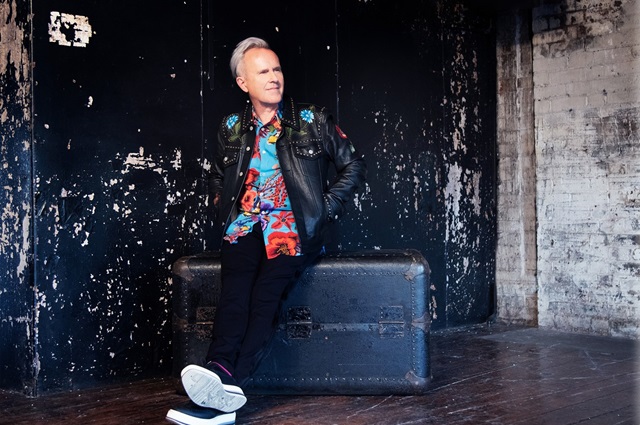
For Howard Jones, enlightenment began with chaos — “a slow-motion explosion of fruit and veg,” as he describes it. In the early 1980s, long before Things Can Only Get Better became an anthem of optimism, Jones and his wife, Jan, ran a greengrocer’s van. One night, a drunk driver smashed into it, injuring a customer and trapping Jan beneath the wreckage. “We both could have died that night,” he recalls. The insurance payout from the crash became their lifeline — and, at Jan’s insistence, the seed money for his music career. “She said, ‘Let’s not waste any time and absolutely go for it.’ It was a turning point.”
Within a few short years, Jones had become one of the defining solo artists of the 1980s, a one-man synth-pop powerhouse turning introspective lyrics into chart-topping hits. Between 1983 and 1986, he landed six UK Top Ten singles, including What Is Love?, Like to Get to Know You Well, and Hide and Seek, alongside two US Top Tens: No One Is to Blame and Things Can Only Get Better. His performance at Live Aid, where tens of thousands sang Hide and Seek back to him, remains one of his fondest memories. “It was magical — completely uplifting,” he says.
Today, at 70, Jones’s music still resonates across generations. Thanks to TikTok, the Watchmen TV series, and even Grand Theft Auto: Vice City Stories, his synth anthems have found new life. Things Can Only Get Better has racked up more than 50 million streams on Spotify, and he continues to sell out 2,000-seat venues on his latest UK tour.
Jones’s fascination with electronics traces back to his childhood. Born in Hampshire, he moved 18 times before adulthood, following his father’s restless career as an engineer and computer scientist. “The first time I saw a synthesizer was at the Isle of Wight Festival in 1970 — Keith Emerson had this huge Moog modular. I’d never heard anything like it.” That moment set him on a lifelong path as a champion of synth music. At the 1985 Grammy Awards, he joined Stevie Wonder, Herbie Hancock, and Thomas Dolby for an iconic four-way keyboard jam — a moment that, he says, “proved synths were every bit as expressive as guitars or drums.”
Jones has always stood apart from the flashier stars of his era. “If you look at my lyrics, they’re about how to live as a human being — not rebellion or excess,” he says. “People thought I was earnest — and I was! But that message of positivity really struck a chord, especially in America.”
Over four decades, he’s worked with artists as diverse as Ringo Starr, the Sugababes, Brandon Flowers of The Killers, and Fred Durst of Limp Bizkit. “Fred wanted something that sounded like me — something that lasts,” Jones says. Flowers even told concertgoers he’d queued for Jones’s autograph as a teenager. “That was wild,” Jones laughs. “But lovely, too.”
Through it all, Buddhism has been Jones’s anchor. A vegetarian since 21 and a practicing Buddhist for nearly 40 years, he says his daily chanting ritual keeps him balanced. “Jeff Banks taught me how to do the chanting, and I’ve done it every single day for 35 years,” he says. “It keeps me positive — it’s about seeing every setback as an opportunity.”
That perspective helped him navigate even surreal moments, like his recent performance on Jimmy Kimmel Live! during the show’s brief suspension amid controversy. Performing Things Can Only Get Better for a worried crew who thought they might lose their jobs, he says, “By the end, everyone was singing along. It was beautiful.”
From the wreckage of a fruit van to the heights of global fame — and the serenity found through Buddhism — Howard Jones’s story is one of transformation. Decades later, his message remains the same as his most enduring song: things can only get better.