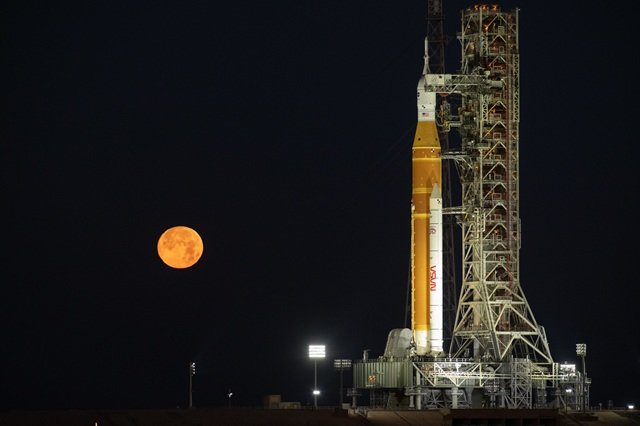
NASA is on the cusp of history once again. Fifty-four years after humans last traveled beyond low Earth orbit, the Artemis 2 mission is preparing to send astronauts past the Moon, this time to explore its enigmatic far side. Unlike the Apollo missions, which orbited close to the lunar surface and saw only select regions, Artemis 2 will maintain a safe distance of more than 7,400 kilometers, enabling its crew to observe vast areas never before glimpsed by human eyes. According to reporting by El País, this mission represents a radical departure from the approach of the 1960s and 70s, prioritizing crew safety while expanding our understanding of the lunar terrain.
The Artemis 2 crew—commander Reid Wiseman, pilot Victor Glover, and mission specialists Christina Koch and Jeremy Hansen—will have the unique privilege of flying over Mare Orientale and other largely unexplored areas on the Moon’s far side. Only 24 people in history, all men and all Americans, have seen this hidden hemisphere. Of them, only five remain alive, all over 90 years old. Koch will be the first woman, Glover the first Black astronaut, and Hansen the first Canadian to join this exclusive group. Their nearly ten-day journey, scheduled for launch on April 1 from Florida’s Kennedy Space Center, could be delayed by minor technical issues or unfavorable weather, highlighting the delicate choreography of space travel.
The mission is designed around a free-return trajectory, a figure-eight path shaped by the gravitational interplay of the Earth and Moon. After a single powerful boost, the Orion spacecraft will glide toward the Moon, circling it without entering orbit and returning to Earth almost entirely under the influence of gravity. This approach significantly reduces the risks faced by the astronauts compared to the Apollo 8 mission, which required precise engine burns to enter lunar orbit. “We want to ensure the safety of the crew while giving them the chance to see the far side in its entirety,” Lori Glaze, acting NASA administrator and planetary volcanology expert, told El País from the Kennedy Space Center. “We are ready to send four astronauts on a safe lunar flyby at the very first attempt.”
Glaze emphasized that the mission is a test flight for many new systems. During the initial 24 hours in orbit around Earth, the Orion spacecraft’s life support and propulsion systems will undergo rigorous checks. Only after these validations will the crew proceed toward the Moon. Even during this early phase, NASA has designed multiple abort scenarios, including the capability to reverse course and return to Earth if critical systems fail. “The environmental control and life support systems are the most crucial for crew safety,” she explained. “We’ve built redundancies and escape options into every stage of the mission.”
The Artemis 2 spacecraft itself represents a leap forward in size and comfort. Roughly the height of a 30-story building with a mass comparable to two buses, Orion carries four astronauts in a capsule nicknamed Integrity. Unlike the cramped Apollo capsules, it includes a full bathroom, a half-ton storage compartment that doubles as a radiation shelter, and exercise equipment for daily routines. The European Service Module, built by Airbus and managed by the ESA, will supply electricity, water, propulsion, and temperature regulation, ensuring the crew remains healthy throughout the journey. El País reports that the capsule also benefits from upgraded thermal protection, designed to withstand the extreme heat of re-entry and prevent issues reminiscent of past disasters like the Columbia tragedy.
The mission’s timeline is exacting. After launch, Orion will reach a highly elliptical Earth orbit, testing its systems in deep space and rehearsing maneuvers necessary for future lunar docking operations. Over the subsequent four days, the spacecraft will travel 406,840 kilometers from Earth, potentially breaking Apollo 13’s record for the farthest humans have ventured. The astronauts will spend several hours over the far side of the Moon in radio silence, documenting craters, maria, and geological formations, and capturing images reminiscent of the iconic Earthrise photograph from 1968.
NASA has meticulously prepared for contingencies, including pre-launch escape mechanisms. The SLS rocket is equipped with a tower and slide system, while Orion itself has thrusters capable of propelling the capsule away from the rocket in the event of an explosion. Astronauts wear advanced pressurized suits designed for fire and smoke protection, capable of sustaining life for up to six days during an emergency return—a period defined by the point at which the free-return trajectory becomes the safest course back to Earth.
“The journey to space is inherently risky, but every effort has been made to mitigate danger,” said Katie Oriti, responsible for integrating Orion with the European Service Module. She explained that redundant systems cover vital functions like oxygen supply, ensuring the crew can survive any single system failure. These layered precautions extend to the re-entry phase, when the capsule will descend at 40,000 kilometers per hour, slowing gradually through atmospheric friction and parachute deployment before splashing down gently in the Pacific Ocean off San Diego, California.
The Artemis 2 mission also carries political and symbolic weight. Conducted under the administration of President Donald Trump, it marks the first step toward a sustainable lunar program aimed at establishing human bases on the Moon within the next decade. According to Lori Glaze, the goal is for regular human missions to the lunar surface, potentially as frequently as twice a year. This ambition is supported by private companies such as SpaceX and Blue Origin, developing lunar landers to facilitate future surface missions. Glaze told El País that Artemis 2 is a demonstration of what can be achieved through international collaboration and technological innovation, offering a hopeful vision at a time of global uncertainty.
Observers at Kennedy Space Center reported a sense of anticipation mixed with awe as the countdown approached. A rainbow arched over the launchpad on the eve of lift-off, casting a surreal light over the SLS rocket. Randy Bresnik, veteran astronaut, reflected on the mission’s urgency amid global competition: “We’ve never been closer to making a sustained return to the Moon,” he said, noting China’s lunar ambitions. Yet the focus remains firmly on crew safety and mission success rather than rivalry.
El País coverage highlights that, while the Artemis 2 astronauts will not land on the Moon, the mission promises to etch their names in history. They will become the first humans in more than half a century to return to the lunar environment, observing landscapes that have remained unseen for generations. Through detailed photographic and scientific observations, Artemis 2 will transform these regions from abstract maps into vivid records, expanding humanity’s understanding of the Moon while laying the groundwork for future exploration and habitation.
In every sense, Artemis 2 embodies a cautious yet bold return to the Moon. By balancing safety with exploration, NASA is not only reclaiming a chapter of human history left dormant for decades but also pushing the frontier of what can be seen and known. When the Orion spacecraft splashes down after ten days, it will mark the beginning of a new era in space exploration—one in which the far side of the Moon is no longer hidden, and humanity edges ever closer to becoming a truly interplanetary species.