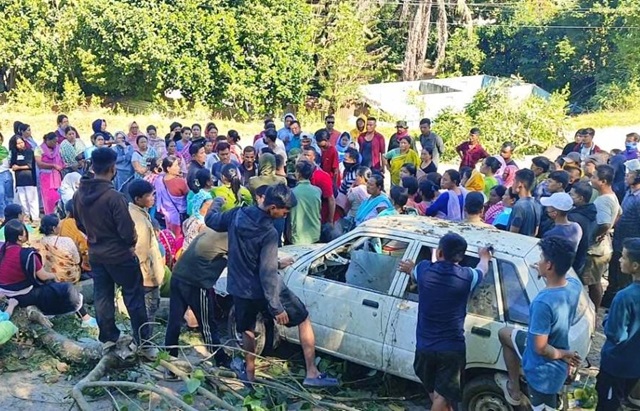
On November 15-16, 2024, six people, including three woman and three children, who went missing from a relief camp on November 11 following a gunfight between Kuki militants and Security Forces (SFs), were found dead at Jirimukh village in Jiribam District. Five of the deceased were identified as Yurembam Rani Devi (60); Telem Thobi Devi (31); Telem Thajamanbi Devi (8); Laishram Chingkheinganba Singh (2.5) and Laishram Langamba Singh (eight months).
On November 14, 2024, a civilian, identified as Waikhom Sanaton (27), was first abducted and then shot dead at Yaralpat, under Porompat Police Station in Imphal East District. Revolutionary People’s Front (RPF) claimed responsibility and stated that Waikhom Sanaton was given the ‘death penalty’ for raping and attempting to kill a 14-year-old girl.
On November 11, a group of militants attacked a Police Station in the Borobekra area of Jiribam, but the attack was thwarted by SFs, resulting in the death of 11 militants and one SF trooper. While retreating, the militants kidnapped three women and three children from a relief camp near the Police Station. Their bodies were found near a river close to the inter-state border and roughly 15 kilometres from where the abductions took place.
On November 11, 2024, at least 11 Kuki militants and a Central Reserve Police Force (CRPF) trooper were killed in a gun battle that erupted in an area under the jurisdiction of Borobekra Police Station in the Borobekra Sub-Division of Jiribam District. The militants used RPGs and AK-47s, among other weapons, in the attack.
On November 11, 2024, two elderly Internally Displaced Persons (IDPs), Maibam Kesho (75) and Laishram Barel (61), were killed by Kuki militants in Jiribam District. It is suspected that the two were burnt alive.
On November 9, 2024, a 39-year-old Meitei woman, identified as Sapam Ongbi Sophia was killed in an attack by suspected Kuki militants in the Bishnupur District of Manipur.
On November 7, 2024, a 31-year-old Hmar tribal woman, Zosangkim Hmar, was shot, captured, and then burned to death by militants at Jairolpokpi (Zairawn) in Jiribam District.
According to partial data compiled by South Asia Terrorism Portal (SATP), 84 persons have been killed in Manipur in insurgency related incidents in the current year, 2024 including 46 civilians, six SF personnel and 29 terrorists (Data till November 17, 2024). During the corresponding period of 2023, which saw the Kuki-Meitei flare-up, the number of such fatalities was 133 (66 civilians, 13 SF personnel, 53 terrorists and one Not Specified, NS). The whole of 2023 had recorded 163 fatalities (72 civilians, 17 SF personnel, 73 terrorists and one NS).
Significantly, in 2022, Manipur recorded an all-time low of seven fatalities (five civilians, one SF trooper and one terrorist), the same number as in 2020, (one civilian, three SF personnel and three terrorists).
Not surprisingly, on November 14, 2024, the Union Ministry of Home Affairs (UMHA) reimposed the Disturbed Areas Act and the Armed Forces Special Powers Act (AFSPA) in the jurisdiction of six Police Stations in the Valley areas of Manipur. The Disturbed Areas status, which was in place in all of Manipur, excluding19 Police Stations in the Meitei-dominated Valley, from where it had been withdrawn between April 2022 and April 2023, has now been extended to the jurisdictions of Sekmai and Lamsang Police Stations in Imphal West District, Lamlai in Imphal East District, Moirang in Bishnupur District, Leimakhong in Kangpokpi District and Jiribam Police Station in Jiribam District. The notification read,
The security situation in the State of Manipur has been further reviewed in consultation with the stakeholders. It is noted that situation continues to remain volatile amidst ongoing ethnic violence in Manipur and intermittent firing in violence-prone areas continues in the fringe areas of Bishnupur-Churachandpur, Imphal East-Kangpokpi-Imphal West and Jiribam districts with several instances of active participation of insurgent groups in heinous acts of violence.
The first four areas are located on the borders of the central Imphal Valley, along the borders of the Kuki-Zomi majority hill areas, where the Disturbed Areas notification under AFSPA is already in place. Jiribam, situated at the westernmost edge of Manipur along the border with Assam’s Cachar District, is currently experiencing severe violence. Known for its ethnically diverse population, the area is surrounded by the hill Districts of Pherzawl and Tamenglong. Although Jiribam had largely remained unaffected by the clashes in the Imphal Valley and nearby hill regions, tensions escalated following the discovery of a farmer’s mutilated body in a field in June 2024.The Disturbed Area status had been rolled back from Sekmai, Lamsang, Lamlai and Jiribam in 2022, and from Moirang and Leimakhong in 2023, just a month before the ongoing conflagration began.
On November 15, 2024, due to the severity of the current situation, the Manipur Government handed over three cases relating to the surge in violent incidents in the Jiribam District to the National Investigation Agency (NIA), under directive from UMHA.
For nearly a year and a half, Manipur has been gripped by sustained inter-ethnic clashes, primarily between the Meitei and Kuki communities. Despite limited efforts to stabilize the region, significant challenges persist. Although the recent Peace Agreement with the United National Liberation Front (UNLF) in November 2023 is noteworthy, the escalating tensions suggest that peace may remain elusive. This volatile environment – characterized by pervasive violence and deep-seated communal divisions – has facilitated an insurgent revival, with the nature of violence shifting from communal clashes to insurgent-led attacks against civilians and security forces, a troubling development with serious implications for the state’s stability and security. The reinstatement of AFSPA is an indicator of the continuing deterioration in Manipur’s security landscape despite more than seventeen months of ethnic strife. Fault lines run deep, and targeted violence has staged a comeback.
Prior to the outbreak of the clashes on May 3, 2023, between January 1 and May 2, 2023, Manipur had recorded four insurgency-linked fatalities (one civilian and three insurgents). On the other hand, between May 3, 2023 and December 31, 2023, 159 fatalities (71 civilians, 17 troopers and 70 insurgents, one Not Specified) were recorded, and another 84 fatalities have been added in 2024, thus far.
In response to the continuing violence, 13 civil society organizations have initiated a complete shutdown in the hill regions, demanding justice for victims. This action led to the closure of schools, markets, and roads, exacerbating tensions across Manipur. To restore stability, the UMHA deployed an additional 2,500 paramilitary personnel, supplementing the 198 companies of Central Forces already deployed in the state following last year’s ethnic clashes, which resulted in over 200 deaths and widespread displacement. Search operations for missing civilians are ongoing, with intensified patrolling to deter further violence. Despite these efforts, tensions persist, and sporadic clashes continue.
The recent escalation of violence in Manipur underscores the enduring volatility of its socio-political landscape, shaped by deep-seated ethnic divisions and insurgent activities. The resurgence of violence, particularly the brutal killings, abductions, and insurgent attacks, highlights the failure of past conflict-mitigation efforts to address the region’s underlying issues. The ethnic conflict between the Meitei and Kuki communities, which resurfaced in May 2023, remains the primary driver of unrest. Despite numerous attempts to broker peace, the conflict has evolved into a dangerous interplay of partisan politics, community violence and insurgent resurgence. The shift from inter-communal clashes in the initial phase of the current conflagration, to insurgent-led violence, is especially troubling, suggesting the emergence of more organized and strategic forms of conflict.
The reimposition of AFSPA in several areas of Manipur reflects the severity of the current situation. AFSPA’s return, despite its contentious nature, underscores the inability of civil governance to ensure security in the face of escalating violence. Nevertheless, on November 16, 2024, the Manipur Government has requested the Centre to withdraw AFSPA from the six Police Station areas in the Valley, in view of the public sentiment against the Act.
On November 16, 2024, further, angered by the incidents in Jiribam and the government’s failure to contain the violence against the Meitei community, an enraged mob tried to storm the private residence of Chief Minister Biren Singh. Mobs also attacked the residences of 10 lawmakers, including Sapam Ranjan, Minister of Health and Family Welfare, L. Susindro Singh, Minister of Consumer Affairs and Public Distribution, Manipur Public Works Department (PWD) Minister Govindas Konthoujam, and BJP MLA Y. Radheshyam. The curfew, which had been relaxed a day earlier, was immediately reimposed and Internet and mobile data services were temporarily suspended in seven Valley districts, in view of the ‘developing law and order situation’.
The rise in civilian fatalities and the deliberate targeting of vulnerable groups, including women and children, reveal a brutal pattern in the conflict. The gruesome incidents in Jiribam District, including the abduction and killing of women and children, and the burning alive of other victims, signify a troubling trend, even as civilians become helpless pawns in the conflict. This not only amplifies the humanitarian crisis but also reflects the insurgents’ intent to instil fear and assert dominance. The extension of AFSPA to areas previously exempted, including the Meitei-dominated valley, indicates a significant failure of the state to normalize the security environment.
Manipur’s trajectory highlights the delicate balance between security and civil liberties. Without addressing the systemic inequalities and historical grievances fuelling the conflict, any semblance of peace will remain tenuous. The role of polarizing politics by the ruling dispensation, as well as the mobilization of violent ethnic formation in destabilizing the state and escalating the conflict and provoking savagery, underlines the need for a genuine commitment to reconciliation, justice, and inclusive governance, to break the cycle of violence and foster lasting harmony in this troubled state.