
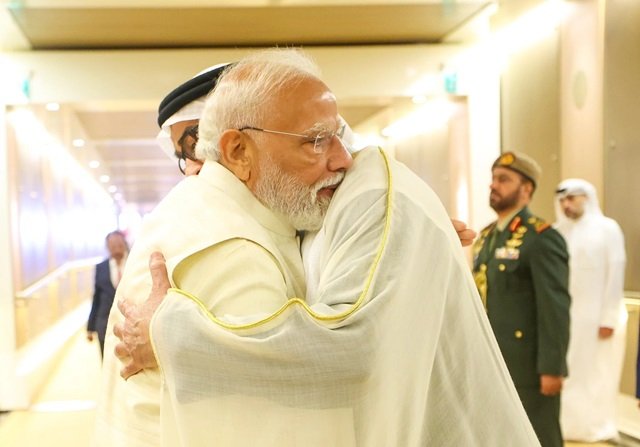
Prime Minister Narendra Modi’s recent visit to the United Arab Emirates was officially framed around energy cooperation, investment expansion and strategic connectivity. Yet beneath the language of economic partnership lies a broader geopolitical reality: India is increasingly attempting to convert its growing economic engagement with the Gulf into long-term political and strategic leverage within a region already burdened by fragmentation, rivalry and competing regional ambitions.
Over the past decade, the India-UAE relationship has evolved rapidly. Trade volumes have expanded, connectivity projects have accelerated, defence cooperation has increased and political coordination has become far more visible. For New Delhi, the UAE has emerged not only as an important commercial partner, but also as a strategic gateway into West Asia at a time when global power competition is intensifying and the international system is moving toward a more fragmented multipolar order.
India’s growing Gulf outreach reflects a broader shift in its foreign policy. New Delhi is no longer satisfied with symbolic diplomacy or non-alignment rhetoric. Instead, it increasingly seeks tangible geopolitical influence through economic interdependence, technological partnerships, logistics corridors and regional strategic positioning.
However, the Gulf cannot be approached purely through commercial logic. Unlike Europe or East Asia, the Middle East remains deeply shaped by security rivalries, ideological legitimacy, sectarian competition and fragile political balances. External actors entering this environment inevitably become entangled in its contradictions.
India’s deepening alignment with the UAE therefore carries implications extending far beyond economics. Across parts of the region, New Delhi’s growing proximity to Abu Dhabi is increasingly viewed as part of a wider effort to expand geopolitical leverage within West Asia while simultaneously reducing Pakistan’s traditional strategic relevance in the Gulf.
This perception has become more pronounced following the post-Abraham Accords regional realignment and India’s expanding partnerships with both the UAE and Israel. Critics across parts of the Muslim world increasingly view these evolving alignments through the prism of shifting political loyalties and weakening regional cohesion within the Islamic world.
The broader concern is not simply diplomatic optics. The Middle East is already experiencing growing fragmentation visible in Yemen, Sudan, Libya and even within the GCC itself. Periodic OPEC+ disagreements and diverging regional priorities have exposed underlying tensions between Gulf actors over leadership, security coordination and regional influence.
In this environment, India’s growing strategic involvement risks adding another competitive layer to an already unstable regional landscape. Rather than functioning as a balancing actor, New Delhi may gradually become drawn into rivalries it neither fully controls nor can easily manage.
The UAE itself, despite its growing economic and diplomatic activism, still operates within a broader Gulf structure where Saudi Arabia retains unmatched political, religious and energy significance. Abu Dhabi’s increasing assertiveness cannot replace Riyadh’s central role within Gulf security architecture, oil coordination mechanisms and broader Islamic legitimacy.
This is precisely where India’s strategy encounters structural limitations. Economic partnerships and trade expansion alone cannot easily substitute for the historical military, ideological and institutional relationships that continue to shape Gulf security frameworks.
For decades, Gulf security structures — particularly those connected to Saudi Arabia — have maintained longstanding military and institutional ties with Pakistan. Geographic proximity, defence cooperation, labour integration and deep-rooted religious affinity have embedded Pakistan within the Gulf’s broader strategic environment in ways that remain difficult to replicate through economics alone.
India’s regional engagement, by contrast, remains primarily commercial and investment-driven. While India-UAE trade has expanded significantly, New Delhi’s regional footprint continues to rely more heavily on economics, diaspora connectivity and market integration than on entrenched security coordination.
The rapid expansion of the Indian diaspora across parts of the Gulf has also generated periodic labour controversies, demographic sensitivities and debates regarding workforce imbalances within local societies. Although these issues do not define bilateral relations, they nevertheless highlight the social and political complexities accompanying large-scale demographic integration.
At the same time, India’s Gulf strategy is unfolding amid intensifying competition involving China, the United States and regional middle powers. Beijing’s growing influence through infrastructure investment, logistics corridors, ports and energy partnerships has transformed the Gulf into a major arena of Asian geopolitical competition. Gulf states themselves are increasingly diversifying strategic relationships as uncertainty grows regarding the future direction of the international order.
For India, deeper engagement with the UAE is therefore not only about economics, but also about avoiding strategic marginalization within a region becoming increasingly central to Eurasian connectivity and Indo-Pacific competition.
Yet this expanding role also carries growing risks. India’s closer alignment with UAE-Israel strategic frameworks may complicate its balancing approach toward Iran at a time when tensions across the region remain highly volatile. Continued instability in Yemen and Sudan, unresolved rivalries involving Iran and fluctuating OPEC+ dynamics all contribute to an increasingly unpredictable environment.
India’s Gulf strategy reflects both ambition and overreach. New Delhi is seeking to transform economic engagement into geopolitical influence in a region where security structures, historical alliances and ideological legitimacy still outweigh commercial power.
That strategy may generate short-term diplomatic gains. But in a Middle East already marked by fragmentation, competing ambitions and fragile alignments, India risks discovering that expanding influence in the Gulf is far easier than sustaining strategic flexibility within it.