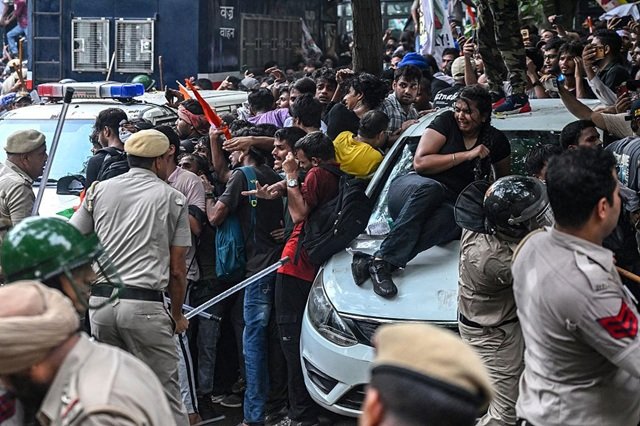
When dissent is labeled as treason, democracy itself is under threat. In India today, the “Pakistani threat” has evolved from a genuine security issue into a political tool, justifying mass arrests and Unlawful Activities Prevention Act (UAPA) prosecutions against minorities and dissenters. By framing legitimate grievances—about education, corruption, and minority rights—as security concerns, the state casts protests as conspiracies and dissent as infiltration.
The media amplifies this narrative with sensational terms like “Pakistani module,” redirecting public anger away from the government. This approach prioritizes internal control over national defense, blurring the lines between security and political interests.
The state’s focus on hunting “Pakistanis” has revealed a contradiction: most of those arrested are Indian citizens, particularly local Muslims. From 2000 to mid-August 2026, India reported over 2,450 arrests related to the banned groups Lashkar-e-Taiba and Jaish-e-Mohammed, but the number of arrests dropped significantly, from 144 in 2022 to just 17 in 2026 for Lashkar-e-Taiba, and from 60 in 2020 to 16 for Jaish-e-Mohammed. Despite this decline, the narrative of a “Pakistan module” persists, framing dissent as a threat from an external enemy. This reliance on arrests linked to Pakistan highlights a central contradiction: national security rhetoric is used as a political tool, masking the repression of Indian citizens.
The trend of securitization intensified in 2025 when the National Investigation Agency labeled 67 of 276 arrested individuals as “jihadi,” merging arrest with guilt despite legal standards that demand judicial scrutiny and admissible evidence. This pattern peaked in August 2026 with a major crackdown resulting in 253 detentions across 14 states, over 200 arrests, and more than 80 First Information Reports (FIR) against an alleged network tied to fugitive Shahzad Bhatti. The figures from states such as Uttar Pradesh 62, Haryana 52, and Delhi 51 highlight the scale of these operations.
However, these mass detentions prompt critical questions: Do they represent real counter-terrorism successes, or do they reflect a political narrative that targets dissent and profiles minorities as “Pakistan-sponsored” threats?
Authorities have reported the recovery of IEDs, grenades allegedly marked by the Pakistan Ordnance Factories, and other military equipment during recent crackdowns. However, it remains unclear whether independent forensic evidence has been presented against each detainee, beyond the large-scale arrests. Investigations have linked fugitive Shahzad Bhatti to multiple incidents, including the October 2024 Baba Siddique case and the March 2025 Jalandhar grenade attack, as well as plots in several states in 2026. Other names, such as Sohail Ahmed, Abid Jatt, Ajmal Gujjar, Rana Hunain, and Hassan Gujjar, have also surfaced as alleged facilitators.
The lack of transparent judicial disclosure—such as forensic evidence, financial records, and digital verification—raises doubts about the validity of these claims and whether they simply serve to reinforce the narrative of “Pakistan-sponsored” networks.
As citizens demand more credibility and accountability, India’s reliance on this narrative seems to weaken. While large-scale arrests receive quick publicity, verifiable evidence often does not. This inconsistency raises questions about the effectiveness of India’s security apparatus. Additionally, cases like that of Kulbhushan Sudhir Jadhav, an Indian Navy officer arrested in Balochistan, highlight how narratives of infiltration can work both ways.
In the United States, Vikash Yadav was charged in October 2024 in a murder-for-hire conspiracy, with co-defendant Nikhil Gupta pleading guilty in February 2026. Meanwhile, in Canada, the Royal Canadian Mounted Police (RCMP) publicly alleged that Indian government agents were linked to homicides, organized crime, and the intimidation of Khalistan-associated community members. Canada’s formal designation of the Lawrence Bishnoi gang as a terrorist entity in September 2025 further intensified the debate over transnational repression linked to India.
These incidents highlight the fragility of India’s security narrative: the persistent invocation of Pakistan as a looming external threat is increasingly challenged by domestic contradictions and international allegations. This raises questions about whether such rhetoric serves national defense or merely serves political expedience.
India’s approach reveals a growing double standard. While its own citizens face widespread arrests related to alleged “Pakistan” links, serious cases of covert Indian activity and transnational repression have emerged abroad. The narrative needs to shift from blaming Pakistan for every issue to examining why New Delhi struggles to address its own governance challenges. Domestic discontent, corruption, minority issues, and regional tensions with Nepal, Bangladesh, and China weaken the claim that Pakistan is the sole source of India’s difficulties. In this context, the “Pakistan” label acts more as a political escape from accountability rather than a legitimate security explanation.
India’s credibility will not hinge on the number of “Pakistani modules” it claims to dismantle, but rather on how many of these allegations can withstand independent judicial scrutiny, supported by verifiable forensic, financial, and digital evidence. The ongoing reliance on mass arrests and propaganda, without providing transparent proof, has damaged New Delhi’s international standing. Meanwhile, Pakistan is positioning itself as a strategic partner for major powers, including the United States, China, Russia, and the European Union. Unless India shifts its focus from spectacle to substance, its security narrative may collapse under the weight of its own contradictions.