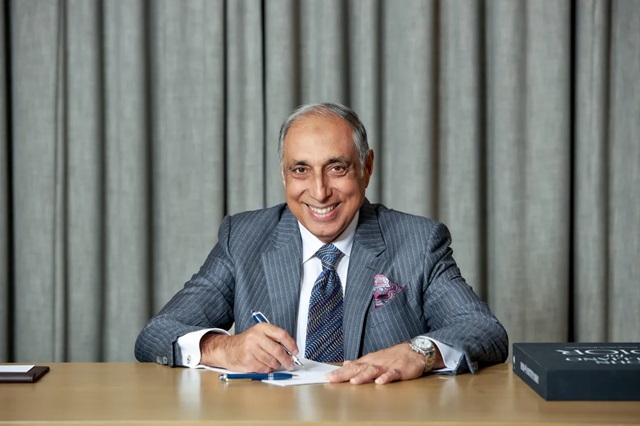
Irfan Razack, the billionaire chairman of Prestige Group, has sounded a cautionary note on India’s booming real estate market, warning that rising costs and oversupply in key cities are creating stress pockets that could weigh on future growth. The remarks come even as Prestige Estates Projects Ltd., one of India’s leading real estate developers, continues to report record profits and expanding national presence.
Razack, who has amassed a $5.5 billion fortune with his brothers Rezwan and Noaman, told Bloomberg in an interview that while India’s post-pandemic property surge has driven enormous growth, challenges are mounting — especially in the tech hub of Hyderabad.
“There is so much space that has been built and companies are looking for deals, a break on the rent or they may want a six or 12-month free rent period,” Razack said. “If you look at Hyderabad, there is so much supply and the price has not gone up by much.”
He also pointed to several pain points straining the sector, including rising land prices, labor shortages, higher construction costs, and mounting government fees. “We have to deliver under these conditions,” said the 71-year-old, who remains deeply involved in Prestige’s operations despite decades in the business.
According to Bloomberg, Prestige’s performance has remained strong. The company posted ₹23 billion ($262 million) in revenue and more than ₹3 billion in profit in the first quarter of the fiscal year, reporting its best-ever sales quarter led by activity in Delhi NCR, Mumbai, and Bengaluru. The Razack family holds a 61% stake in the publicly traded firm, giving them a combined net worth of more than $5.5 billion, according to the Bloomberg Billionaires Index.
Despite strong quarterly figures, Razack emphasized that affordability remains a major concern. “As a young person, you are paying something like 30% to 33% more just for taxes,” he said, adding that this cost burden is dampening demand, especially in the mid-market segment — Prestige’s primary focus.
India’s supply of affordable homes has dropped to a seven-year low, according to a recent report by Knight Frank. While luxury properties worth over ₹100 million ($1.1 million) have also seen sluggish sales, Prestige continues to pursue such projects, though Razack noted that “luxury sales take time but over the life of a project the units get sold.”
Prestige has also been aggressive in expanding beyond its Bengaluru base into cities like Hyderabad, Delhi NCR, and most recently, Mumbai — India’s most expensive property market — where it acquired land during the pandemic at relatively low prices.
“The challenge for the company is acquiring land,” said Parikshit Kandpal, Senior Vice President of Research at HDFC Securities, in comments to Bloomberg. “Given their size, they would need to keep doing larger projects.”
Razack, whose business journey began in his father’s apparel store before co-founding Prestige in the 1980s, remains committed to building iconic structures across India. The company’s first project — a modest 10,000 sq. ft. office space in Bengaluru — paved the way for a decades-long transformation that paralleled the city’s rise as a global tech hub.
“Most developers operate with single-digit margins at around 8%, we are around 12%,” Razack said, crediting Prestige’s efficient execution strategy and strong market positioning.
While the macroeconomic environment remains uncertain, Razack maintains an optimistic yet cautious stance. “Real estate companies need to know how to balance themselves,” he said. “You need to be smart about the size, understand the neighborhood and target audience.”
As India’s cities continue to expand and urbanization accelerates, Prestige’s trajectory — from shirts to skyscrapers — reflects the scale of opportunity and challenge facing the country’s property market. And for Razack, who says he has no plans to retire, the work continues: “An elderly lawyer once told me a long time ago, it is better to fade out than to rust out.”