


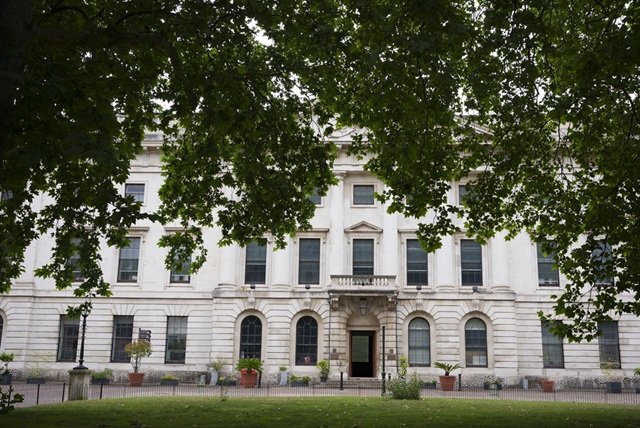
On 20 January 2026, the UK government formally approved plans for a new Chinese mega-embassy at Royal Mint Court in the City of London, ending months of intense political debate, security reviews, and diplomatic pressure. The proposed 20,000-square-metre complex, purchased by the Chinese government in 2018 for £255 million, is set to become one of the largest diplomatic missions in Europe. Supporters of the plan argue that maintaining strong diplomatic and economic ties with China is essential at a time of shifting global trade alignments, particularly amid uncertainty in US foreign policy. Critics, however, have raised alarm over national security risks, citing the site’s proximity to critical fibre optic infrastructure and the London Internet Exchange, warning that the embassy could pose potential cyber vulnerabilities.
Yet, as noted in reporting by History Today, the controversy surrounding the new embassy is not without historical precedent. The Chinese diplomatic presence in London has repeatedly stood at the centre of geopolitical tension, espionage fears, and domestic political dispute since its inception in the late 19th century. The new embassy, though modern in scale and technology, carries with it a legacy shaped by imperial rivalry, revolution, and shifting global orders.
The origins of China’s diplomatic mission in Britain date back to January 1877, when Qing envoy Guo Songtao arrived in London to establish China’s first permanent overseas legation at 49 Portland Place. His mission was born out of crisis following the 1875 killing of British official Augustus Raymond Margary in China, which triggered diplomatic pressure on the Qing court to issue an official apology to Queen Victoria. Guo’s arrival marked a turning point in China’s engagement with the Western world, but it also revealed the extent of Britain’s informal influence over Chinese affairs.
The establishment of the legation was not entirely orchestrated by Chinese officials alone. Key logistical arrangements were handled by James Duncan Campbell of the Chinese Imperial Customs Service in London, an institution that itself reflected Britain’s deep entanglement in Chinese economic governance. Media coverage at the time focused less on Guo and more on Western intermediaries such as Dr Halliday Macartney, a British military surgeon who became a long-standing adviser to the mission. To many observers in Britain, the Chinese legation was less a symbol of sovereign equality than a tool for educating China in the mechanisms of Western power.
Despite its subdued early years, the legation soon became a stage for one of the most dramatic episodes in modern Chinese political history. In 1896, revolutionary figure Sun Yat-sen was abducted by Qing agents in London and detained inside the Portland Place building, where he faced the prospect of deportation and execution. His fate shifted dramatically after he managed to smuggle a note to his former teacher Sir James Cantlie, who mobilised public and political pressure for his release. The incident sparked a media storm in Britain and forced the Foreign Office to intervene. Sun’s survival would later prove decisive in the collapse of the Qing dynasty, as he went on to play a central role in the 1911 Revolution and became the first president of the Chinese Republic.
Throughout the early 20th century, the legation continued to reflect the turbulence of China’s position in global politics. In the aftermath of the First World War, Chinese diplomats in London sought to renegotiate a relationship long shaped by what Chinese intellectuals called a “century of humiliation.” The 1919 Paris Peace Conference, where China’s claims were sidelined in favour of Japanese interests, triggered widespread protests in China and the May Fourth Movement, marking a profound rupture in Sino-Western relations.
Despite these tensions, Chinese envoys such as Wellington Koo and Alfred Sze worked to improve China’s diplomatic standing in Britain. By the mid-1920s, British policy began to shift cautiously toward conciliation, culminating in the 1926 “December Memorandum,” which signalled tentative support for a more equitable relationship with China. The Chinese diplomatic presence in London expanded accordingly, with the legation eventually upgraded to full embassy status in 1935.
The collapse of Britain’s informal empire in China during the Second World War and the Communist revolution of 1949 fundamentally reshaped diplomatic relations. Britain’s recognition of the People’s Republic of China in 1950 was driven largely by pragmatic concerns, including the desire to preserve economic ties and maintain influence in Hong Kong. However, continued relations with Taiwan led Beijing to describe the relationship as only “half relations,” reflecting the fragility of early Cold War diplomacy.
Tensions escalated further during the Cultural Revolution, when ideological radicalism spilled into foreign policy. In 1967, violent incidents erupted at both the Chinese embassy in London and the British mission in Beijing, underscoring the volatility of diplomatic relations during the period. Protesters clashed with embassy staff in London, while Chinese Red Guards attacked British diplomatic premises in Beijing. Though the crisis was eventually contained through diplomatic channels, it left a lasting imprint on the identity of the Chinese mission in Britain.
Normalisation of relations in 1972 stabilised ties, but the embassy remained a focal point for political activism and protest in the decades that followed. From demonstrations over Tiananmen Square in 1989 to more recent protests concerning Hong Kong, Tibet, and Xinjiang, the site on Portland Place has consistently functioned as both a diplomatic hub and a stage for global dissent.
Today, as the embassy prepares to move from its historic Georgian surroundings to a purpose-built mega-complex at Royal Mint Court, many of these historical tensions appear set to travel with it. The physical relocation does not erase the legacy of surveillance fears, ideological confrontation, and contested sovereignty that has long defined the site of Chinese diplomacy in London. As History Today observes, the embassy is more than a building; it is a living archive of Anglo-Chinese relations, carrying 150 years of history into a new and more contested era of global politics.









