


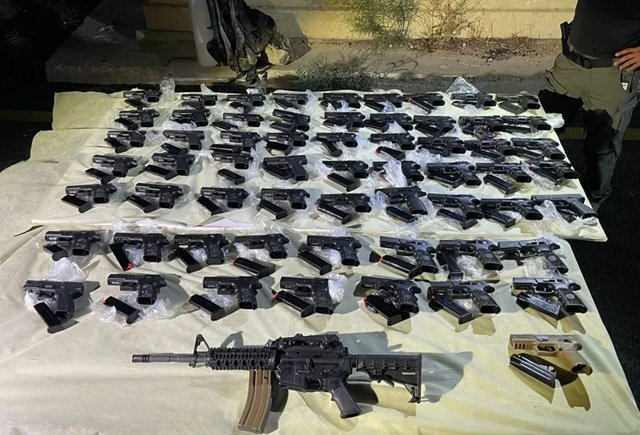
Deep in the mountains of Iraq’s Kurdistan Region, close to the Iranian border, a weapons factory established nearly a decade ago has emerged as the focus of an extensive investigation linking illicit firearms production to regional arms trafficking, organized crime and militant violence. According to an investigation by Haaretz, the factory has produced thousands of rifles and pistols that have spread across black markets throughout the Middle East, with at least 200 of those weapons later smuggled into Israel and the West Bank.
The investigation identifies the facility as the source of firearms manufactured under the Delta Defense Group (DDG) brand, a name that has increasingly drawn attention from international arms researchers. Many of the weapons, Haaretz reports, are copies of Israeli-designed rifles and pistols, adding an unexpected dimension to an already complex trafficking network that stretches from northern Iraq through neighboring countries and into Israel.
The factory was established around 2016 in Iraq’s Sulaymaniyah Province under the patronage of the Patriotic Union of Kurdistan, one of the region’s dominant political parties. Financing came from the Faruk Investment Group, one of Iraq’s largest business conglomerates. Management of the project was entrusted to Ross Roggio, a former U.S. Army paratrooper whose career would later unravel following an FBI investigation.
Roggio had been recruited to help establish a domestic weapons manufacturing capability capable of producing thousands of assault rifles and pistols every month for the Peshmerga, the armed forces of Iraq’s Kurdistan Region. Court documents and reporting cited by Haaretz show that the project quickly became mired in financial misconduct. Prosecutors alleged that millions of dollars allocated for manufacturing equipment were diverted to luxury purchases, while cheaper machinery was acquired in an effort to conceal the shortfalls. When concerns arose that an employee might expose the scheme, Roggio was accused of arranging the man’s kidnapping and torture.
The FBI arrested Roggio in 2017 during a visit to the United States following an investigation into the unlicensed export of firearms components to Iraq. He was convicted in federal court in Pennsylvania in 2023 on charges including arms trafficking and torture and was sentenced to 70 years in prison.
Despite Roggio’s conviction, the weapons produced at the Kurdistan factory continued to circulate across illicit markets. Researchers interviewed by Haaretz say DDG firearms have appeared in Iraq, Syria, Jordan, Lebanon, Libya and even the United Kingdom, illustrating the broad geographic reach of the trafficking network.
A study by the Combating Terrorism Center at the U.S. Military Academy at West Point, cited by Haaretz, found that during the surge in weapons smuggling into Israel in 2023, many of the seized handguns entering through Jordan had been manufactured by Delta Defense Group.
Mick F., an analyst with Armament Research Services, told Haaretz that DDG pistols and rifles are commonly sold on Iraq’s black market before being smuggled through neighboring countries. According to the analyst, two principal routes carry the firearms into Israel. One passes through Jordan into the West Bank, while another moves through Syria and Lebanon before reaching northern Israel.
Israeli security researchers say these smuggling routes intersect with networks used by both organized crime and militant organizations. Shlomo Mofaz, director of the Meir Amit Intelligence and Terrorism Information Center, told Haaretz that the trafficking channels also align with Iran’s broader efforts to arm Hamas operatives in the West Bank through networks linked to the Islamic Revolutionary Guard Corps’ Quds Force.
DDG-manufactured weapons have also appeared in images involving senior Hamas figures. Haaretz notes that Saleh al-Arouri, Hamas’ deputy leader, was photographed in 2023 holding a DDG rifle several months before he was killed in an Israeli strike.
The investigation also sought to determine the origins of the weapons themselves. After examining dozens of photographs and consulting firearms experts, Haaretz concluded that several DDG products closely replicate Israeli firearm designs.
Among the copied weapons identified are a DDG M4 rifle resembling the MZ-4 manufactured by Israeli company Emtan, a DDG 19 pistol modeled on Emtan’s Ramon pistol, and DDG C5 and C6 pistols that closely resemble Bul Armory’s Cherokee and Cherokee FS models. Experts interviewed by Haaretz said similarities extended beyond the overall appearance to identical manufacturing features and even engraved safety warnings.
Jonathan Ferguson, Keeper of Firearms and Artillery at the Royal Armouries Museum in Leeds, told Haaretz that he had directed British authorities investigating a seized DDG pistol to previous research highlighting its striking resemblance to Israeli firearm designs.
How those Israeli-designed weapons reached the Iraqi factory remains unresolved. During testimony in his U.S. trial, Roggio stated that factory engineers had reverse-engineered three sample rifles supplied to them, including one described as an Israeli model. A former factory employee interviewed by Haaretz confirmed that engineers dismantled and studied supplied firearms before beginning production but said he did not know where the originals had originated.
The former employee also said engineers relied extensively on publicly available online information alongside the physical samples to reproduce the firearms. Emtan told Haaretz it had no knowledge of the factory or any connection to it, while Bul Armory declined to comment.
According to Haaretz, publicly available evidence suggests weapons produced at the Kurdistan facility began appearing in Israel in significant numbers from 2021, with smuggling peaking in 2022. One shipment intercepted along the Jordanian border that year contained dozens of DDG pistols, while investigators have linked the weapons to both criminal activity and militant attacks.
The investigation notes that a DDG pistol was used in the fatal shooting of Elan Ganeles near the northern Dead Sea in February 2023. More recently, Israeli forces seized another DDG pistol during operations in Tulkarm, while police recovered a similar weapon from suspects accused of planning a gang-related assassination in Tel Aviv.
Photographs circulating in online weapons-trading groups indicate that firearms bearing the DDG logo continue to appear on illicit markets, including newly developed models. Arms researchers interviewed by Haaretz say they continue to encounter the pistols throughout the region, suggesting production may still be ongoing at the Sulaymaniyah facility.
The copied firearms have also become highly valued on black markets. According to prices cited in the investigation, a DDG C5 pistol advertised in Kurdistan can sell for about $1,400, rising to around $1,800 in Syria. Once smuggled into Israel, the same weapon can command prices worth tens of thousands of shekels, significantly exceeding the retail price of the original Israeli-made pistol from which it was copied.
While investigators have traced the factory’s history, documented its production methods and identified its products across multiple conflict zones, one central question remains unanswered. As Haaretz concludes, neither investigators nor firearms experts have been able to determine with certainty how the Israeli-designed weapons that served as templates for the copied firearms first reached the factory in Iraqi Kurdistan.









