


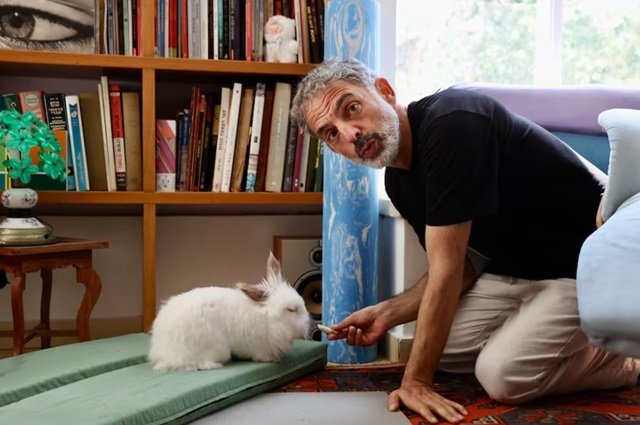
The Israeli writer Etgar Keret has long built his literary reputation on blending the absurd with the intimate, but in his latest reflections he describes a country where reality itself seems to have shifted into dystopian fiction. “If life is a movie, Israel today is a zombie movie,” he said in an interview with El País, capturing a sense of disorientation that runs through both his personal experience and his newly published short story collection The Blues of the End of the World.
The book was originally meant to reach his publisher on October 8, 2023, just days after Keret had begun to feel uneasy about its tone. He had been working toward a carefully structured rhythm that governs much of his creative life: a new collection every seven years or so, delivered with almost ritual precision. But even before the manuscript was completed, he sensed something had shifted. The stories, shaped by years marked by personal loss, political tension, and pandemic isolation, felt darker than usual. His wife, screenwriter and filmmaker Shira Geffen, encouraged him to revisit the work and decide whether it truly reflected what he wanted to say.
Two days later, on October 7, the Hamas attack on Israel shattered that fragile pre-publication moment. The violence, which left around 1,200 dead and more than 250 hostages taken, overwhelmed the country and abruptly transformed the context in which Keret’s book existed. “The book’s tone became the least of my concerns,” he recalled. In the months that followed, as reservists were mobilized and the invasion of Gaza escalated, publication became impossible. Eventually, Keret added two new stories to the manuscript, and the collection was released in Spanish by Siruela under its current title.
Speaking to El País from his home in Tel Aviv, Keret described how reality seemed to overtake fiction in unsettling ways. At one point, he said he had told his wife the manuscript might not be publishable because “the world isn’t as bad as the one I described.” After October 7, that feeling reversed. “Reality descended to the level of the book,” he said, as if the boundary between imagination and lived experience had collapsed entirely.
In The Blues of the End of the World, Keret continues his trademark narrative style, where everyday situations slip into surreal or unsettling turns without warning. A man feeds a nest of red ants using his eye. Another character seeking a casual encounter ends up participating in a religious minyan, the quorum required for Jewish prayer. In his hometown of Ramat Gan, two of the last remaining humans on Earth give guided tours to visiting aliens. These stories, while strange, are grounded in recognizable emotional terrain: fear, longing, grief, and dislocation.
Keret’s writing has often been described as among the most distinctive in contemporary Hebrew literature, precisely because it moves fluidly between the banal and the impossible. Global cultural references such as Spotify or Tinder coexist with biblical echoes and Israeli slang, anchoring his fiction in a world that feels simultaneously universal and hyperlocal. Yet in this latest collection, political references are rare and deliberately restrained. One exception is a story titled “Dog for Dog,” which he has described as a metaphor for the cycles of revenge that shape the Middle East conflict.
Unlike some public intellectuals, Keret tends to avoid overt political commentary in his fiction, reserving it instead for columns, newsletters, and public demonstrations. After the October 7 attack, he helped deliver books to Israeli soldiers on the front lines, an act he described as an attempt to maintain some form of cultural continuity amid chaos. Later, he joined silent vigils honoring Palestinian children killed in Israeli bombings, holding photographs as a gesture of remembrance and acknowledgment.
That balance has placed him in a complex position within Israeli public discourse. Keret, the son of Holocaust survivors, has spoken openly about the moral and emotional strain of witnessing violence while also being criticized for expressing dissenting views about his government and military actions. In his conversation with El País, he expressed frustration with the rigidity of some political language used to describe the conflict, particularly the term “genocide,” which he said he finds unhelpful in capturing the complexity of what is unfolding. “The fact that Israel has done horrible things and that they must be judged is one thing,” he said, “but reducing everything to a single label… that’s not my discourse.”
His broader concern, he suggested, is that both internal and external pressures are forcing people into simplified positions that erase nuance. In Israel, he feels attacked for acknowledging wrongdoing by the state; abroad, he feels pressured to adopt definitive moral classifications. “It’s like asking which football team you support,” he said, arguing that such framing turns moral catastrophe into a binary game rather than a space for reflection or accountability.
Keret’s public persona is inseparable from his humor, which he describes not as escapism but as a mechanism of survival. In conversation, often delivered through rapid and sprawling audio messages, he shifts between anecdotes, jokes, and philosophical digressions. At one point, he even offered a deliberately absurd list of possible responses to any question, ranging from answering it directly to “punching you or giving you a French kiss,” underscoring his belief that communication is always unstable, always performative.
For him, humor is not decorative but existential. “It is a way of maintaining dignity in a world where it has been taken from you,” he said. Life itself, he added, is structured by humiliation and loss, beginning with birth and ending in death, with suffering and uncertainty in between. The function of humor, then, is to create a small space where meaning can still be negotiated rather than imposed.
His most striking metaphor in the interview with El País was cinematic. “If life is a movie, living in Israel today is like living in a zombie movie,” he said. In his explanation, he described a society in which individuals appear emotionally numbed, shaped by trauma, fear, and accumulated shock. People, he suggested, speak and act in ways that may not fully originate from themselves but from a collective psychological collapse. In such a state, he said, society becomes a kind of “laboratory of a broken creature,” where confusion replaces coherence.
He rejected the idea that this condition resembles ordered authoritarianism. Instead, he described it as chaotic, fragmented, and emotionally incoherent. “In a fascist country, there is order,” he said. “What we have here is animalistic chaos, mixed with megalomania and messianic thinking.” It is this lack of structure, more than ideological clarity, that he finds most unsettling.
As Israel continues to grapple with the aftermath of war and political polarization, Keret’s work stands as a reflection of a society where fiction and reality increasingly blur. In his telling, the role of the writer is not to resolve that tension but to hold it open, even when the world outside seems to be collapsing into something unrecognizable.









