by Our Correspondent in Doha
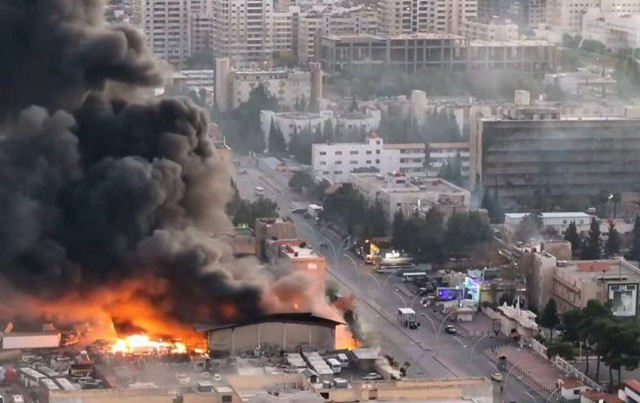
just hours after the fall of Bashar al-Assad’s regime, Israeli warplanes launched targeted strikes on key military and strategic locations near Damascus. Among the targets were the Mazzeh Military Airport, the Passport and Immigration Office, and the Research Institute in the Syrian capital. Simultaneously, Israeli ground forces advanced into Syrian territory, capturing strategic locations in the Qunaytra governorate, intensifying regional tensions.
The Israeli Defense Forces (IDF) justified the airstrikes as an effort to prevent advanced weaponry from falling into the hands of terrorists amid the chaos in post-Assad Syria. However, analysts suggest the real objective may be to weaken what remains of the Syrian Arab Army (SAA) and ensure that any new military force emerging in Damascus is less capable than its predecessor.
Israeli Ground Incursion into Southern Syria
The IDF has also pushed into Qunaytra, capturing towns including Qunaytra, Al Hamidiyah, Al-Qahtaniyah, and Samadaniya al Gharbiyya, as well as Mount Hermon along the Syrian-Lebanese border. Reports suggest that Israeli forces have advanced beyond the 1974 disengagement line, but these claims remain unverified. Artillery and airstrikes have simultaneously pounded positions across Qunaytra, Daraa, Suwayda, and Damascus governorates.
Lt. Gen. Herzi Halevi, Chief of the Israeli General Staff, confirmed that operations aim to establish a de-militarised zone (DMZ) along the border to secure Israel from potential hostilities. Speaking to soldiers of the 1st Golani Brigade, Halevi stated, “The IDF is now operating on four frontiers: the West Bank, Gaza, Lebanon, and now Syria. This responsibility will soon rest on your shoulders.”
Buffer Zone Objectives and Regional Implications
The IDF claims its incursion into the buffer zone is a defensive measure to stabilise its borders amid the Syrian turmoil. Over the weekend, unidentified gunmen reportedly attacked a UN post in the region, exacerbating Israeli concerns. The military has distributed urgent warnings to residents in southern Syrian villages, urging them to stay indoors for their safety.
“The fighting in your area is forcing the IDF to act. We do not intend to harm you. For your safety, stay at home until further notice,” said Col. Avichay Adraee, the IDF’s Arabic-language spokesman, addressing residents via social media.
Observers argue that Israel’s moves may also serve a long-term strategy to cultivate proxy forces among Syrian rebel factions, potentially using these groups to bolster the DMZ and extend Israeli influence into southern Syria.
Challenges for Syria’s New Leadership
For the newly victorious rebel coalition in Damascus, the Israeli incursions present a complex challenge. While the rebels’ swift overthrow of Assad has been celebrated as a triumph, their fragmented nature and reliance on external support leave them vulnerable to pressure from regional powers like Israel and Turkey.
The coalition must now navigate this precarious situation, balancing the need for internal unity with growing external threats. Analysts fear that Israel’s intervention, coupled with the rebels’ internal divisions, could further destabilise the region and hinder efforts to rebuild Syria.
Wider Geopolitical Ramifications
Israel’s actions risk drawing condemnation from Syria’s allies, including Iran and Hezbollah, potentially sparking broader confrontations in an already volatile region. Russia, which recently granted asylum to Bashar al-Assad, may also view the incursion as a challenge to its strategic influence in Syria.